The Joyful Necessity of Dying Daily

Eye+Fetch+Photography+Stormy+Wheat+Fields+by+Diane+Loft (1)
Photo by Diane Loft

“We know that our old sinful selves were crucified with Christ so that sin might lose its power in our lives. We are no longer slaves to sin.”

Romans 6:6, NLT

“There are two things which the Church needs: more death and more life— more death in order to live; more life in order to die.”

C.A. Fox

The need of this moment is critical. Many believers have never came to this point of ‘knowing.’ Maturity comes when one realizes that crucifixion has dealt with the old man. We died when He died, we were there when He died, we were part of that event. Romans 6 is all about a believers ‘co-crucifixion’ with Jesus Christ. Calvary was far more than a religious event— it was where our sin was terminated. It was more than just a penalty carried— it was where our old nature put to death.

“My old self has been crucified with Christ. It is no longer I who live, but Christ lives in me. So I live in this earthly body by trusting in the Son of God, who loved me and gave himself for me.”

Galatians 2:20

Sin has no power to sway a dead man. A man who is dead doesn’t respond to a girl in a leopard skin bikini. (It doesn’t matter if she is insanely gorgeous). He no longer can be tempted to sin. Why?  Because he is dead. This is not an issue of semantics, it is not poetic interpretation of a metaphor. It rings true in heaven and it is quite real here on earth.

Sin should no longer remain in power of a believer’s life. We believe that our sins have been dealt with on the cross, that Jesus took our sins from us, bearing them as a ‘sacrificial lamb.’ But the same is true to say, “My sinful nature was also crucified with him.”

“I tell you the truth, unless a kernel of wheat is planted in the soil and dies, it remains alone. But its death will produce many new kernels—a plentiful harvest of new lives.”

John 12:24

The principle is from farming. A kernel of wheat will bring an abundance. But it must be buried first. The dead seed miraculously sprouts. At the moment of death it suddenly receives a new life. The dead seed grows into a bountiful harvest. This is the New Testament principle of dying to self. A few things:

  • we are not sinless— we must deal daily with the sinful part of us,
  • this must be taken by faith, much like anything else from God, Heb. 11
  • discipline aids our quest for holiness, 1 Tim. 4:8
  • it accentuates the role of water baptism, it’s a daily reckoning, Rom. 6:4,
  • temptations can be really strong, but He enables us, 1 Cor. 10:13
  • this is a God honoring way to live.

Crucifixion should always be taken by faith in God’s Word and it will lead to resurrection. Crucifixion weakness is necessary for resurrection power. Jesus shares his life with us— his power is given to his people. He shares all that He is so we might become like him.

“Do not let sin control the way you live; do not give in to sinful desires. 13 Do not let any part of your body become an instrument of evil to serve sin. Instead, give yourselves completely to God, for you were dead, but now you have new life. So use your whole body as an instrument to do what is right for the glory of God.”

Romans 6:12-13

We’ve been given a gracious teacher in the person of the Holy Spirit. He will never condemn our feeble efforts to be holy. Be encouraged: God delights to make the weakest of us strong. He has done all He can to work holiness into our hearts.

bry-signat-1-1


cropped-christiangraffiti1.jpg


Forgiven First

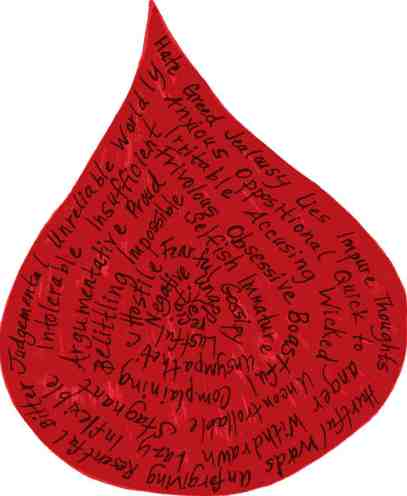
Forgiven-drop

This evening I got tired of the TV. Or maybe tired of the control it emits over me. I picked up one of the many Bibles I have in my loft. I do think it is ‘funny/sinister’ of the real pressure it takes to open its pages. I have no doubt it is the darkness of my flesh and the wickedness of demons. Melodramatic? I think not.

But this is what I read and thought.

“Jesus climbed into a boat and went back across the lake to his own town. Some people brought to him a paralyzed man on a mat. Seeing their faith, Jesus said to the paralyzed man,“Be encouraged, my child! Your sins are forgiven.”

Matthew 9:1-2, NLT

Jesus is mobile. He moves and goes where His Father goes. At this moment He is needed in Capernaum. He is to meet a small crowd– and a paralyzed man on a mat. Jesus travels, but this man can only be carried. So Jesus Christ the Son of God, comes to him.

The Lord’s eyes alertly move over these people. People are the reason He came. This crippled man has been waiting. Jesus looks, and all He sees is “faith.” And He knows that the Father has led Him here.

The Word says that He could see their faith. Funny. What does faith look like? It seems like that is the first thing He saw, and noted. I’m not sure about the man on the mat. Did he have faith? Or had it been ‘burned out of him’ by too many doctors, and too many ‘treatments’? It is good to surround yourself with others who will believe when you can’t.

Jesus finally spoke, and its worth noting His first utterance was to proclaim forgiveness. Not healing. Forgiveness! What did this man’s friends think? I see them feel tenative, and maybe a bit shocked about this. What evil did their friend commit? What had he hidden from them, the way we try to hide things from each other?

The healing is going to come. This man will stand. He will carry his mat and go home. (V. 6). But perhaps the paralysis wasn’t the main reason he was there.

Maybe, his biggest need was to be forgiven?

Man has two basic needs.

  • One, to be forgiven of awful sin. Washed and cleansed. Forgivemess.
  • Two, to become a good person. Kind and humble. Healing.

There will always be those looking on who will condemn and challenge what is taking place. For them, it has nothing at all to do with the hearts of people. That means nothing to them. Rather for these, it has to do with a rigid and lifeless religion– with its 613 laws, and tithing of dill and mint.

What do you really need? Forgiveness? Or something else? Psalm 103:3-4, are verses for the redeemed.

“He forgives all my sins
    and heals all my diseases.
He redeems me from death
    and crowns me with love and tender mercies.”

*

“God pardons like a mother, who kisses the offense into everlasting forgiveness.”  

Henry Ward Beecher

bry-signat (1)

cropped-christiangraffiti1.jpg

$

Simply Golden

by Norman Rockwell, 1961

“And as you wish that others would do to you, do so to them.”

Luke 6:31, ESV — The Golden Rule

 “Here is a simple rule of thumb for behavior: Ask yourself what you want people to do for you; then grab the initiative and do it for them! If you only love the lovable, do you expect a pat on the back? Run-of-the-mill sinners do that.” 

Luke 6:31-32, MSG

Sometimes it seems, I hit the switch, and shut it all down. Essentially, I get wrapped up with one of my favorite sins and soon I turn off my faith, unplugging myself from the wall.  I have a desire to escape from what I see as restrictions that I believe faith brings me.  I want to have fun–I don’t want to pray, or read the Bible.

Actually I can do this subtly.  I just raise the volume of my sinful desires, and try to drown out that still small voice.  I can maintain a holy life for my Christian friends, while I enjoy the pleasures of my favorite sins.  Sins or holiness, I want to go for both– but the reality is I just get one.

There is still a voice that is speaking profoundly. And as you wish that others would do to you, do so to them.”  Our particular concepts of Christianity so rarely include this–“the golden rule.”  In my own mind, I diminish this as a little bit antiquated.  I will rarely feel its pinch or pull.  It is never a topic of serious thought or meditation.  It seems that it has become what I call–“an optional truth.”  It is very much real, but it is not connected to me in my daily walk.

Treating others, the very way you want to be treated—do this!  Love other people outrageously and deeply; because you like it when they do this to you.  There is reciprocal action here, a sort of spiritual circle of kindness.  Our vernacular says, “What goes around, comes around.”  And it certainly has a ring of truth in it.

All too often we have a version of Christianity that has had its teeth pulled. We have tamed it, and brought the sharp teeth of the faith under our personal decision-making process.  The wildness of a true faith is domesticated and ‘house-broken.’  And we start the rush to unplug things.  The golden rule gets detached right away.

As I struggle as a mentally ill Christian, it is mandatory that the truth be lifted up in my life.  I can become quite disturbed and manipulated by life’s dealings.  My issues of paranoia and delusion cripple me, or they could become the step-stool for those wonderous things on the shelf of grace.

Dear ones, use your illness to reach for the best, live this and change your world.

%

1brobry-sig4


cropped-christiangraffiti1 (1)

Dismayed by My Own Fallenness

“As the Scriptures say,

“No one is righteous—
    not even one.
11 No one is truly wise;
    no one is seeking God.
12 All have turned away;
    all have become useless.
No one does good,
    not a single one.”

Romans 3:10-12

Scripture never, ever flatters the human ego.  It acts on us directly, “dividing the spirit from the soul.”  I find no glowing review of our “noble” humanity. The opposite is true.

At our deepest core, the Bible teaches that we are depraved—separated from truth and goodness.  In theology this is called, “original sin.”  (I don’t think there is really anything original about it.) There is also a concept called “contrition.”   It means, “having sorrow or sadness over sin involving making steps to amend your ways.”  Notice the definition instills a sense of action.  Perhaps the idea of penitence need a new emphasis?

Does your discipleship include the reality of you?

There are broad, generalized teachings that are woven into the Word— the iniquity and fallenness of men.  It consistently talks a seemless truth, without fail. ( That’s one of the reasons why I know the Bible is true.)  Yet the Father has made provision for our falseness and weakness, he sweeps nothing under a cosmic rug.  You might say the Scripture completely understands us, as us.  Our illusions and deceptions, blatant or subtle, do not confuse or mislead him.

Our discipleship must be “walked out” in brokenness. That is the only way it will work.

We have absolutely nothing to boast about.  I cannot point to this blog— or having been a missionary, a teacher and a pastor as my “good things.”  Today, I sat and became very aware of my inner wickedness. But because He directly intervenes in my life, I will not die in my sins like I deserve.

I am sad.  You see, I am fallen, a complete failure.  It’s easier to find water in the Sahara Desert than to find goodness in my heart.  As a matter of fact, I’ve taken evil to a new level.  I excel, and then I keep practicing it trying to squeeze out more and more power— pride— pleasure.

Those who mourn their contagiously evil hearts (Matthew 5:3-4) are the ones who God can comfort.  Our sadness over our sin (and the sin of the world)—is evidence of the Spirit’s action over our depravity. Look for it, and rest in the Spirit’s work.

“Original sin is in us, like the beard. We are shaved today and look clean, and have a smooth chin; tomorrow our beard has grown again, nor does it cease growing while we remain on earth. In like manner original sin cannot be extirpated [completely destroyed]  from us; it springs up in us as long as we live. Nevertheless we are bound to resist it to our utmost strength, and to cut it down unceasingly.” 

 ~Martin Luther

bry-signat (1)cropped-christiangraffiti1.jpg