7–8 Jesus continued, “After a servant has finished his work in the field or with the livestock, he doesn’t immediately sit down to relax and eat. No, a true servant prepares the food for his master and makes sure his master is served his meal before he sits down to eat his own.
Does the true servant expect to be thanked for doing what is required of him?10 So learn this lesson: After doing all that is commanded of you, simply say, ‘We are mere servants, undeserving of special praise, for we are just doing what is expected of us and fulfilling our duties.’”
Luke 17, TPT
Selfishness is endemic to men of all stripes. It’s in our bloodstream It taints the most noble of actions and the most wonderful of efforts.
There is an exception for the empowered Christian. The ability to live unselfishly is the believer’s option. We can live above the issues of the worldling. To us is given the joy of obedience. Obeying God’s will is the privilege of redeemed men and women. We have the Holy Spirit’s abilities to meet the situation around us.
We serve because we’ve been served.
But we still are ”mere servants” and we shouldn’t make a big deal of our efforts. Within our most noble efforts is the possibility of falling short of the Lord’s wishes for us.
The only safe place for us is found in a sacred humility. It is the posture of obedience which generates something enduring. You might say that humility is the wiring that keeps us from ‘shorting out.’ Being a humble person will insulate us from the holy power of any disobedience.
I’m afraid that is the only way it’ll work.
“We had long known the Lord without realizing that meekness and lowliness of heart should be the distinguishing feature of the disciple.”
“When the woman saw that the fruit of the tree was good for food and pleasing to the eye, and also desirable for gaining wisdom, she took some and ate it. She also gave some to her husband, who was with her, and he ate it.7 Then the eyes of both of them were opened, and they realized they were naked; so they sewed fig leaves together and made coverings for themselves.”
Genesis 3:6-7
The broken believer survives because he or she is constantly having to move toward “authenticity.” There exists a credibility and a realness about them. You’ll suddenly realize that you’re talking with someone who is real. They’ve stepped out of the wreckage and have survived their personal catastrophes. This doesn’t come easy.
It is a rarity and a gift.
On the other hand, we see those wrapped up in so much self-imposed deception that can’t admit anything is wrong. Like the problem drinker who denies he has a problem, we can’t handle the reality and drink to alter it. The addicted are compelled to live a delusion of their own choices, and soon discover they are hopelessly trapped. And so we hide under our favorite bush.
(Euphoria was my favorite.)
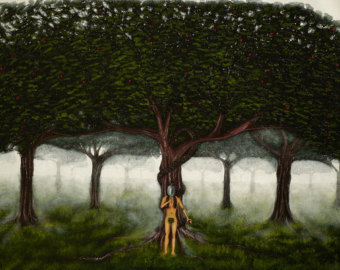
“When the cool evening breezes were blowing, the manand his wife heard the Lord God walking about in the garden. So they hid from the Lord God among the trees.9 Then the Lord God called to the man, “Where are you?”
Genesis 3:8
There is a Latin phrase, esse quam videri; to be rather than seem to be.” We would rather be “seeming to be” than actually just “be.” The sons of Adam and the daughters of Eve are still using “fig leaves.” We don’t want to deal with the truth about ourselves and face the sin of our lives. But it seems to be more than that.
The struggler and the broken believer may try to conceal themselves.
They may hold up an image that deflects the curious onlooker from seeing the real them. We won’t deal with the truth, and we choose to hide ourselves. We want to be seen as “together” even if we are not. It is all about looking good. This is pretense and sham. We dodge and deflect.
“And this is the judgment: the light has come into the world, and people loved the darkness rather than the light because their works were evil.”
John 3:19
This was Jesus’ indictment of the human heart. I wish it was otherwise.
Each day I must put to death my old self. Take my meds, and ask the Lord for strength to stay real. No more pretense, and no more projecting a false self to others (and myself.) I choose reality over fantasy.
The Holy Spirit is eagerly waiting to fill me. In this I discover I can live well with the strength and joy He gives me.
“The God who can change a sinner into a Christian by giving him His life can equally transform the fleshly Christian into a spiritual one by giving him His life more abundantly.”
—Watchman Nee
Lord Jesus, may it be that the real me meets the real You. Keep me real and authentic. Amen.
Today, through the marvel of modern medicine, we can do heart bypasses, heart transplants and install artificial hearts.
But no one can make an unclean heart clean once it becomes dirty. We cannot fix it to live in eternity with a infinitely holy God. It’s through the process of biblical discipleship that you and I are being prepared for living with Him.
Discipleship is the methodology (?!) God has ordained for us to change our hearts. But because discipleship is so challenging and so demanding, we’re tempted to avoid the Gospel’s call. Sometimes it seems like there are many, many believers and just a few disciples.
Nothing but discipleship is an acceptable response to His sacrifice on the cross for me.
Let’s consider the terms and conditions of being his disciple. Please think these through, perhaps they will help, and perhaps you already understand them. They’re somewhat basic:
1) A true disciple will love Jesus Christ above all.
34-37 “Don’t think I’ve come to make life cozy. I’ve come to cut—make a sharp knife-cut between son and father, daughter and mother, bride and mother-in-law—cut through these cozy domestic arrangements and free you for God. Well-meaning family members can be your worst enemies. If you prefer father or mother over me, you don’t deserve me. If you prefer son or daughter over me, you don’t deserve me.”
Matthew 10:34-37, Message
“It never cost a disciple anything to follow Jesus; to talk about cost when you are in love with Him is an insult.”
–Oswald Chambers
2) A true disciple must deny himself.
“Then Jesus told his disciples, “If anyone would come after me, let him deny himself and take up his cross and follow me.”
Matthew 16:24
3) A true disciple, intentionally and deliberately, embraces the cross.
“And whoever does not take his cross and follow me is not worthy of me.”
Matthew 10:38
“The cross of discipleship is that I daily and hourly delight to tell my human nature that I an not my own; I no longer claim right to myself.”
–Oswald Chambers
4) A true disciple is close to Jesus and follows Him.
“If anyone serves me, he must follow me; and where I am, there will my servant be also. If anyone serves me, the Father will honor him.”
John 12:26
5) A true disciple will love other disciples.
“Beloved, let us love one another, for love is from God, and whoever loves has been born of God and knows God.”
1 John 4:7
It is incredible to see the fervor with which the people of that religion help each other in their wants, They spare nothing. Their first legislator [Jesus] has put it in their hearts that they are brethren.”
–Lucian, Greek writer (120-200 A.D.)
6) A true disciple abides (continues) in the teaching of the Lord.
“So Jesus said to the Jews who had believed him, “If you abide in my word, you are truly my disciples.”
John 8:31 (John 15:8-9)
7) A true disciple lives to follow the words and teaching of the Lord Jesus.
“Jesus said to him, “’No one who puts his hand to the plow and looks back is fit for the kingdom of God.’”
Luke 9:62
A simple word about joy. The Holy Spirit turns all the hard things of discipleship into sweetness. Perhaps the difficult part is found in the first few minutes of the decision to follow in a specific matter. But the peaceful presence soon follows and your life will be flooded with light. There is incredible joy in this life of discipleship.
A word about obedience. The Holy Spirit rushes in to touch the weakest act of obedience. He understands our feeble and cowardly hearts and promises to help us to obey Him.
A word about becoming unique. The disciple is a rarity among the world (and even the Church). Following Him in your walk may set you apart as odd and peculiar. If you will follow it will mean you will die to what people think. You should love them anyway. You may be persecuted and spoken evil of. Forgive them, they won’t understand.
“For you are all children of the light and of the day; we don’t belong to darkness and night.”
1 Thess. 5:5
This is my personal testimony of the grace of God.
A year before I received Christ as my Savior, I was hospitalized in a U.S. Army psychiatric ward. My uniform was replaced with the distinctive attire of a mental patient. Ironically, I’d been attached to the same hospital working on the pediatric floor.
And to make things only slightly more surreal was that a medic there on the psych ward was someone I bought drugs from!
Previous to this hospitalization, I had dropped two hits of LSD and found myself in an awful mess. It was night out and I was hallucinating badly. I had lost control of my thoughts. I had pretty much flipped out and it entered my drug-saturated brain that the darkness would kill me, that very night!
Utterly convinced I was going to die, my mind seized upon the street lights outside.
If I could stay in that illuminated circle I would escape dying. Somehow I knew that the light would save me. So I remained under that street light for several hours. As I stood I could see very clearly the boundary between the light and the dark. I knew I was safe as long as I didn’t wander, I knew I would stay safe.
But despite that very traumatic experience, the drugs and my mental instability continued to slide.
I was now shooting up cocaine, crossing my “no needle rule.” I also became quite the heavy drinker, with whiskey for breakfast. I had one basic rule though. As a medic who worked in maternal/child health, I had one of the best assignments in the Army. Many people coveted it, and I was not going to endanger it with drugs or alcohol.
I never went on duty loaded. That was my rule. I would be the best medic the Army ever had.
Shortly after my psych ward discharge, I was reassigned to Labor & Delivery on the night shift. One slow time I was pulled from my duty there to go on an ambulance run as the medic in charge. We were called to the officer’s housing where an older man had died in bed. This got me thinking. Back at the hospital, I returned to L&D. But on the way back I took a shortcut through a ward on another floor. That’s when I found it!
On a waiting room table was a small book called,“More Than a Carpenter” by Josh McDowell. I picked it up, reading it right on duty because there was no one in the delivery room. By the end of my shift, I was well on my way to becoming a Christian. It was a book solidly speaking of the light, and of the dark. And I knew beyond a doubt that I couldn’t remain in the dark anymore.
I was honorably discharged from the U.S. Army in June of 1982.
I became a born-again believer shortly after that. I went to Bible College that October. Life has become radically different, and over time, I became a missionary, pastor, and Bible college instructor.
I married my sweetheart and I now have a wonderful family. I attend a great and wonderful church faithfully.
I want to tell you that Jesus is real, He is alive and the Bible is true. I have been lifted from the dark and I am not afraid anymore. Jesus is my light.
“The people who sat in darkness have seen a great light. And for those who lived in the land where death casts its shadow, a light has shined.”