The Numbers Don’t Lie: Mental Illness in America

giving-up2

~Mental Illness in America, 2016

Mental disorders are common in the United States and internationally. An estimated 26.2 percent of Americans ages 18 and older — about one in four adults — suffer from a diagnosable mental disorder in a given year.1

When applied to the 2004 U.S. Census residential population estimate for ages 18 and older, this figure translates to 57.7 million people.2 Even though mental disorders are widespread in the population, the main burden of illness is concentrated in a much smaller proportion — about 6 percent, or 1 in 17 — who suffer from a serious mental illness.1

In addition, mental disorders are the leading cause of disability in the U.S. and Canada.3 Many people suffer from more than one mental disorder at a given time. Nearly half (45 percent) of those with any mental disorder meet criteria for 2 or more disorders, with severity strongly related to comorbidity.1

In the U.S., mental disorders are diagnosed based on the Diagnostic and Statistical Manual of Mental Disorders, fourth edition (DSM-V).4

Mood Disorders

Mood disorders include major depressive disorder, dysthymic disorder, and bipolar disorder.

  • Approximately 20.9 million American adults, or about 9.5 percent of the U.S. population age 18 and older in a given year, have a mood disorder.1,2
  • The median age of onset for mood disorders is 30 years.5
  • Depressive disorders often co-occur with anxiety disorders and substance abuse.5

Major Depressive Disorder

  • Major Depressive Disorder is the leading cause of disability in the U.S. for ages 15-44.3
  • Major depressive disorder affects approximately 14.8 million American adults, or about 6.7 percent of the U.S. population age 18 and older in a given year.1, 2
  • While major depressive disorder can develop at any age, the median age at onset is 32.5
  • Major depressive disorder is more prevalent in women than in men.6

Dysthymic Disorder

  • Symptoms of dysthymic disorder (chronic, mild depression) must persist for at least two years in adults (one year in children) to meet criteria for the diagnosis. Dysthymic disorder affects approximately 1.5 percent of the U.S. population age 18 and older in a given year.1, This figure translates to about 3.3 million American adults.2
  • The median age of onset of dysthymic disorder is 31.1

Bipolar Disorder

  • Bipolar disorder affects approximately 5.7 million American adults, or about 2.6 percent of the U.S. population age 18 and older in a given year.1, 2
  • The median age of onset for bipolar disorders is 25 years.5

Suicide

  • In 2006, 33,300 (approximately 11 per 100,000) people died by suicide in the U.S.7
  • More than 90 percent of people who kill themselves have a diagnosable mental disorder, most commonly a depressive disorder or a substance abuse disorder.8
  • The highest suicide rates in the U.S. are found in white men over age 85.9
  • Four times as many men as women die by suicide9; however, women attempt suicide two to three times as often as men.10

Schizophrenia

  • Approximately 2.4 million American adults, or about 1.1 percent of the population age 18 and older in a given year,11, 2 have schizophrenia.
  • Schizophrenia affects men and women with equal frequency.12
  • Schizophrenia often first appears in men in their late teens or early twenties. In contrast, women are generally affected in their twenties or early thirties.12

Anxiety Disorders

Anxiety disorders include panic disorder, obsessive-compulsive disorder, post-traumatic stress disorder, generalized anxiety disorder, and phobias (social phobia, agoraphobia, and specific phobia).

  • Approximately 40 million American adults ages 18 and older, or about 18.1 percent of people in this age group in a given year, have an anxiety disorder.1,2
  • Anxiety disorders frequently co-occur with depressive disorders or substance abuse.1
  • Most people with one anxiety disorder also have another anxiety disorder. Nearly three-quarters of those with an anxiety disorder will have their first episode by age 21.5 5

Panic Disorder

  • Approximately 6 million American adults ages 18 and older, or about 2.7 percent of people in this age group in a given year, have panic disorder.1, 2
  • Panic disorder typically develops in early adulthood (median age of onset is 24), but the age of onset extends throughout adulthood.5
  • About one in three people with panic disorder develops agoraphobia, a condition in which the individual becomes afraid of being in any place or situation where escape might be difficult or help unavailable in the event of a panic attack.12

Obsessive-Compulsive Disorder (OCD)

  • Approximately 2.2 million American adults age 18 and older, or about 1.0 percent of people in this age group in a given year, have OCD.1, 2
  • The first symptoms of OCD often begin during childhood or adolescence, however, the median age of onset is 19.5

Post-Traumatic Stress Disorder (PTSD)

  • Approximately 7.7 million American adults age 18 and older, or about 3.5 percent of people in this age group in a given year, have PTSD.1, 2
  • PTSD can develop at any age, including childhood, but research shows that the median age of onset is 23 years.5
  • About 19 percent of Vietnam veterans experienced PTSD at some point after the war.13 The disorder also frequently occurs after violent personal assaults such as rape, mugging, or domestic violence; terrorism; natural or human-caused disasters; and accidents.

Generalized Anxiety Disorder (GAD)

  • Approximately 6.8 million American adults, or about 3.1 percent of people age 18 and over, have GAD in a given year.1, 2
  • GAD can begin across the life cycle, though the median age of onset is 31 years old.5
To finish reading this article, you will need to go to its source at:

http://www.nimh.nih.gov/health/publications/the-numbers-count-mental-disorders-in-america/index.shtml  


cropped-christiangraffiti1 (1)

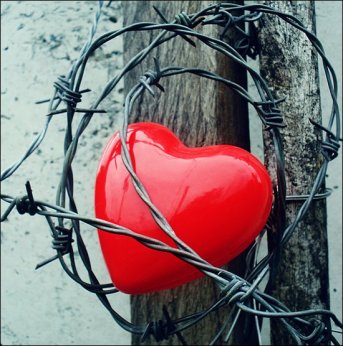
Heart Disease

Hearts 168457_154905807894473_110794108972310_320156_2061498_n“The human heart is the most deceitful of all things,
and desperately wicked. Who really knows how bad it is?”

Jeremiah 17:9, NLT

We are the wounded. What exactly has caused it isn’t always known.  A death, divorce, depression and disability are great triggers.  Some of us are chronically ill, others are mentally ill.  We struggle to hold a job, and to go to church. There are some who are reading this who are controlled by addictions.  And a few of us consider suicide on pretty much a regular basis.

We’ve been hospitalized and stigmatized, and sometimes even institutionalized. And at times we endure massive attacks of fear and anxiety.  We are not easily understood, and we hear the whispers.  Our paranoia can often saturate what what we are thinking, (I think its more like a “marinade.”  Our brains just soak it up.)  Most of us are ‘walking wounded.’ We limp physically, and figuratively with equal pain.

“For thus says the LORD: Your hurt is incurable,
    and your wound is grievous.”

Jeremiah 30:12, ESV

If we are honest (and God insists on a rigorous honesty) we realize that we are a mess!  The prophet Jeremiah had a tremendous understanding of the human condition, and was never beguiled by the lie of pride, arrogance and selfishness.  He declares that we are diseased down to the core, like a rotten apple.

At times we continue in our favorite style of darkness.  And havoc sporadically rips through us and we become “disaster areas.”  How very sad, and profoundly tragic.

But you must understand this powerful fact.  Jesus Christ has been sent by the Father to save and cleanse all who come to Him.

“At that time a fountain will be open for David’s descendants and for the people of Jerusalem to cleanse them of their sin and uncleanness.”

Zechariah 13:1, NCV

“Children, it’s time for a bath,” and what God has done provides us the only way to “get better.” Some of us have carried staggering burdens for decades.  But I must be truthful. Our afflictions may continue to disturb us.  If you are bipolar or depressed, it just could be you’ll remain so.  But I know first-hand that our Father will give us an extra ration of grace.

In the Old Testament, family patriarchs could give an additional portion to a son he especially loved.  All were blessed, but some more so. That peculiar proclivity of our Father is why some of us with deep wounds can follow closer than others who are healthy.

“For I am the LORD, your healer.” Ex. 15:26

flourish2

“The treatment a wound gets decides whether time will bring healing or bondage.”

&

ybic, Bryan

kyrie elesion. (Lord, have mercy on each reader)

cropped-christiangraffiti1-2

The Church Triumphant

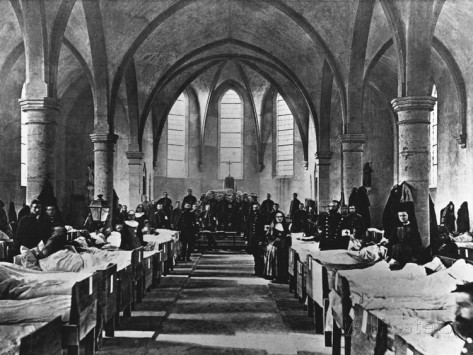
the-church-military-hospital
A church as a hospital during WW1
“The church is not a select circle of the immaculate, but a home where the outcast may come in. It is not a palace with gate attendants and challenging sentinels along the entrance-ways holding off at arm’s-length the stranger, but rather a hospital where the broken-hearted may be healed, and where all the weary and troubled may find rest and take counsel together.” 

James H. Aughey

I have heard of a hospital in England that gives a loaf of bread to everyone who asks. This tradition has been going on for over 800 years. The hungry are fed at St. Cross Hospital by just knocking at a door. This hospital takes ministry very seriously.

Jesus Christ so loves sinners that He gives to all who come to Him. Hungry sinners have to do is knock. But there is more than this. He provides a bath to all who are filthy. A wardrobe to cover up any nakedness. A bed to everyone who is weary and sad, for the Gospel meets every spiritual need.

I like to think that there is room for the mentally ill at Jesus’ hospital. A safe place for those who are exhausted by their battles, a room where Jesus can bless those who are afflicted. I believe there is such a place. For my own soul has been comforted by Him.

The Church carries on the ministry— it’s a St. Cross Hospital— for the immense needs of human beings. The sons of Adam and the daughters of Eve can find salvation and comfort from a world that intends only to destroy. Furthermore we now represent Jesus to a desperate world. We become Christ-like for this reason. The Church triumphs during times like this.

The poor and needy– the sick, the lame, the mentally ill, the prisoner, the addict are the Church’s glory. This little group of rag-tag disciples are responsible for the care of the lost. We just need to figure out how we can reach them. The Holy Spirit will help us.

The World is watching us. We welcome this, for we are the salt and light lifted up so all can see. We were born to serve.

 “You are the salt of the earth. But if the salt loses its saltiness, how can it be made salty again? It is no longer good for anything, except to be thrown out and trampled underfoot.

14 You are the light of the world. A town built on a hill cannot be hidden.”

Matthew 5:13-14

We dare not remove and nullify our mission. When we do so we become nothing more than another institution that is trying hard to secure a place in this world, Our distinctiveness is “blood bought” and our mandate is to be  “the Salt and Light” in this dark place. It is our sure calling. It is the Father’s will. We will be the Church triumphant.

bry-signat-1

cropped-christiangraffiti1 (2)

Check out: https://en.wikipedia.org/wiki/Hospital_of_St_Cross

April Fool’s Day: An Accident Report

This is a bricklayer’s accident report that was printed in the newsletter of the English equivalent of the Workers’ Compensation Board.

Dear Sirs,

I am writing in response to your request for additional information in Block #3 of the accident reporting form. I put “Poor Planning” as the cause of my accident. You asked for a fuller explanation and I trust the following details will be sufficient.

I am a bricklayer by trade. On the day of the accident, I was working alone on the roof of a new six-story building. When I completed my work, I found I had some bricks left over which when weighed later were found to weigh 240 lbs. Rather than carry the bricks down by hand, I decided to lower them in a barrel by using a pulley which was attached to the side of the building at the sixth floor.

Securing the rope at ground level, I went up to the roof, swung the barrel out and loaded the bricks into it. Then I went down and untied the rope, holding it tightly to insure a slow descent of the 240 lbs of bricks. You will note on the accident reporting form that my weight is 165 lbs. Due to my surprise at being jerked off the ground so suddenly, I lost my presence of mind and forgot to let go of the rope. Needless to say, I proceeded at a rapid rate up the side of the building.

In the vicinity of the third floor, I met the barrel which was now proceeding downward at an equally impressive speed. This explains the fractured skull, minor abrasions and the broken collarbone, as listed in Section 3, accident reporting form. Slowed only slightly, I continued my rapid ascent, not stopping until the fingers of my right hand were two knuckles deep into the pulley which I mentioned in Paragraph 2 of this correspondence. Fortunately by this time I had regained my presence of mind and was able to hold tightly to the rope, in spite of the excruciating pain I was now beginning to experience.

At approximately the same time, however, the barrel of bricks hit the ground and the bottom fell out of the barrel. Now devoid of the weight of the bricks, the barrel weighed approximately 50 lbs. I refer you again to my weight. As you might imagine, I began a rapid descent down the side of the building. In the vicinity of the third floor, I met the barrel coming up. This accounts for the two fractured ankles, broken tooth and severe lacerations of my legs and lower body.

Here my luck began to change slightly. The encounter with the barrel seemed to slow me enough to lessen my injuries when I fell into the pile of bricks and fortunately only three vertebrae were cracked.

I am sorry to report, however, as I lay there on the pile of bricks, in pain, unable to move and watching the empty barrel six stories above me, I again lost my composure and presence of mind and let go of the rope. And I lay there watching the empty barrel begin its journey back onto me.

1brobry-sig4

cropped-christiangraffiti1 (1)