How Things Grow, [Work]

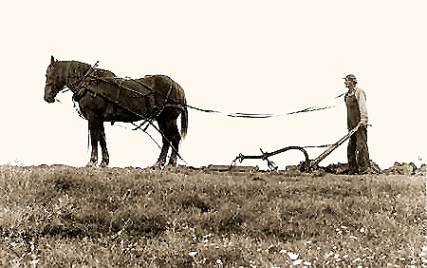
plow1930s

A farmer slowly walks behind his plow. The ground is hard and unyielding, but the steel cuts the heavy sod like a knife. He is preparing the soil for receiving the seed. He knows that what he is doing is imperative and he shouts out to encourage the horse. Its getting late and he wants to cut another furrow before night.

Plodding behind the plow he thinks many things. He can break up the ground, till and fertilize it, sow the seed— and then wait. He is powerless it get the seed to germinate and grow. He is limited to cultivating the soil and waiting. That is all he can really do, and he accepts this powerlessness. He can do everything right, and still not have a crop. All he can do is his part.

The farmer works in partnership with God. He is dependent on Him to grow the seed. The farmer must rely on the weather to meet and engage the planted seed. There are no shortcuts here. He does all he can, and then hopes that it is enough.

Farming is a joint endeavor between man and God. The man does what he has to do. God takes what the man has done and then finishes it. The crop will grow because He wills it. The farmer plays a part for sure, but ultimately God must become involved. Afterall, He makes the seed to sprout and grow.

We can say decisively that the pursuit of holiness in a Christian’s life is a joint endeavor between a believer and God.

Each have made the effort. The Christian does what is necessary, and then the seed is finally sown. It is then up to God to make the seed become the seedling. But each must work to finish the growth.

No one can attain holiness in their life apart from the work of preparation (it’s indeed work). The man must prepare the ground through plowing and cultivating. The farmer works the ground in order to make the ground ready. On the other hand, God provides both the environment and the growth needed to grow the seedling. Both the farmer and God must do their work.

A life of holiness is not automatic. It will never come at measured pace, trickling into our souls at a mechanized rate. (It would be nice if it would). Rather it wheat-field-landscape-picture_1920x1200_79595seems to come, in fits and spurts, sputtering rather than simply flowing.

Holiness is like a steamy Amazon jungle, vibrant and full of life. It is saturated with things living and green. It is not like an arid and sterile desert. Holiness is pulsating and powerful, full of lush growing things.

Becoming a person of holiness is the grandest adventure for the human soul. It defies our tendency to be rigid and legalistic. It is quite the opposite. It is tapping into life itself, and who is up to the task? Our morbid ideas of what holiness are not worthy of what really is.

Yes, to be holy is to work. Just as the farmer must prepare the soil for the seed, we too must guide our plows. God is ready to sow, and we should be ready to be ready. That is if we want to be fruitful and productive.

“Oh, the fullness, pleasure, sheer excitement of knowing God on earth!”

 Jim Elliot

bry-signat (1)

cropped-christiangraffiti1.jpg

The Curious Case of Being Job

XIR84999 Job (oil on canvas) by Bonnat, Leon Joseph Florentin (1833-1922) oil on canvas Musee Bonnat, Bayonne, France Lauros / Giraudon French, out of copyright
Image by Bonnat, Leon Joseph Florentin (1833-1922) Musee Bonnat, Bayonne, France French, out of copyright

One of the most intriguing characters in the Bible is Job. Tempted and accused, ignored and maligned– he maintained a faith in God’s goodness when hell wanted to destroy him.

His goodness should not be questioned oe diminished.

“In the land of Uz there lived a man whose name was Job. This man was blameless and upright; he feared God and shunned evil.”

Job 1:1

Job becomes an oblivious participant in a cosmic exchange. God and Satan lock horns over Job’s faithfulness. God is sure of his love, while the Adversary thinks Job will fold when repeatedly tempted. But keep in mind, Job hasn’t a clue of who or why. He has to deal with life that is an enigma wrapped in a mystery. Job will soon become intimate with pain and suffering.

“Then the Lord said to Satan, “Have you considered my servant Job? There is no one on earth like him; he is blameless and upright, a man who God, and shuns evil.”

Job 1:8

Satan is like a pit bull. And God has pointed out the character of Job, and what an enticing “meal” he would make. It’s a bit like slathering bacon grease on him and turning him over to the nearest pack of wolves. Satan now pursues his prey.

Again, Job is completely unaware of this contest. No one has bothered to consult him directly about this. Job knows nothing about this ”wager.” And it’s hard to be kept in the dark. I contend that had Job  known what was going on, this all would’ve been far easier. However, everything would be “unscripted” and  Job would suffer in complete ignorance. And that is doubly hard.

“At this, Job got up and tore his robe and shaved his head. Then he fell to the ground in worship and said: “Naked I came from my mother’s womb, and naked I will depart. The Lord gave, and the Lord has taken away; may the name of the Lord be praised.” In all this, Job did not sin by charging God with wrongdoing.”

Job 1:20-22

But there was no sin! Job will not travel down that road. Yet he loses everything– all of it. And things are going to get even worse for him. He will be visited by three “friends.” However, they won’t help him. They will only make things worse.

The life of Job, and the “total war” on his soul must be our consideration and our precedent to order our lives.

The pain of Job should become the blackboard where we practice our figures. In the New Testament book of James, (5:11) we are told to think about Job. And in our deliberations, to consider the compassion and mercy of God. Ironic, in some wild cosmic way, our trials of faith are significant.

We should realize that if you or I are going to come out clean in this, we will need to emulate the faith of Job. I think that this what James meant in 5:10-11. We understand that Jesus absorbed all our sin and pain, completely. When we see that, we can come through just about any nastiness. It won’t make the trials any easier, but it will frame the full goodness of God.

bry-signat (1)

cropped-christiangraffiti1.jpg

God Will Sustain You

elijah-2

“Some Christians are called to endure a disproportionate amount of suffering. Such Christians are a spectacle of grace to the church, like flaming bushes unconsumed, and cause us to ask, like Moses: ‘Why is this bush not burned up?’

The strength and stability of these believers can be explained only by the miracle of God’s sustaining grace. The God who sustains Christians in unceasing pain is the same God — with the same grace — who sustains me in my smaller sufferings. We marvel at God’s persevering grace and grow in our confidence in Him as He governs our lives.”

— John Newton, 1725-1807, Author of “Amazing Grace”

“The angel of the Lord appeared to him in a blazing fire from the midst of a bush; and he looked, and behold, the bush was burning with fire, yet the bush was not consumed.”

Exodus 3:2, NASB

u

u

cropped-christiangraffiti1-3-1

Is Mania A Spiritual Experience? [Bipolar]

by Chris Cole

I was eighteen years old when I first experienced acute manic psychosis. I had just arrived at the University of Georgia for my freshman fall semester when I suddenly had what seemed like a profound spiritual awakening. I felt as if I was waking up from a bad dream, as if my mind and body were merely figments of my imagination. I felt an incredible transcendence and oneness with the universe, an experience I could only fathom to be spiritual. Back then, I didn’t know anything about bipolar disorder.

My first thought upon being struck with this overwhelmingly blissful state was, “This is what God feels like; I must be Jesus!” It was from there that I began my deluded descent into madness. I ran upstairs in my dormitory, assuming that my friends would be my first disciples, and tried to perform miracles to prove my divinity. When they attempted to calm me down, I punched one of them in the face, calling him the devil, and ran back downstairs. Campus police promptly met me in the dorm lobby and arrested me on the spot.

On my way to jail, I was no longer feeling so ecstatic. In fact, it was the most excruciating fear I had ever experienced. I began believing that the police officers were the Pharisees taking me to my crucifixion. They placed me in my own jail cell, and I began stripping off my clothes, demanding for the officers to come look at my naked body. Throughout the whole experience, I felt almost completely dissociated, as if I was watching a movie of myself with little to no control of the actor.

After a few days of trying to convince my parents that I was returning humanity to the Garden of Eden, they realized my condition might not be from taking psychedelic drugs as they had thought. I was escorted to my local psychiatric hospital, and once medicated, came down from my messianic mission to create heaven on earth. The only problem was, I had never been more certain of God in my life, and the clinicians just kept telling me that it was normal for grandiose delusions to take on religious and spiritual themes. I was not convinced.

My thoughts immediately went to the biblical stories I grew up with: how God tested Abraham’s faith when he was told to sacrifice his son, and how God communicated to Moses through a burning bush. Were these not examples of delusions and hallucinations? Even Jesus was convinced to be the Son of God. Were the holy men of the Bible bipolar? I had a lot of questions, and my questions seemed to be forcing me to choose one side or the other—either spirituality or psychiatry.

It took me about a decade to finally integrate both truths and find some peace around my manic episodes. I studied spirituality and psychology, and I came to the conclusion that bipolar disorder and spiritual experiences didn’t need to exist in opposition. I’ve come to some basic definition of spirituality as the transcendence of ego. In this sense, mania was indeed a spiritual experience, albeit an unmanageable one. This didn’t mean my bipolar diagnosis was bogus, and I’m not saying all psychotic episodes are spiritual. But I can now rest easy knowing that my experiences were both spiritual and bipolar.

If I’m honest with myself, a major sign of my mania is increased spirituality, but at the same time, a major sign of my depression is a lack of spiritual significance. Finding balance in recovery means that I am able to seek both spiritual and clinical solutions to my bipolar symptoms without fear that I am falling out of grace with God. When I was first diagnosed, I had the idea that either bipolar existed or God existed. There was no space for both.

My spirituality has necessarily evolved over the years. Because of my history with manic psychosis, I have to guard myself against dogmatic or superstitious beliefs. I try my best to live a life of love, and I rest assured knowing that the more kindness I spread to the world, the more aligned I am with my spiritual path. Telling my story of recovery has become part of this spiritual process. My faith means a great deal to my health, and without it, my recovery wouldn’t be as strong as it is today. I hope that by sharing my story, others going through the same difficulties might not take so long to make sense of their own experiences.

____________________________

Chris Cole has authored a book recounting his experiences, and he’s now a life coach for folks in recovery.

Source: http://www.ibpf.org/blog/mania-spiritual-experience

cropped-cropped-christiangraffiti1.jpg