The Desperation Factor

  1. : Loss of hope and surrender to despair. 2. : a state of hopelessness leading to rashness.
  2. Synonyms–desperation · concern · dejection · depression · despondency · disconsolateness · distraction · distress · pang · torture · trouble · worry. noun as in rashness.

A terrific study is finding the people who fell at Jesus’ feet. Tucked in the Gospels you’ll find stories of those who despair. You’ll also see them come to Jesus in brokenness and humility, without any other recourse. I call these the feet-finders.

They came to Jesus because they had no hope otherwise. They were people who were hopeless and wretched, they had long ago run out of options. They came to Jesus, falling down in front of Him. They were all feet-finders.

They were men and women who were truly desperate.

John 11:32

One of the classic scenes in the Gospels is when Mary meets Jesus after her brother’s death. She doesn’t understand Jesus’ delay, Lazarus has been very ill and Jesus could have healed him. She is grieving and confused. But she only has one posture and one place in her heart to be– at the feet!

There are some common characteristics that feet-finders have:

  • A great need that can’t be met without His touch
  • To understand one’s true condition–humility, brokenness
  • To beg for a healing, for self or family
  • To honor Jesus as the Messiah
  • To be more receptive to His teaching, to understand Him
  • To become a witness to others (although it does seem secondary)

The following 3 verses are just a small selection of those who fell at Jesus feet.

Matthew 15:30

Mark 7:25

Luke 8:35

But there are several other instances where people came to sit at Jesus’ feet:

  • Mark 5:22-23, Jairus, a leader in the local synagogue
  • Luke 7:37-38, a sorrowing mother for her daughter
  • Luke 8:41, also Jairus
  • Luke 10:39, Mary, when Jesus was teaching
  • John 11:32, Mary, meeting Jesus entering Bethany
  • John 12:3, Mary, with her perfume
  • Revelation 1:17, John to express what he was seeing (also 19:10)

In every case we find people consciously coming and kneeling at the feet of the Lord Jesus. It was a deliberate action that came from their hearts. Each had a terrible need, and each was without hope.

Formality and religious politeness are jettisoned. Brokenness and true humility takes their place. A foot-finder is no longer operating on spiritual niceties. Religion is comfortable, noble, and respectable, but it cannot heal or change people deeply.

Feet-finders know that they need Jesus desperately and will go to any length just to be touched by Him. They defy what is conventional and proper. They are not what we call respectable. You can find them at the feet of Jesus. They are feet-finders. Foot-finders weep, kneel, beg, shout. Too many tears and maybe some snot.

Hardly decent to religious people.

Are you really that desperate yet? Have you seen your need, and do you realize how lost you would be without His healing touch?

Often when I do pray, I sometimes think of the woman who was unclean. She speaks to me about approaching Jesus. I see myself in a crushing crowd of people, and I’m reaching out just to touch the hem of His robe. I know only Jesus can stop my own uncleanness. (Matthew 9.)

I’m convinced only Jesus can make me clean and whole.

I’ve tried to be holy and acceptable to Him. But I felt like a juggler, trying to keep my balls in the air all at the same time, and I could never pull it off. So I tried again and again. I was the unofficial master of religious effort.

But I found my rightful place at His feet. It’s where I belong. I love Him.

I’m not ashamed to be found kneeling.

bry-signat (1)

*

Twisted and Bent

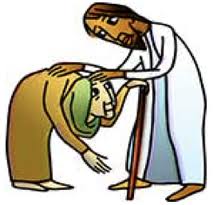
Luke 13:10-13

When we read through the Gospels we see that Jesus never laid His hands on those who were demon possessed, rather He would first command the demon to leave. (Interesting.)

The text tells us that the woman had been bent over for 18 years. (That’s a long, long time.) The cause was being “demonized” which is very different than being possessed.

There is a difference. Demons can oppress people and influence their lives, especially if that person is living in sin and rebellion.

“The physical cause of her inability to straighten up has been examined by J. Wilkinson, who identified the paralysis as the result of spondylitis ankylopoetica, which produces the fusion of the spinal bones.”

That is absurd. There’s a truth here that this “leader” is covering up. The woman is instantly healed, and this so-called leadertries to nullify what has just happened. Rather than rejoicing, he renounces what has just happened, and claims that the Sabbath law has been violated. He declares the Law is greater than this woman’s healing.

Jesus never once asserts His authority. Rather He points to this woman’s healing as being truly the very essence of the Law. In spite of what the Law means legalistically, it can never invalidate mercy.

CH Spurgeon

Her private agony was never to be found again. She was free. The pain she lived with was no more. The captivity was gone, and she was freed. The biblical text seems to ignore this and concentrates on the synagogues leader’s response, and that’s well and good. Perhaps though we should focus on this woman’s healing from an awful terrible darkness.

She is free. The stoop is gone. The pain is gone. Jesus has set her free, she gazes at the sun after many years. She stands erect, and though everything now seems different, she now knows her deliverer, and her healer.

“Bent,” brokenbelievers.com, Bryan Lowe

In Need of Grace–Quotes

To Manning, every person is redeemable, none are too far gone.  Brennan Manning was a strong voice to the weak, the lame, the mentally challenged, and for the prodigal.

*******

“There is a beautiful transparency to honest disciples who never wear a false face and do not pretend to be anything but who they are.”

My deepest awareness of myself is that I am deeply loved by Jesus Christ and I have done nothing to earn it or deserve it.”

 “To live by grace means to acknowledge my whole life story, the light side and the dark. In admitting my shadow side I learn who I am and what God’s grace means.”

“To be alive is to be broken; to be broken is to stand in need of grace.”

“Christianity doesn’t deny the reality of suffering and evil… Our hope… is not based on the idea that we are going to be free of pain and suffering. Rather, it is based on the conviction that we will triumph over suffering.”

“I am what I am in the sight of Jesus and nothing more. It is His approval that counts.”

“[Be] daring enough to be different, humble enough to make mistakes, wild enough to be burnt in the fire of love, real enough to make others see how phony [you] are.”

“The blood of the Lamb points to the truth of grace: what we cannot do for ourselves, God has done for us. On the cross, somehow, someway, Christ bore our sins, took our place, died for us. At the cross, Jesus unmasks the sinner not only as a beggar but as a criminal before God.”

“Do the truth quietly without display.”

“It is for the inconsistent, the unsteady disciples whose cheese is falling off their cracker.”

“The dominant characteristic of an authentic spiritual life is the gratitude that flows from trust—not only for all the gifts that I receive from God, but gratitude for all the suffering. Because in that purifying experience, suffering has often been the shortest path to intimacy with God.”

“The greatest single cause of atheism in the world today is Christians, who acknowledge Jesus with their lips and walk out the door and deny him with their life style. That is what an unbelieving world simply finds unbelievable.”

“The saved sinner is prostrate in adoration, lost in wonder and praise. He knows repentance is not what we do in order to earn forgiveness; it is what we do because we have been forgiven. It serves as an expression of gratitude rather than an effort to earn forgiveness.”

“In essence, there is only one thing God asks of us–that we be men and women of prayer, people who live close to God, people for whom God is everything and for whom God is enough. That is the root of peace.”

***********

I really hope some of these quotes have connected.  Brennan Manning has authored several books all of which I can heartily recommend. 


Despair and David’s Theology

For those on the mat and wrestling, things can move very fast.  Our own adversary is strong, and he knows us too well.  He is quite aware of the sequence of moves needed to pin us to the floor, and crush us.  He is spiritually dangerous. He is lethal.

I get bewildered and rattled by his attacks.  He knows how to pressure me at just the right time, and he refuses to follow the rules. He is no gentleman, he is both a cheater and a liar.

Of course I am talking about Satan and his team of demons.  I will not dispute their reality with you.  There is almost as much scriptural support for his existence as there is for Jesus’.  His hostility is  toward God and His people, and his viciousness cannot be camouflaged.  Evil is real, and believe this–

Satan has a terrible, and ugly plan for your life.

As a Christian, who has bouts of depression it quickly morphs into despondency and despair.  When I sink to that level I start to lose all hope.  It’s like I’m in a lifeboat and decide that I should abandon it and tread water on my own.  Despondency is not rational and just a little bit is deadly.

David intimately knew all about darkness and desperation.

He had been chased by his enemies, and maneuvered into the most difficult of situations.  To observe him at a distance we would say that “there is no hope for him in God.” Even God can’t save him, for he is reprobate.  We would be convinced that there is nothing for him in God’s thinking.

David fully understands how twisted he really is inside, and it’s at that point he composes Psalm 51. It shows us the way to freedom.

David was a moral failure; he was an adulterer and a brazen killer. You can debate this, but it seems that David had sinned deeper and more intensely than Saul ever had.  Join with the logic of the crowd, “There is no hope for him in God!”  No hope, none, nada, zero.

“Yet I am always with you;
you hold me by my right hand.

You guide me with your counsel,
and afterward you will take me into glory.

Whom have I in heaven but you?
And earth has nothing I desire besides you.

My flesh and my heart may fail,
but God is the strength of my heart
and my portion forever.”

–Psalm 73

David defied the theology of his day.  He embraced the Lord God with a desperate passion.  It was not orthodox or logical.  You could say it was disturbing for many who didn’t understand the infinite mercy of God.  But David would not let go of God!  He hung on, and continued to sing in faith, even though most wouldn’t agree he had the right to.

I encourage you besieged brother, and embattled sister.  Hold on to Him, even if it baffles all logic or theology. Renounce your sin, but seek His promises with a fervency, open your heart to Him with a passion.  Remember that sin can and will destroy you.  It is part of Satan’s stratagem.

Sing in your cave, and never lose hope of God’s love for you.

“The most valuable thing the Psalms do for me is to express the same delight in God which made David dance.”

C.S. Lewis

“Despondency and David’s Theology,” brokenbelievers.com, Bryan Lowe


bry-signat (1)

Related articles