A Broken System

mental-health

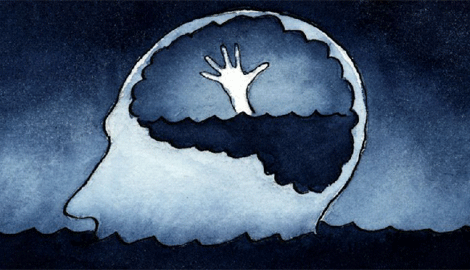
Sixty million Americans – that’s one in five adults – will experience a mental illness in the coming year. That means every one of us knows someone who is living with a mental illness – depression, anxiety, schizophrenia, an eating disorder, bipolar disorder, borderline personality disorder and some additionally have a substance abuse.”

The stats are staggering. They are also easily forgotten. (It seems that we approach life not as it is, but as we want it to be.) But consider this:

• Half of all adults will suffer from mental illness in their lifetime.
• Half of all chronic mental illness begins by the age of 14.
• One in five children will have a mental illness by age 18.
• Ninety percent of people who die by suicide also had mental illness.

Brokenbelievers is not just a “niche” site– we’re dealing with hardcore issues that are significant for far too many. Mental illness is a pervasive and terrible issue in our society. Christians must witness to what Jesus can do in the midst of this. We are his witnesses.

Accentuating this, our mental health care system is broken. Jails and prisons have become “dumping grounds” for afflicted people. I guess that this is considered “routine” for us. Imagine the outcry if, instead of doing this to the mentally ill, we did incarcerated those with diabetes? Yet we do so because that’s the way the system works.

There are many beautifully competent people who toil in the mental health field. Some of the kindest and caring can be found working in these places. They deserved to be commended, not vilified.

The landscape is strewn with casualties. Mental illness will affect half of adults in their lifetimes, and the collateral damage can’t even begin to be quantified. Our therapists, nurses and doctors have a grisly job security. Money can never fix our system of dealing with those with a mental illness.

Many of us will disagree about what to do.

Perhaps we should advocate a multi-prong approach. Brokenbelievers exists for Christian believers that are having to work out their faith in the presence of a tenacious illness. It’s good to have someone that understands depression or other issues in the life of a disciple of Jesus Christ.

We must think differently– and do differently. With God’s help we can.
bry-signat (1)

cropped-christiangraffiti1.jpg

Sources:

https://www.nami.org/Learn-More/Mental-Health-By-the-Numbers

http://www.huffingtonpost.com/kay-warren/hope-for-mental-illness_b_8045810.html

OCD: Rituals and Obsession

“I couldn’t do anything without rituals. They invaded every aspect of my life. Counting really bogged me down. I would wash my hair three times as opposed to once because three was a good luck number and one wasn’t. It took me longer to read because I’d count the lines in a paragraph. When I set my alarm at night, I had to set it to a number that wouldn’t add up to a ’bad’ number.”

“I knew the rituals didn’t make sense, and I was deeply ashamed of them, but I couldn’t seem to overcome them until I had therapy.”

“Getting dressed in the morning was tough, because I had a routine, and if I didn’t follow the routine, I’d get anxious and would have to get dressed again. I always worried that if I didn’t do something, my parents were going to die. I’d have these terrible thoughts of harming my parents. That was completely irrational, but the thoughts triggered more anxiety and more senseless behavior. Because of the time I spent on rituals, I was unable to do a lot of things that were important to me.”

People with obsessive-compulsive disorder (OCD) have persistent, upsetting thoughts (obsessions) and use rituals (compulsions) to control the anxiety these thoughts produce. Most of the time, the rituals end up controlling them.

For example, if people are obsessed with germs or dirt, they may develop a compulsion to wash their hands over and over again. If they develop an obsession with intruders, they may lock and relock their doors many times before going to bed. Being afraid of social embarrassment may prompt people with OCD to comb their hair compulsively in front of a mirror-sometimes they get “caught” in the mirror and can’t move away from it. Performing such rituals is not pleasurable. At best, it produces temporary relief from the anxiety created by obsessive thoughts.

Other common rituals are a need to repeatedly check things, touch things (especially in a particular sequence), or count things. Some common obsessions include having frequent thoughts of violence and harming loved ones, persistently thinking about performing sexual acts the person dislikes, or having thoughts that are prohibited by religious beliefs. People with OCD may also be preoccupied with order and symmetry, have difficulty throwing things out (so they accumulate), or hoard unneeded items.

Healthy people also have rituals, such as checking to see if the stove is off several times before leaving the house. The difference is that people with OCD perform their rituals even though doing so interferes with daily life and they find the repetition distressing. Although most adults with OCD recognize that what they are doing is senseless, some adults and most children may not realize that their behavior is out of the ordinary.

OCD affects about 2.2 million American adults, and the problem can be accompanied by eating disorders, other anxiety disorders, or depression.  It strikes men and women in roughly equal numbers and usually appears in childhood, adolescence, or early adulthood. One-third of adults with OCD develop symptoms as children, and research indicates that OCD might run in families.

The course of the disease is quite varied. Symptoms may come and go, ease over time, or get worse. If OCD becomes severe, it can keep a person from working or carrying out normal responsibilities at home. People with OCD may try to help themselves by avoiding situations that trigger their obsessions, or they may use alcohol or drugs to calm themselves.

OCD usually responds well to treatment with certain medications and/or exposure-based psychotherapy, in which people face situations that cause fear or anxiety and become less sensitive (desensitized) to them.

Source: http://www.nimh.nih.gov/index.shtml

cropped-christiangraffiti1 (1)

Different Ways to Fall Out of a Tree

boy-falling
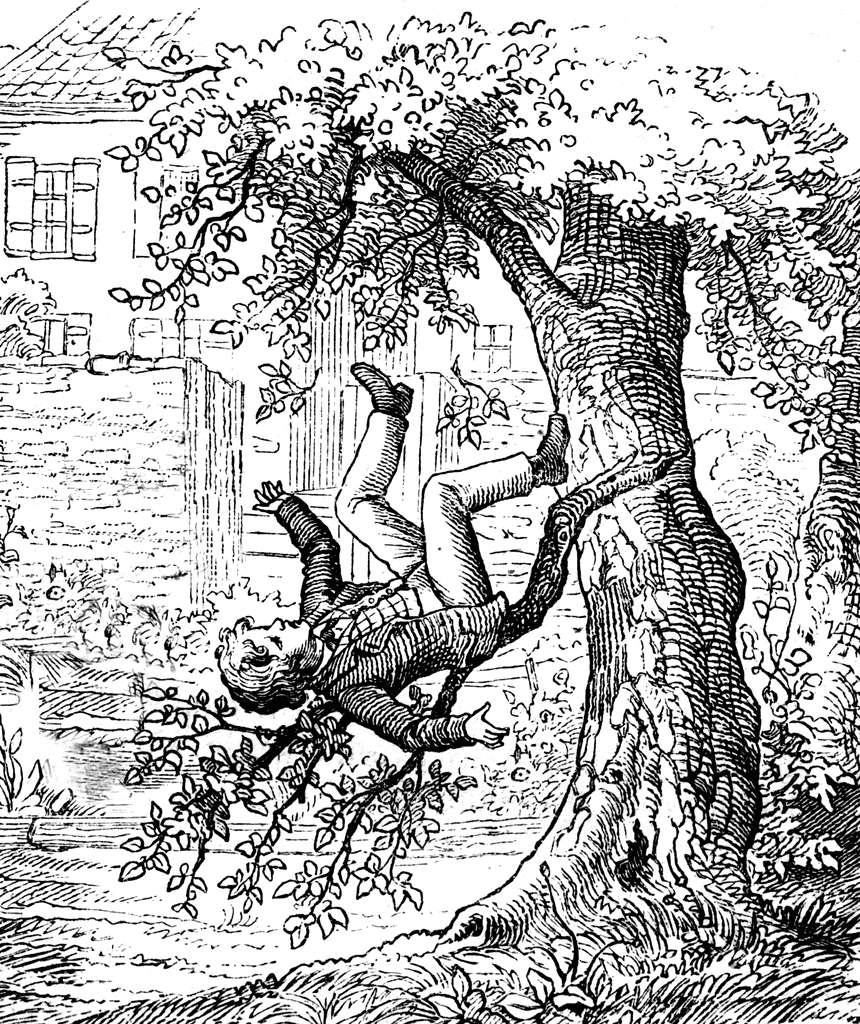
Imagine climbing up to the top of a very tall tree. You work your way up to the highest point– you can go no further. The view is completely glorious, it’s more than you hoped for. You want to post it on Facebook, so you dig into your pocket to get your camera-phone. You suddenly slip, and because your arms are occupied getting your camera, you fall. And you fall fast.

As you plummet, you realize that you’re hitting every branch on the way down. The smaller ones break, and the bigger ones, well– you just bounce off. The trip down is very fast, and perhaps even a bit illuminating.

  1. First, you think of death.
  2. Then you think about the pain each branch causes, and wonder about your imminent arrival on terra firma.
  3. Perhaps you consider how stupid you are, and how you are going to explain it.
  4. Lastly, I suppose, you wonder if you have clean underwear on, like your mother always told you to wear.

This is how my life has gone, the last 20 years. This metaphor is a good way for me to process things, and to find some understanding. I now believe that some of us go through life sideways, or horizontal. We careen off of every branch on the way down, and it seems we are hitting branches that we didn’t even know were there. Tree limbs are snapping, as we are dropping.

Others who are wiser (or maybe more experienced,) try to fall more vertically. As they fall, they use their hands to try to slow their descent. (This does work!) They will take their fair share of jolts, no doubt. But their journey to the forest floor is way less traumatic. They may end up in the hospital– but not in emergency surgery like the first guy.

It sometimes seems like every trouble I have faced I have gone into it sideways. I have broken a lot of branches on my way down. I suppose I’ve entertained some who have watched me plummet, and seen me careen and spiral my way to the bottom. These have been some painful times, I have inflicted considerable amount of bruises on myself.

People who go through life sideways will invariably suffer. They seem to hit every obstacle and trial that could be in their flight path. The existence of pain in this life cannot be disputed.

“I have told you all this so that you may have peace in me. Here on earth you will have many trials and sorrows. But take heart, because I have overcome the world.”

John 16:33, NLT

Jesus understands. Especially if you are one of those people who are “trial magnets” going through life horizontal. (You just seem to collect them.) My hope for you that as you break your branches on the way down (for maybe the 100th time). You will try to plummet vertically. Not that it is any easier, life will hurt. But perhaps it won’t be as agonizing. And I suppose that would be a good thing.

“Now unto him that is able to keep you from falling, and to present you faultless before the presence of his glory with exceeding joy,”

Jude 24

Just hanging on!bry-signat (1)

cropped-christiangraffiti1.jpg


kyrie elesion.

Together, for Each Other

together1

“The Bible knows nothing of solitary religion.” 

–John Wesley

There isn’t really a place for the individual in our walk of discipleship.  This is a most exceptional truth.  You might say that our society here in the U.S. is expressed in the ‘Marlboro Man’ who rides alone.  “High Noon,” (my favorite Western) is based on a solitary man who stands when other won’t.  The message of individualism saturates this movie. Like Gary Cooper, I think I have to face the bad guys alone.

But I think we need to understand that we are connected to other believers.  In fact, I believe that the Holy Spirit works quite distinctly in ‘generations.’  Whether we like it or not, each of us is connected to our generation.  We are responsible for our own time and place. I’m a child of the Sixties, it’s what makes me tick.

Stellar individuals like Charles Spurgeon and D.L. Moody spoke directly to their generation.  They were voices in the late 1800s.  They connected to their particular milieu, but were surrounded by many praying believers.  Their ministries and sermons, were founded upon the prayers of many saints.  Their ministries were an extension of many people. They were surrounded by other believers.

We are connected with others who are also connected. We are organically related and that needs to be understood.  It’s funny about that, we are called a “body.”  This is a difficult concept for us to understand.  But we need to know that you are not so much solitary, but woven into the life of others. The Church is plural and it happens when believers join together.

We need to understand that the Christian life is not solitary.

If this makes you curious, check out the word “together” in New Testament.  We can reflect on this, and think out what that really means. Just a few scriptures:

“From whom the whole body, joined and held together by every joint with which it is equipped, when each part is working properly, makes the body grow so that it builds itself up in love.”  

Ephesians 4:16, ESV

“For, in the first place, when you come together as a church, I hear that there are divisions among you. And I believe it in part.”

1 Corinthians 11:17-19

“Not neglecting to meet together, as is the habit of some, but encouraging one another, and all the more as you see the Day drawing near.”

Hebrews 10:24-26,

And there is at least a dozen or so more.  The idea– ‘together,’ is only a start, and we need to understand that the Christian life is not solitary. The Father melts our independence, and then molds us with each other to make us into something new.  Whether we like it or not, we are “together.”

bry-signat

flourish8