How Things Grow, [Work]

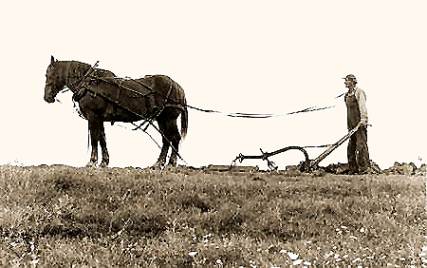
plow1930s

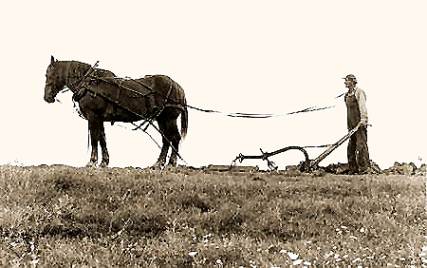
A farmer slowly walks behind his plow. The ground is hard and unyielding, but the steel cuts the heavy sod like a knife. He is preparing the soil for receiving the seed. He knows that what he is doing is imperative and he shouts out to encourage the horse. Its getting late and he wants to cut another furrow before night.

Plodding behind the plow he thinks many things. He can break up the ground, till and fertilize it, sow the seed— and then wait. He is powerless it get the seed to germinate and grow. He is limited to cultivating the soil and waiting. That is all he can really do, and he accepts this powerlessness. He can do everything right, and still not have a crop. All he can do is his part.

The farmer works in partnership with God. He is dependent on Him to grow the seed. The farmer must rely on the weather to meet and engage the planted seed. There are no shortcuts here. He does all he can, and then hopes that it is enough.

Farming is a joint endeavor between man and God. The man does what he has to do. God takes what the man has done and then finishes it. The crop will grow because He wills it. The farmer plays a part for sure, but ultimately God must become involved. Afterall, He makes the seed to sprout and grow.

We can say decisively that the pursuit of holiness in a Christian’s life is a joint endeavor between a believer and God.

Each have made the effort. The Christian does what is necessary, and then the seed is finally sown. It is then up to God to make the seed become the seedling. But each must work to finish the growth.

No one can attain holiness in their life apart from the work of preparation (it’s indeed work). The man must prepare the ground through plowing and cultivating. The farmer works the ground in order to make the ground ready. On the other hand, God provides both the environment and the growth needed to grow the seedling. Both the farmer and God must do their work.

A life of holiness is not automatic. It will never come at measured pace, trickling into our souls at a mechanized rate. (It would be nice if it would). Rather it wheat-field-landscape-picture_1920x1200_79595seems to come, in fits and spurts, sputtering rather than simply flowing.

Holiness is like a steamy Amazon jungle, vibrant and full of life. It is saturated with things living and green. It is not like an arid and sterile desert. Holiness is pulsating and powerful, full of lush growing things.

Becoming a person of holiness is the grandest adventure for the human soul. It defies our tendency to be rigid and legalistic. It is quite the opposite. It is tapping into life itself, and who is up to the task? Our morbid ideas of what holiness are not worthy of what really is.

Yes, to be holy is to work. Just as the farmer must prepare the soil for the seed, we too must guide our plows. God is ready to sow, and we should be ready to be ready. That is if we want to be fruitful and productive.

“Oh, the fullness, pleasure, sheer excitement of knowing God on earth!”

 Jim Elliot

bry-signat (1)

cropped-christiangraffiti1.jpg

Traveling Mercies, [The Journey]

Things can get pretty grim just living life.  But add a disability, and suddenly blam! It gets worse.  A mental illness intensifies life, and the weird concoction of symptoms and hospitals, therapists and medications and family/friends is a bit daunting for anyone. Imagine, that it’s a bit like running through the wilderness slathered in ‘bacon grease,’ trying to stay ahead from the bears (I’m writing this from Alaska, hence the bear imagery, lol.)

My walk with Jesus has extreme variations (at least, on my part.)  I’m up, and then I’m down.  I’m on fire and then I’m cold.  I struggle to attempt at least a modicum of consistency, wishing I could just put two ‘good days’ together.  I am ashamed by this volatility.  The apostle Peter, or David are probably the only guys in scripture I can really understand.

The impulsivity of my mental illness has driven me to turn my credit cards over to Lynn.  I try to avoid liquor stores, porn sites, and urges to strip off my clothes and run down Pioneer Avenue.  I definitely try to go to Church, read the Bible and pray.  But I have been known to hallucinate, I hear things, and get awfully paranoid.  I’m always, it seems just one step ahead of my psychiatrist in avoiding the hospital.  (And I want to keep it that way.) And suicidality is an almost real monster– always lurking for me under my bed.

But I have also learned many other things from being a mentally ill believer:

  • When its really dark, His love always comes through. He understands me. He intentionally ‘looks’ for me. He’ll never quit on me.
  • My discipleship is not about the externals of my theology, but it’s about romance from my heart.
  • In my pathetic brokenness, He is my strength and my shield. Always.
  • Worship and prayer are more like invasive “medical procedures” that keep me alive.
  • Love. I’m learning to be kinder and more aware of others then ever before.
  • I want to live in the Light and respond to others in Christlike way. Never out of my fallen sinfulness.

I suppose I could add more, if I thought about it.  Ultimately, it all comes down to the presence of Jesus Christ coming to meet me, to forgive me and to change me.  This simple blog is saturated with posts that other Brokenbelievers can wade through, and some just might help, lol.

The title of this post alludes to a quote I found. I’ve gently modified it. Not sure where I found it. But it gives the explanation for all that I’ve said:

“Life should NOT be a journey to heaven with the
intention of arriving safely in an attractive and well
preserved body, but rather to skid in sideways,
with bruises and band-aids, and some tears as well, body thoroughly used up, totally worn out and screaming… “WOO HOO what a ride!”

bry-signat (1)

cropped-christiangraffiti1.jpg


A Doubting Faith

faith-and-doubt“”Then the disciples came to Jesus in private and asked, “Why couldn’t we drive it out?”

“He replied, “Because you have so little faith. Truly I tell you, if you have faith as small as a mustard seed, you can say to this mountain, ‘Move from here to there,’ and it will move. Nothing will be impossible for you.””

Matthew 17:19-20, NLT

The text is intriguing; it seems to direct us to consider the unbelief of the disciples. They had tried so hard to do what Jesus wanted; they get an “A” for effort, but they can’t heal this boy. They correctly discern a demons presence, but they are stymied after trying to exorcise it.

The disciples “crash and burn” is uppermost in their hearts. They have a private meeting with Jesus to determine what went wrong. Their expectations were running high; they expected success in this encounter with darkness. After all, weren’t they Jesus elite followers?

“Even after Jesus had performed so many signs in their presence, they still would not believe in him.” 

John 12:37, NIV

 Jesus is on his way to be crucified. It would be fair to say that his mind was occupied with this. He is still performing healings for the needy, and although awesome things are happening, the crowds remained doubting. They would remain uncertain about him, and many would go on to mock and revile him in just a few days.

Doubt is an insidious thing. It allows one to see, but not respond. It seems to be a cowardly attitude that masks itself as safety and security. There is a willingness not to make a response when that is precisely what is being called for. It is content to live uncommitted and remain unaffiliated. Truth is neutered and we want it to be so.

I certainly don’t mean to be overly harsh to those with doubts. But there are some who put their faith in their doubts and that is slightly disturbing. They see, but do not perceive. They hear, but do not really listen.

“So faith comes from hearing, and hearing through the word of Christ.”

Romans 10:17

 Believers who doubt are in a strange place. But saving faith is always growing, in spite of one’s own skepticism. Questions are to be welcomed; honest inquiry is not a threat, but an issue of a seeking heart. Faith without evidence is no better than superstition. I think believers who never ever doubt are “a freak of nature.” Our faith may struggle, and hard questions be asked, but my faith still holds even when I doubt.

“Now faith is confidence in what we hope for and assurance about what we do not see.”

Hebrews 11:1

We are to grow in our faith. The Bible describes it as “life.” To be a believer in Jesus is a journey of confidence and hope (these words have been carefully chosen). When we find ourselves without these two working in our hearts we become unbelieving believers.

Maybe we should doubt our doubts before we doubt our faith.

“Faith never knows where it is being led, but it loves and knows the One who is leading.”   

—Oswald Chambers

bry-signat (1)

cropped-christiangraffiti1.jpg

The Inertia, [Apathy]

Customer-Inertia-2

“Science may have found a cure for most evils; but it has found no remedy for the worst of them all – the apathy of human beings.”

Helen Keller

—————————————-

As I suffer with manic depression I have come to see that much grief comes not from mania, and not from the debilitating depression. These are both substantial, but my biggest issue has to do with the inertia that lies between these two poles. There is a paralysis– an apathy that immobilizes me. And this is as bad as any other state of mind.

“And Elijah came to all the people, and said, “How long will you falter between two opinions? If the Lord is God, follow Him; but if Baal, follow him.” But the people answered him not a word.”

1 Kings 18:21

My passivity is disturbing, and bipolar disorder is as much of “detachment” as it is of extremes. I sit and stare, not able to motivate myself to get up and do something. I’m not really depressed, but nor am I manic– I’m just “there” unable to find energy to do anything. Life just rolls over me.

Perhaps the most deadly sin is this “faltering between two opinions?” We are content to just sit and watch with no commitment. We’re content to let things just roll on by as we sit in our inertia and passiveness. This is the part of my BP that scares me the most (or at least it should.)

If you suddenly went up in flames I wouldn’t stir. Yes, it would get my attention, but I probably wouldn’t do anything, (I’d probably just take notes for my book.)

Inertia is not just a part of a mental illness. It effects normal people as well, and there are degrees of it. The average person it seems will avoid making a real decisive decision at all costs. Inertia can be encountered in any church (ask a pastor who tries to get volunteers) or workplace.

In his day, Elijah cried out for a decision from the Israelite people. I have to believe he was disturbed not only by the idolatry– but by the passiveness of the bystanders. Their neutrality was a big issue.

Joshua would call out to a passive people these words:

“But if you refuse to serve the Lord, then choose today whom you will serve. Would you prefer the gods your ancestors served beyond the Euphrates? Or will it be the gods of the Amorites in whose land you now live? But as for me and my family, we will serve the Lord.”

Joshua 24:15

I know my own heart, and I know my own spiritual paralysis. Rather than commit myself, I would rather settle down on a sofa and just let things happen. I’m quick to point out how those in the arena are doing it all wrong. I’m ready to criticize, but unwilling to volunteer.

Mental illness is filled with ordinary things, but often in the wrong proportions. When we do things it is extreme or not at all. My own apathy is just a mirror of what happens in the hearts of normal people.

I may be excessive, but my own issues have made me aware of what is happening in others.

—————————————–

“It is not the critic who counts; not the man who points out how the strong man stumbles, or where the doer of deeds could have done them better. The credit belongs to the man who is actually in the arena, whose face is marred by dust and sweat and blood; who strives valiantly; who errs, who comes short again and again, because there is no effort without error and shortcoming; but who does actually strive to do the deeds; who knows great enthusiasms, the great devotions; who spends himself in a worthy cause; who at the best knows in the end the triumph of high achievement, and who at the worst, if he fails, at least fails while daring greatly, so that his place shall never be with those cold and timid souls who neither know victory nor defeat.”

–Theodore Roosevelt

bry-signat (1)

cropped-christiangraffiti1.jpg