How Things Grow, [Work]

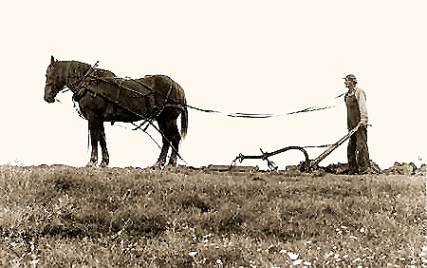
plow1930s

A farmer slowly walks behind his plow. The ground is hard and unyielding, but the steel cuts the heavy sod like a knife. He is preparing the soil for receiving the seed. He knows that what he is doing is imperative and he shouts out to encourage the horse. Its getting late and he wants to cut another furrow before night.

Plodding behind the plow he thinks many things. He can break up the ground, till and fertilize it, sow the seed— and then wait. He is powerless it get the seed to germinate and grow. He is limited to cultivating the soil and waiting. That is all he can really do, and he accepts this powerlessness. He can do everything right, and still not have a crop. All he can do is his part.

The farmer works in partnership with God. He is dependent on Him to grow the seed. The farmer must rely on the weather to meet and engage the planted seed. There are no shortcuts here. He does all he can, and then hopes that it is enough.

Farming is a joint endeavor between man and God. The man does what he has to do. God takes what the man has done and then finishes it. The crop will grow because He wills it. The farmer plays a part for sure, but ultimately God must become involved. Afterall, He makes the seed to sprout and grow.

We can say decisively that the pursuit of holiness in a Christian’s life is a joint endeavor between a believer and God.

Each have made the effort. The Christian does what is necessary, and then the seed is finally sown. It is then up to God to make the seed become the seedling. But each must work to finish the growth.

No one can attain holiness in their life apart from the work of preparation (it’s indeed work). The man must prepare the ground through plowing and cultivating. The farmer works the ground in order to make the ground ready. On the other hand, God provides both the environment and the growth needed to grow the seedling. Both the farmer and God must do their work.

A life of holiness is not automatic. It will never come at measured pace, trickling into our souls at a mechanized rate. (It would be nice if it would). Rather it wheat-field-landscape-picture_1920x1200_79595seems to come, in fits and spurts, sputtering rather than simply flowing.

Holiness is like a steamy Amazon jungle, vibrant and full of life. It is saturated with things living and green. It is not like an arid and sterile desert. Holiness is pulsating and powerful, full of lush growing things.

Becoming a person of holiness is the grandest adventure for the human soul. It defies our tendency to be rigid and legalistic. It is quite the opposite. It is tapping into life itself, and who is up to the task? Our morbid ideas of what holiness are not worthy of what really is.

Yes, to be holy is to work. Just as the farmer must prepare the soil for the seed, we too must guide our plows. God is ready to sow, and we should be ready to be ready. That is if we want to be fruitful and productive.

“Oh, the fullness, pleasure, sheer excitement of knowing God on earth!”

 Jim Elliot

bry-signat (1)

cropped-christiangraffiti1.jpg

A Doubting Faith

faith-and-doubt“”Then the disciples came to Jesus in private and asked, “Why couldn’t we drive it out?”

He replied, “Because you have so little faith. Truly I tell you, if you have faith as small as a mustard seed, you can say to this mountain, ‘Move from here to there,’ and it will move. Nothing will be impossible for you.””

Matthew 17:19-20, NLT

The text is intriguing; it seems to direct us to consider the unbelief of the disciples. They had tried so hard to do what Jesus wanted; they get an “A” for effort, but they can’t heal this boy. They correctly discern a demons presence, but they are stymied after trying to exorcise it.

The disciples “crash and burn” is uppermost in their hearts. They have a private meeting with Jesus to determine what went wrong. Their expectations were running high; they expected success in this encounter with darkness. After all, weren’t they Jesus elite followers?

Even after Jesus had performed so many signs in their presence, they still would not believe in him.” 

John 12:37, NIV

 Jesus is on his way to be crucified. It would be fair to say that his mind was occupied with this. He is still performing healings for the needy, and although awesome things are happening, the crowds remained doubting. They would remain uncertain about him, and many would go on to mock and revile him in just a few days.

Doubt is an insidious thing. It allows one to see, but not respond. It seems to be a cowardly attitude that masks itself as safety and security. There is a willingness not to make a response when that is precisely what is being called for. It is content to live uncommitted and remain unaffiliated. Truth is neutered and we want it to be so.

I certainly don’t mean to be overly harsh to those with doubts. But there are some who put their faith in their doubts and that is slightly disturbing. They see, but do not perceive. They hear, but do not really listen.

“So faith comes from hearing, and hearing through the word of Christ.”

Romans 10:17

 Believers who doubt are in a strange place. But saving faith is always growing, in spite of one’s own skepticism. Questions are to be welcomed; honest inquiry is not a threat, but an issue of a seeking heart. Faith without evidence is no better than superstition. I think believers who never ever doubt are “a freak of nature.” Our faith may struggle, and hard questions be asked, but my faith still holds even when I doubt.

“Now faith is confidence in what we hope for and assurance about what we do not see.”

Hebrews 11:1

We are to grow in our faith. The Bible describes it as “life.” To be a believer in Jesus is a journey of confidence and hope (these words have been carefully chosen). When we find ourselves without these two working in our hearts we become unbelieving believers.

Maybe we should doubt our doubts before we doubt our faith.

“Faith never knows where it is being led, but it loves and knows the One who is leading.”   

Oswald Chambers

bry-signat (1)

cropped-christiangraffiti1.jpg

Different Ways to Fall Out of a Tree

boy-falling
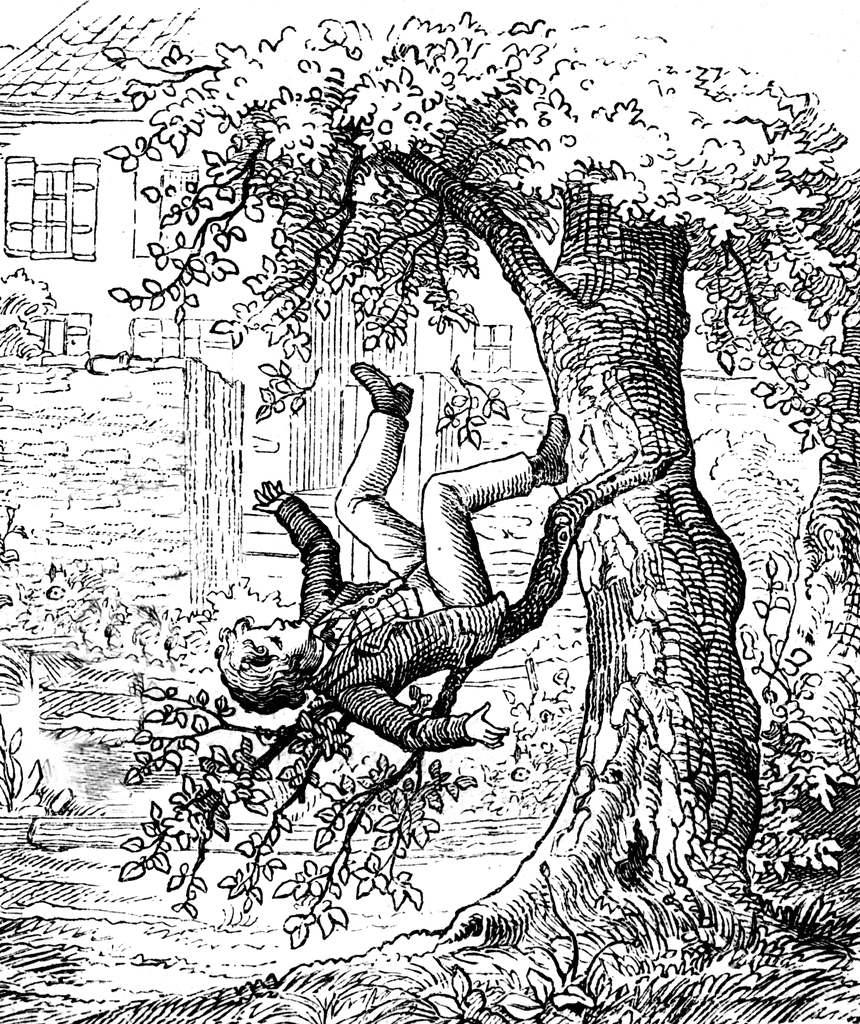
Imagine climbing up to the top of a very tall tree. You work your way up to the highest point– you can go no further. The view is completely glorious, it’s more than you hoped for. You want to post it on Facebook, so you dig into your pocket to get your camera-phone. You suddenly slip, and because your arms are occupied getting your camera, you fall. And you fall fast.

As you plummet, you realize that you’re hitting every branch on the way down. The smaller ones break, and the bigger ones, well– you just bounce off. The trip down is very fast, and perhaps even a bit illuminating.

  1. First, you think of death.
  2. Then you think about the pain each branch causes, and wonder about your imminent arrival on terra firma.
  3. Perhaps you consider how stupid you are, and how you are going to explain it.
  4. Lastly, I suppose, you wonder if you have clean underwear on, like your mother always told you to wear.

This is how my life has gone, the last 20 years. This metaphor is a good way for me to process things, and to find some understanding. I now believe that some of us go through life sideways, or horizontal. We careen off of every branch on the way down, and it seems we are hitting branches that we didn’t even know were there. Tree limbs are snapping, as we are dropping.

Others who are wiser (or maybe more experienced,) try to fall more vertically. As they fall, they use their hands to try to slow their descent. (This does work!) They will take their fair share of jolts, no doubt. But their journey to the forest floor is way less traumatic. They may end up in the hospital– but not in emergency surgery like the first guy.

It sometimes seems like every trouble I have faced I have gone into it sideways. I have broken a lot of branches on my way down. I suppose I’ve entertained some who have watched me plummet, and seen me careen and spiral my way to the bottom. These have been some painful times, I have inflicted considerable amount of bruises on myself.

People who go through life sideways will invariably suffer. They seem to hit every obstacle and trial that could be in their flight path. The existence of pain in this life cannot be disputed.

“I have told you all this so that you may have peace in me. Here on earth you will have many trials and sorrows. But take heart, because I have overcome the world.”

John 16:33, NLT

Jesus understands. Especially if you are one of those people who are “trial magnets” going through life horizontal. (You just seem to collect them.) My hope for you that as you break your branches on the way down (for maybe the 100th time). You will try to plummet vertically. Not that it is any easier, life will hurt. But perhaps it won’t be as agonizing. And I suppose that would be a good thing.

“Now unto him that is able to keep you from falling, and to present you faultless before the presence of his glory with exceeding joy,”

Jude 24

Just hanging on!bry-signat (1)

cropped-christiangraffiti1.jpg


kyrie elesion.

Suffering: Finding Some Reasons

suffering1“Since he himself has gone through suffering and testing, he is able to help us when we are being tested.”

Hebrews 2:18, (NLT)

“Whenever you meet someone who has really suffered; been limited, gone through things for the Lord, willing to be imprisoned by the Lord, just being satisfied with Him and nothing else, immediately you scent the fragrance. There is a savor of the Lord. Something has been crushed, something has been broken, and there is a resulting odor of sweetness.”

  Watchman Nee

I remember a time many years ago when I felt like I had a ‘charmed’ life. I had no issues, few problems– life was smooth, there was no ‘roughness.’ I felt like I was God’s favorite, His ‘golden boy.’ I should have known it wouldn’t last :-).

Suffering in the scriptures is often linked with the concept of endurance. Often within the selected verse the writer weaves into it this idea. I believe that to endure something transforms it to good. Believers will suffer, but the issues get transformed into something quite beautiful, if, we add the ingredient of patient endurance.

“We give great honor to those who endure under suffering. For instance, you know about Job, a man of great endurance. You can see how the Lord was kind to him at the end, for the Lord is full of tenderness and mercy.”

James 5:11

In many ways, suffering is a tutor teaching us the foreign dialect of the Kingdom. If done under the kind direction of the Holy Spirit, it can give us a working knowledge of patience, endurance and joy. We must learn to speak in another language. A suffering believer will find a new vocabulary in pain that allows him to speak with understanding to those who are also in pain.

I spent several years studying Spanish. Even though I wasn’t really fluent, I discovered it opened a whole new world; being bilingual created new opportunities that I’d never even knew existed. I believe that suffering works under this same principle.

light-end-tunnelDo you speak the language? Can you communicate with love to those who hurt? Learning it can transform you to a person that can speak authoritatively to a wide swath of people. Having had to handle your own pain gives you the privilege of interpreting God’s love into pain and hurt.

From our own hurt (through endurance and joy) we can help others. I can always tell a fellow-sufferer. They are typically gentle and loving people, devoid of pride and control. These are the ones who have learned to speak the idiom of the Kingdom of God.

“He comforts us in all our troubles so that we can comfort others. When they are troubled, we will be able to give them the same comfort God has given us… We were crushed and overwhelmed beyond our ability to endure, and we thought we would never live through it. In fact, we expected to die. But as a result, we stopped relying on ourselves and learned to rely only on God, who raises the dead.

2 Corinthians 1:4, 8-9

bry-signat

flourish8