Pouring Oil on the Waves (Peace)

“Storm Warning”

“…And through him God reconciled everything to himself.  He made peace with everything in heaven and on earth by means of Christ’s blood on the cross.”

Colossians 1:20, NLT

Jesus has brought a complete peace into God’s world. Everything is now reconciled, taken care of by what Jesus has done. The precise word is “shalom.” It has within it the idea of ‘wholeness, or healthiness.’ It is in a general sense, being ‘made whole or complete.’ This present ‘sickness’ has become obsolete. That is our message.

There is no room really for any “peace” without completeness, it just isn’t possible. The “peace” that the Bible teaches is far more comprehensive, and total. The word in Hebrew, has a strong attachment to health, harmony and prosperity. It has the sense of being well, with the complete absence of turmoil or conflict.

“And he will be called:
Wonderful Counselor, Mighty God,
    Everlasting Father, Prince of Peace.
7 His government and its peace
    will never end.”

Isaiah 9:6-7, NLT

Peace is more than a snazzy marketing approach. At its basic sense it is what He fully intends for the “peoples of the earth.” But this all comes to us with a price. In Isaiah 53:5, (ESV)

“But he was pierced for our transgressions;
he was crushed for our iniquities;
upon him was the chastisement that brought us peace,
and with his wounds we are healed.”

The brutalization of Jesus had a purpose. He “brought us peace.” And we needed peace, desperately. But, oh, the cost!

In ancient times, sailors in a nasty tempest, would pray to their gods, and then pour oil on the waves. They believed the oil, poured out in barrels would settle the violent seas. (I suppose they figured the viscosity of the oil on the waves, would give them some time to manage their ship.)

Today, we know that it doesn’t work this way. Our storms however, are just as bitter, and challenging. Things get so tumultuous, and savagely extreme. But somehow, we want to pour God’s peace on our awful storm. Inherently we know that His peaceful presence can restore some sanity on our crazy lives.

Jesus is “the Prince of Peace.” We look right at Him when things get so ugly. He has come to do this. He is God’s solution to our sad conflict. He brings the oil, for our storm.

bry-signat (1)

cropped-christiangraffiti1.jpg

Working in the Time of Grace

ii9508101a

 “These men who were hired last worked only one hour,’ they said, ‘and you have made them equal to us who have borne the burden of the work and the heat of the day.”

Matt. 20:12, NIV

Matthew 20 irritates me.  People are working the entire day, and along comes people who have only worked for one hour.  This discrepancy drives the believer nuts.  How in the world could such a thing take place?  It is foolishness to us who insist on a ‘grace of appropriateness.’  We want grace to be fair, recognizing the person who has worked very hard.

The problem is that God is outrageous with His grace and love.  He completely expands us to a point where we must embrace a grace that is completely beyond us.  We have to break down and accept what is available to us.  Grace completely dumps us upside down.

We can only proceed if we accept His definition of Grace.

Those who have labored the least are made equal to those who work the hardest.  This seems incredibly unfair and we revolt against such extravagance.  It strikes us as outrageously unfair.  How can those who worked only an hour receive the exact same amount as those who have labored a full eight?

The miracle of  this shockingly outrageous grace is that we are confronted by a profound freedom.  We basically get brought to the point where we get stripped of these illusions and need to walk out the scripture.  It has the tendency to eliminate the issues that could block us and bring us to a most receptive position.

“But he replied to one of them, ‘My friend, I’m not being unjust to you. Wasn’t our agreement for a silver coin a day? Take your money and go home. It is my wish to give the latecomers as much as I give you. May I not do what I like with what belongs to me? Must you be jealous because I am generous?’

16 “So, many who are the last now will be the first then and the first last.”

Matthew 20:13-16

We must admit that God’s grace reaches out to everyone. 

That He has the deep, deep desire to see that each of us connect with His love.  This is indeed the radicalness of the gospel.  It is outrageous and astonishing.  That He would love us who have hated Him.  Our sense of equity is completely undone.  His grace completely turns us upside down. I think that is a good thing.

bry-signat (1)

cropped-christiangraffiti1.jpg


Simply Golden

by Norman Rockwell, 1961

“And as you wish that others would do to you, do so to them.”

Luke 6:31, ESV — The Golden Rule

 “Here is a simple rule of thumb for behavior: Ask yourself what you want people to do for you; then grab the initiative and do it for them! If you only love the lovable, do you expect a pat on the back? Run-of-the-mill sinners do that.” 

Luke 6:31-32, MSG

Sometimes it seems, I hit the switch, and shut it all down. Essentially, I get wrapped up with one of my favorite sins and soon I turn off my faith, unplugging myself from the wall.  I have a desire to escape from what I see as restrictions that I believe faith brings me.  I want to have fun–I don’t want to pray, or read the Bible.

Actually I can do this subtly.  I just raise the volume of my sinful desires, and try to drown out that still small voice.  I can maintain a holy life for my Christian friends, while I enjoy the pleasures of my favorite sins.  Sins or holiness, I want to go for both– but the reality is I just get one.

There is still a voice that is speaking profoundly. “And as you wish that others would do to you, do so to them.”  Our particular concepts of Christianity so rarely include this–“the golden rule.”  In my own mind, I diminish this as a little bit antiquated.  I will rarely feel its pinch or pull.  It is never a topic of serious thought or meditation.  It seems that it has become what I call–“an optional truth.”  It is very much real, but it is not connected to me in my daily walk.

Treating others, the very way you want to be treated—do this!  Love other people outrageously and deeply; because you like it when they do this to you.  There is reciprocal action here, a sort of spiritual circle of kindness.  Our vernacular says, “What goes around, comes around.”  And it certainly has a ring of truth in it.

All too often we have a version of Christianity that has had its teeth pulled. We have tamed it, and brought the sharp teeth of the faith under our personal decision-making process.  The wildness of a true faith is domesticated and ‘house-broken.’  And we start the rush to unplug things.  The golden rule gets detached right away.

As I struggle as a mentally ill Christian, it is mandatory that the truth be lifted up in my life.  I can become quite disturbed and manipulated by life’s dealings.  My issues of paranoia and delusion cripple me, or they could become the step-stool for those wonderous things on the shelf of grace.

Dear ones, use your illness to reach for the best, live this and change your world.

%

1brobry-sig4


cropped-christiangraffiti1 (1)

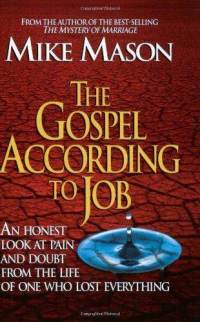
The Gospel According to Job

Today, I want to bring out this book, out into the spotlight.  It is a tremendous devotional that makes its way through the book of Job.  I have leaned on it, and it has held me nicely.  I challlenge you to get a copy of this, and to let it work in the confines of your spirit and mind. ––Bryan

A

Excerpt from “The Gospel According to Job,” by Mike Mason


“An Honest Look at Pain and Doubt from the Life of One who Lost Everything”

_______________________

A“Once I met a man who, like Abraham, had moved his entire household halfway around the world on the strength of a vision from God. When I asked him to tell me the story, he answered that there were three versions of that story, and which one did I want to hear? First, there was the version of the story that he told to Christians. Then there was the version he told to non-Christians. Finally, there was the truth. Job is a book that tells things from the third point of view. Probably, along with Ecclesiastes, it does this better than any other book in the Bible.

Not that the other Scriptures do not tell the truth. But Job tells the truth in a way that makes it almost impossible to pervert the truth into pious pabulum. A few years ago I went through a difficult time. Never mind what the problem was. It was nothing compared to the trials of Job. In fact, it was nothing at all compared to the sufferings of many of my neighbors right there on the quiet street where I lived.

But pain is pain, and suffice it to say that my pain was enough to drive me to my knees, totally defeated, half-crazy at times, and crying out for relief. Month after month the battles raged on, thick, dark, agonizing. I prayed, but somehow prayer did not ‘work.’ Usually nothing at all worked, except lying low and gritting my teeth until, for reasons entirely obscure to me, the straightjacket of oppression began to loosen a little––at least enough for me to get on with my life for another day or so before the screws tightened again. What else could I do? How was I to fight this?

In retrospect I can see that a large part of my anguish was rooted in the fact that there really was nothing I could do to control what was happening to me. I was absolutely helpless, and it is this, perhaps, that is the soul of suffering, this terrifying impotence. It is a little taste of the final and most terrifying impotence of all, which is death.

We Christians do not like to think about being absolutely helpless in the hands of our God. With all of our faith, and with all of His grace, we still prefer to maintain some semblance of control over our lives. When difficulties arise, we like to think that there are certain steps we can take, or attitudes we can adopt, to alleviate our anguish and be happy. Sometimes there are. But anyone who has truly suffered will know that when it comes to the real thing there is no help for it, no human help whatsoever.

Simply put, when we are in a deep dark hole we cannot think our way out; neither can we hope, sing, pray, or even love our way out. In fact there is absolutely nothing either we or anyone else can do to better our situation. We can have faith, yes; but in itself faith will not change anything. Neither faith, nor any other good thing that a person might have or do, can actually lift the cloud, move the mountain, or bring about an end to the problem.

Only the Lord Himself can do that, and when He does, as Exodus 6:6 puts it, “Then you will know that I am the Lord your God, who brought you out from under the yoke.” How will we know? Simply because nothing and no one else could possibly have done it. In this kind of crucible, therefore, we come to a new understanding of what it means to be saved, what it means to be snatched away from the brink of destruction.

Here we get down to the bedrock of the gospel. During my night of anguish, I turned to the book of Job, and there I began to make contact with the gospel in a way that somehow I never had in studying the New Testament. Reading Job, I found myself experiencing in new and astonishing depth the reality of Jesus’ promise in John 8:32,

 “You will know the truth, and the truth will set you free.”


cropped-christiangraffiti1.jpg