Chasing Down Euphoria

“That’s the difference between me and the rest of the world! Happiness isn’t good enough for me! I demand euphoria!” 

Calvin & Hobbes, comic strip

One of the blessings of turning 55 is I come to a place where I can sit and think about my life. I’m intrigued by how it unfolded the way that it did.  I know I can be a bit of an eccentric. But that’s ok. When the warm ocean current of depression and the cold water current of weird personality meet it will  get very tumultuous.  And being diagnosed with Bipolar Disorder brings even more issues. But I do admit– I have lived life hard. (Perhaps harder then it had to be.)

I do have a ‘dark side.’ One of the most disturbing areas I had was an almost insatiable thirst for ‘euphoria.’  Both drugs and alcohol, I discovered would put me in the place of exhilaration and elation.  And I longed for anything that would put me in this mental state.  If you had come to me with two hits of ‘acid,’ I would definitely take them both, and not even blink. That has changed since I accepted Christ. The impulses are tamed by God’s Spirit and Word. (Thank God!)

My quest for euphoria has taken me down some strange paths.  I learned to buy those drugs that would work that special bliss into my being.  But I couldn’t maintain euphoria.  I chased after that idea, without ever achieving it.  LSD, PCP, marijuana, whiskey, cocaine, and  even ‘needles’— all those old standbys have brought me to a false sense of inner freedom.  I tried to stay ‘stoned’ as long as I could. I drank enough vodka to float a battleship.  I was a maniac. Completely out-of-control.

“You will be bruised all over, without even remembering how it all happened. And you will lie awake asking,  “When will morning come, so I can drink some more?” 

Proverbs 23:35, CEV

depressedcomputerThe man who penned this must have knew the back side of getting hammered.  There is a lot of pain in this lifestyle, and not just hangovers and depression. Yet we can’t wait until we can start it all over again.  This love for the high is the precursor to addiction.  Crossing this line is a moment of strange logic for the user, but in reality,  it is a form of mental illness and insanity.

My addictions (which imprinted an ‘addictive personality’) are seldom reasonable.  As I pursue the euphoria (I love to get “high!”) my own ravenous appetite begins to feed off my own personality.  When a dam breaks, it starts at a tiny leak. This can take several years.  But the pressure will slowly continue and then it begins to escalate.  Soon the water pushes through until the dam breaks.  Floods ensue as the lake flows through.  Disaster is just that close.

“You say to each other,  “Let’s drink till we’re drunk!  Tomorrow we’ll do it again.  We’ll really enjoy ourselves.” 

Isa. 56:12, CEV

When we pursue, and then try to purchase our euphoria, we will inevitably end up as drunks and as addicts.  When fixed on the pursuit of carnal pleasure, we end up destroying ourselves, and the lives of those closest to us. When I start hurting others by my actions, I must consider I may have a big problem. Maturity is in part, understanding our desperateness, and then moving beyond it.  But the reality is that we are scarred, and that we continue to escape by “the skin of our teeth” until we die or get sober. Only Christ can save the euphoria-chaser.

Sometimes I’m a piece of work, it’s alright though because I’m His piece of work.

bry-signat (1)

cropped-christiangraffiti1.jpg

*

The Awful Pain of Job

job-and-his-friends

“Oh, why give light to those in misery,
    and life to those who are bitter?
21 They long for death, and it won’t come.
    They search for death more eagerly than for hidden treasure.
22 They’re filled with joy when they finally die,
    and rejoice when they find the grave.
2Why is life given to those with no future,
    those God has surrounded with difficulties?”

Job 3:20-23, NLT

Job begins to curse his existence and his words are saturated with frustration. He grieves for all of his dead children and is sickened by his afflictions. Job is a man pushed beyond the edge.

Job is the “poster child” of human suffering. He is completely without pretense as he openly grieves. He voices exactly what is in his heart.

Let us be clear about this; He is devastated, ravaged by Satan’s grim ministry. Job to his credit, is oblivious to Satan’s wager with the Almighty God. He has no clue that he has been chosen by God in this matter. The Lord keeps His secrets.

All Job knows is the pain, and there is the endless grief that even his tears can’t help.

In Job’s first speech he asks some basic questions:

  • Why is light given to those who are full of pain?
  • Why does life unfold to the one who rather not live anymore?

Death has a powerful influence in this three verses, He wants to die, and end the charade. He wishes for non-existence and laments that he can not die fast enough.

People with disabilities and chronic pain can understand Job’s desire for release. Once they were “whole” people. Death was something to be avoided at all costs. But now it is seen as an escape.

Hurting people will often turn to drinking and drugging as a way of coping. We’ll try anything to numb our thinking. It’s what gets us through the day. Oblivion has become my best friend.

For Job (the patron saint of pain) finds that nothing will fix him. His friends have come, but they seem to only accuse and confuse job. Honestly he is better when they just sat with him in silence.

“God wants us to choose to love him freely, even when that choice involves pain, because we are committed to him, not to our own good feelings and rewards. He wants us to cleave to him, as Job did, even when we have every reason to deny him hotly.”

–Philip Yancey

“Come quickly, Lord, and answer me, for my depression deepens. Don’t turn away from me, or I will die. Let me hear of your unfailing love each morning, for I am trusting you. Show me where to walk, for I give myself to you.”

Psalm 143:7-8

ybic, Bryan


cropped-christiangraffiti1 (3)


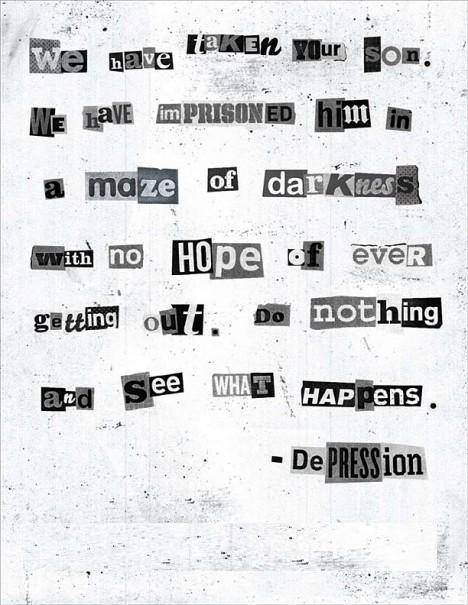
The Ransom Note

depression-note

“We collapse in the dust,
    lying face down in the dirt.
26 Rise up! Help us!
    Ransom us because of your unfailing love.”

Psalm 44:25-26, NLT

“For even the Son of Man came not to be served but to serve others and to give his life as a ransom for many.”

Mark 10:45

“God chose him as your ransom long before the world began, but he has now revealed him to you in these last days.”

1 Peter 1:20

I think that God has more or less ransacked the human language in His effort to get through to us the critical nature of what exactly has been done just for us. When it comes to our salvation and what that means to the universe, the word, “ransom” is used.

The connection for us, as we consider the implications, has mainly a connection with the crime of “kidnapping.” This is when someone is captured by other men, and held in captivity until certain terms are met. When the kidnapper feels his needs are fully met, then the hostage is released.

In the Bible sense, we should work through several verses. There are at least three Hebrew words. In the N.T. Greek just a single word to explain “ransom” is seen. And yet we can say, each word is linked back to the idea of being “helpless.” And helpless is far more than a definition, rather it is a description of a “state of being.”

We come to understand that helplessness is the natural state of human beings. We each have been captured, taken away and are being held, until terms are met for our release. I suppose that some see this helplessness easier than others. (And I’m sure a few will never acknowledge it at all). But nevertheless, it is real and it describes every single person that has ever lived.

Being completely helpless is hardly a situation we would ever choose. Having ransom demands being made to set us free is mostly awkward. And it’s an affront. Perhaps, we feel we are worth more? But the issues here are eternal, and currency concepts are never the consideration.

But there is a present need, to purchase back those who are being held as captives. The absolute clear position is that the Lord Jesus Christ, died in our place. Choosing to die for us, he was essentially tortured before his cruel death. In this decision, he himself paid my ransom. In doing this, I was set free and fully able to return home.

There are many who have been free. But there is a thing called “the Stockholm Syndrome.” This refers to those in captivity who somehow “connect” with their kidnappers through a prolonged captivity. This is to the point where they begin to act less than the victims, and more like the captor. It is confusing. They seem to go out of their way to act “pro-kidnapper”. This can get very disturbing.

We must look to our children, and closest family and our friends. They are toiling for Satan, the captor of our souls (past-tense). Many different tactics are being used– depression, addictions, lust, greed, anger, gluttony, pride, guilt and many other deceitful things. They are being held, until faith (the key) “springs” them out of their prison.

Thank you Jesus, for coming to free us. Thank you for forgiving us. We have been released, and now walk away free. You died, so we might live. We desperately want to see the others we love set free.

*

ybic, Bryan


cropped-christiangraffiti1 (3)

*

The Numbers Don’t Lie: Mental Illness in America

giving-up2

~Mental Illness in America, 2016

Mental disorders are common in the United States and internationally. An estimated 26.2 percent of Americans ages 18 and older — about one in four adults — suffer from a diagnosable mental disorder in a given year.1

When applied to the 2004 U.S. Census residential population estimate for ages 18 and older, this figure translates to 57.7 million people.2 Even though mental disorders are widespread in the population, the main burden of illness is concentrated in a much smaller proportion — about 6 percent, or 1 in 17 — who suffer from a serious mental illness.1

In addition, mental disorders are the leading cause of disability in the U.S. and Canada.3 Many people suffer from more than one mental disorder at a given time. Nearly half (45 percent) of those with any mental disorder meet criteria for 2 or more disorders, with severity strongly related to comorbidity.1

In the U.S., mental disorders are diagnosed based on the Diagnostic and Statistical Manual of Mental Disorders, fourth edition (DSM-V).4

Mood Disorders

Mood disorders include major depressive disorder, dysthymic disorder, and bipolar disorder.

  • Approximately 20.9 million American adults, or about 9.5 percent of the U.S. population age 18 and older in a given year, have a mood disorder.1,2
  • The median age of onset for mood disorders is 30 years.5
  • Depressive disorders often co-occur with anxiety disorders and substance abuse.5

Major Depressive Disorder

  • Major Depressive Disorder is the leading cause of disability in the U.S. for ages 15-44.3
  • Major depressive disorder affects approximately 14.8 million American adults, or about 6.7 percent of the U.S. population age 18 and older in a given year.1, 2
  • While major depressive disorder can develop at any age, the median age at onset is 32.5
  • Major depressive disorder is more prevalent in women than in men.6

Dysthymic Disorder

  • Symptoms of dysthymic disorder (chronic, mild depression) must persist for at least two years in adults (one year in children) to meet criteria for the diagnosis. Dysthymic disorder affects approximately 1.5 percent of the U.S. population age 18 and older in a given year.1, This figure translates to about 3.3 million American adults.2
  • The median age of onset of dysthymic disorder is 31.1

Bipolar Disorder

  • Bipolar disorder affects approximately 5.7 million American adults, or about 2.6 percent of the U.S. population age 18 and older in a given year.1, 2
  • The median age of onset for bipolar disorders is 25 years.5

Suicide

  • In 2006, 33,300 (approximately 11 per 100,000) people died by suicide in the U.S.7
  • More than 90 percent of people who kill themselves have a diagnosable mental disorder, most commonly a depressive disorder or a substance abuse disorder.8
  • The highest suicide rates in the U.S. are found in white men over age 85.9
  • Four times as many men as women die by suicide9; however, women attempt suicide two to three times as often as men.10

Schizophrenia

  • Approximately 2.4 million American adults, or about 1.1 percent of the population age 18 and older in a given year,11, 2 have schizophrenia.
  • Schizophrenia affects men and women with equal frequency.12
  • Schizophrenia often first appears in men in their late teens or early twenties. In contrast, women are generally affected in their twenties or early thirties.12

Anxiety Disorders

Anxiety disorders include panic disorder, obsessive-compulsive disorder, post-traumatic stress disorder, generalized anxiety disorder, and phobias (social phobia, agoraphobia, and specific phobia).

  • Approximately 40 million American adults ages 18 and older, or about 18.1 percent of people in this age group in a given year, have an anxiety disorder.1,2
  • Anxiety disorders frequently co-occur with depressive disorders or substance abuse.1
  • Most people with one anxiety disorder also have another anxiety disorder. Nearly three-quarters of those with an anxiety disorder will have their first episode by age 21.5 5

Panic Disorder

  • Approximately 6 million American adults ages 18 and older, or about 2.7 percent of people in this age group in a given year, have panic disorder.1, 2
  • Panic disorder typically develops in early adulthood (median age of onset is 24), but the age of onset extends throughout adulthood.5
  • About one in three people with panic disorder develops agoraphobia, a condition in which the individual becomes afraid of being in any place or situation where escape might be difficult or help unavailable in the event of a panic attack.12

Obsessive-Compulsive Disorder (OCD)

  • Approximately 2.2 million American adults age 18 and older, or about 1.0 percent of people in this age group in a given year, have OCD.1, 2
  • The first symptoms of OCD often begin during childhood or adolescence, however, the median age of onset is 19.5

Post-Traumatic Stress Disorder (PTSD)

  • Approximately 7.7 million American adults age 18 and older, or about 3.5 percent of people in this age group in a given year, have PTSD.1, 2
  • PTSD can develop at any age, including childhood, but research shows that the median age of onset is 23 years.5
  • About 19 percent of Vietnam veterans experienced PTSD at some point after the war.13 The disorder also frequently occurs after violent personal assaults such as rape, mugging, or domestic violence; terrorism; natural or human-caused disasters; and accidents.

Generalized Anxiety Disorder (GAD)

  • Approximately 6.8 million American adults, or about 3.1 percent of people age 18 and over, have GAD in a given year.1, 2
  • GAD can begin across the life cycle, though the median age of onset is 31 years old.5
To finish reading this article, you will need to go to its source at:

http://www.nimh.nih.gov/health/publications/the-numbers-count-mental-disorders-in-america/index.shtml  


cropped-christiangraffiti1 (1)