‘Snowflake’ Discipleship

“Thank you for making me so wonderfully complex! Your workmanship is marvelous—how well I know it.”

Psalm 139:14

“God is not a duplicator, He is a Creator. You are an original.”

-Reinhard Bonnke

The Bible states many wonderful things. One of them is that we are created in the image of God, and I’m quite certain that each of us are shaped completely different. I recently read that an estimated 117 billion people have lived on earth. That’s amazing; and to think we are all unique.

Sometime ago I found my Grandmother’s Bible.

I was somewhat intrigued, and I supposed that it might just ‘impart’ some special spiritual blessing to me. I sat down on the couch, and reverently opened it up. It was filled with wonderful handwritten notes.

As I sat down to read it though, I slowly began to realize that it was exactly like my own! The verses and the promises were the same, they had not changed. What was true for my grandma was true for me. That amazed me, and it kind of sent me spinning. But I suddenly started thinking.

Each of us struggles differently.

We endure depression, PTSD, schizophrenia, even suicidal thoughts. We struggle with different addictions and lonely divorces. There are those believers who are epileptics or disabled. There are some of us who have been raped or molested. I have a paralyzed right arm, and am typing this with my left hand. I also struggle with depression and anger.

Each of us are the same in a basic sense, and yet we are all distinctly different. We all have gone through things, some good, some quite awful. These issues are uniquely our own. Our “personal” testimony with God is unlike someone else’s. We respond to our different circumstances in different ways.

We are “snowflakes’ that have been artistically crafted. Our circumstances are individually tailored by God, who is the ultimate Artist. I opened this post with the idea that God creates “snowflakes,” and I’ve been told that every one of them is unique.

I do believe that when we stand before God we will all have these fantastically different stories. Each of us have found forgiveness, mercy and grace that the Lord freely gives us. As “grace-walkers” our life can be mixed with His love, filtered through a myriad of circumstances.

And they mix exceedingly well.

Reading the Word we must realize that each man or woman who walked with God had a different story to tell. We rightly consider them in amazement. And yet none of them knew they were special at the time, all they understood was “the daily grind.”

We can trust Him. We slowly begin to see, and understand, that there are implications of being ‘snowflakes.’ God took Joseph and ‘molded’ him by His unique circumstances, he went from prison to the Prime Minister overnight. Each of us has testimony of His incredible care.

–Francis Schaeffer

Your very unique brother,

Bryan

My Facebook

The Extraordinary Breath of Jesus

“Jesus said to them again, “Peace be with you. As the Father has sent me, I also send you.” 22 After saying this, he breathed on them and said, “Receive the Holy Spirit. 23 If you forgive the sins of any, they are forgiven them; if you retain the sins of any, they are retained.”

John 20:21-23 (19-23)

This is the second “peace be with you” in this passage. So why the duplication of this peace proclamation? The disciples are sequestered and scared in the upper room (v. 19; and Luke 24:36. Having peace is being emphasized–the disciples were afraid of the Pharisees, but they also were undone by Jesus’ surprise visit.

Peace was definitely a precious commodity for them.

Jesus gives his disciples a mission to do, and they must be as ‘familiar’ with Jesus just as Jesus is with God. The disciples had followed him for three years–seeing incredible miracles, and hearing profound teaching, they’re ready, they just need power.

In track and field, there’s a relay race where a baton is passed from runner to runner, and maybe that’s how it’s working here? We see the same idea in John 17:18.

The baton has now been passed to the disciples.

The breath of the risen Jesus is necessary (and yes, he’s breathing.) What went down here, I don’t know exactly. But Jesus recognizes that his 12 followers will need this to do his work. Also, we might consider Adam in Genesis 2:7 where God’s breath brought him to life, which is pretty awesome when you think of the parallels.

The Holy Spirit energizes these men to do this new work.

The disciples were pretty much observers, but now they are to take up the ‘mantle’ of Jesus’ work. This is a definite duplication, which connects with the idea of one seed producing many others (John 12:24.) That’s how the Kingdom will come to people.

Verse 23 intrigues me. It seems that our life comes from the breath of Jesus. And it’s the Holy Spirit that gives both power and the authority that’s needed to function like Jesus. We now have the ability to pronounce forgiveness to the new believer, and yet that doesn’t seem a function of the Church today.

I wonder why this is so?

This entire passage as a doozy. It clearly declares the Churches new role as we follow in his footsteps. Disciples are to do exactly what Jesus does–with his breath and authority–filled with the Holy Spirit.

If we neglect these things (it seems anyway) we’re going to fall flat on our face.

“The work of Jesus for His disciples on resurrection Sunday gives an ongoing pattern for His work among His people. Jesus wants to continue this fourfold ministry of assurancemission, the Holy Spirit and authority to His people today.”

From David Guzik’s website

Always Be Children, [Always]

Matthew 18:1-3, ESV

I have always believed that maturity brings wisdom and growth, a beautiful journey to embark on. When it comes to spiritual matters, it is an opportunity to delve deeper into the richness of faith. I eagerly embraced the challenge of expanding my understanding and exploring the profound teachings. Jesus’ devoted disciples, too, were presented with invaluable guidance and encouraging direction:

15 “Now they were bringing even infants to him that he might touch them. And when the disciples saw it, they rebuked them. 16 But Jesus called them to him, saying, “Let the children come to me, and do not hinder them, for to such belongs the kingdom of God. 

17 Truly, I say to you, whoever does not receive the kingdom of God like a child shall not enter it.”

Luke 18:15-17

Jesus makes a special effort to get his followers to see their need. He voices the dictate that they must become children again; that they must learn that the basics are the core. We won’t grow out of them.

Real faith remains childlike even as it gets old.  

As we see the children that are in our midst, we should see in them the pattern for us as we connect with the Lord, and with each other. It’s a paradox, but we mature as children, and this doesn’t ever change. Jesus told us that the Kingdom belongs to those whose faith is childlike.

Childlike faith seems to have three focuses:

  1. Areas of intimacy, coming together in the presence of the Lord as His sons and daughters.
  2. Areas of relationships, between each other as brothers and sisters in love with each other.
  3. Issues of spiritual warfare, facing the daily battle with sin and darkness with a steady awareness of the ones alongside us.

Holding a child’s faith has an extraordinary power to shape our lives in profound ways. It’s a delicate balance of innocence, trust, and vulnerability that leaves an indelible mark on our hearts and souls. The childlike belief in something greater than ourselves and it opens up a world of possibilities and invites us to embrace the wonders of the unknown with open arms.

Our Father is with us.

But what does it truly mean to hold onto a child’s faith? It goes beyond the simple act of believing in something beyond our understanding. It requires a humility that allows us to acknowledge our own limitations and embrace the beauty of our imperfections. In a world that often values strength and self-assuredness, the child’s faith reminds us of the importance of embracing vulnerability and being open to being led in fresh ways.

Picture for a moment the scenario of being suddenly clothed in nothing but our humility. It is a humbling thought, isn’t it? In that state, stripped of all pretenses and facades, we are forced to confront our true selves. We are reminded of our humanity, and our weakness with the swirling world around us. It’s in those vulnerable moments that we truly come to appreciate the depth and power of a child’s faith.

In a society that often prioritizes material success, power, and self-exaltation, we may find ourselves striving to shed our humility in favor of more desirable qualities. However, it’s precisely in cherishing our humility that we can find true wisdom and grow into more compassionate and merciful people. It’s through humility that we can connect with others on a deeper level, understanding their joys and sorrows with a genuine empathy.

Let’s embrace the innocence of a child’s faith.

Let’s allow it to ‘infect’ our lives with a sense of real wonder, curiosity, and a supernatural love. Let’s never forget the lessons it teaches us about the importance of embracing humility in our journey through life.

Let’s hold onto a child’s faith tightly, for within its grasp lies the power to transform our lives and the world around us. May it be a constant reminder of the child-like beauty that exists within each and every one of us.

Humility is the stuff Jesus uses to make a place for His Kingdom.

Becoming a person of childlike faith will take a lifetime, that is why we should stay small and keep growing in our dependence on Him.

Martin Luther

bry-signat (1)

Jumpstarting a Prayer Life

We must (MUST!) pray as believers in Jesus. Prayer is the oxygen of our spiritual life. We must breathe, or else. When I go to my doctor she puts an 0ximeter on my finger so she can assess how my lungs are using oxygen. I suppose if we would put it on our “spiritual finger,” might it reveal something?

We don’t know exactly how to pray, I think communicating with God isn’t natural. We must be taught. The disciples wanted desperately how to pray–they didn’t know how, (Luke 11:1-2). So, we too must have Jesus teach us.

We can only learn how if the Spirit teaches us.

Also, we must practice praying. We may do it terribly rotten, but we should never give up–it’s not natural–it’s supernatural. But we learn by doing. We may get discouraged but keep at it. Even if you’re a pro, the Holy Spirit will make sure you keep learning. Our walk should always grow deeper.

For me praying the Psalms is good practice, and there are 150 of them. The Jewish people have a 4000-year start on us–they’ve used the Psalms as their prayer/praise book. My sense is that this covers every human need–the entirety of our spiritual walk!

I think that Psalms 103 might be a great place to get started.

I’ve been told by some that the “Lord’s Prayer” is quite useful as well. I guess if you honestly take it phrase by phrase, something good will happen. I’m still learning (and I suspect I still will).

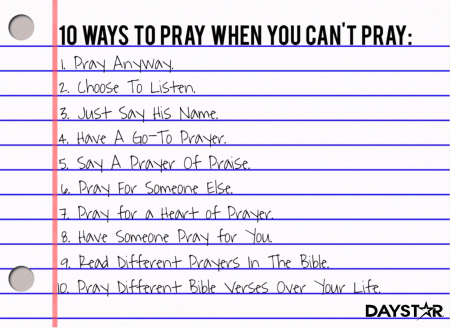
Below we find a way to jumpstart our prayer life. I hope you can use it.

One more thought. “Conversational Prayer” is a good thing for me lately. Talk with Jesus as if He was in the same room with you (He is) and just converse. Share your ups and downs, and it’s okay if you feel messed up. Relax. He’s your Father!

He absolutely loves talking with you.