More Current, Please!

angel1I have always had a crazy connection with electricity. As a young boy of six or seven I started to push nails into the wall outlets of our home. My mom would come in to find me in a heap, with the nail still in the outlet. It would blow me backwards, and I remember “smelling the ozone” from each experience. I did this fairly often. Mom grew very concerned about me.

Then I discovered the shocking world of electric fences. Most were “pulse” currents, which meant they were alternately energized– and then off. If you grabbed it at the right time, you could beat the fencer and not be shocked. Of course, complicating things would be standing on wet grass. But bringing your little brother meant you could grab his hand, touch the wire, and he would get the full voltage. This was always fun.

Coming into the presence of a holy and loving God should be a powerful jolt. But it needs to be real– never theatrical or showy. Whether it is prayer or worship, we reach into a real world. While electrical shock is detrimental, the Holy Spirit is always strengthening and affirming. My prayer the last few months has been this: “May it be the real me who connects with the real You.”

In a nuclear power plant the workers clearly understand the nature of fission. They can’t see it, or feel it. They must take precautions, because what they handle is really dangerous. In 1 Samuel 6, we read of the time when the Philistines controlled the Ark of the Covenant. But the power they received was not anything they could handle or manage. They finally sent it back. “But the Lord killed seventy men from Beth-shemesh because they looked into the Ark of the Lord. And the people mourned greatly because of what the Lord had done. “Who is able to stand in the presence of the Lord, this holy God?” they cried out. “Where can we send the Ark from here?”

God is dangerous, “my Bible tells me so.” My thinking often would regard Him as docile and tame, but I challenge you to understand differently. I submit to you that our faith should put us into a perilous place– one in which we are asked to do outrageous things. Like building an ark, or going from a slave to a prime minister, or getting out of our boat and walking on the sea. Furthermore, the Book of Revelation is John’s account of being in God’s power and majesty (Rev. 15).

“We worship a dangerous God and He is coming to threaten every area of your life.  God is a loving God, do not be mistaken about that.  His love, however, is unlike any human love; its chief concern is not to make you comfortable, but to make you free and to be free is dangerous and the act of making us free is dangerous.” Joe Spann (and below)

electric-shockPlease don’t try to domesticate God.

He is wild and pretty much unpredictable– and we will not ever tame or teach Him. You can’t manage Him, or train Him to use a box. (He will defy this.) If we are truly going to draw close it will be like stepping into a spiritual reactor, or sticking a figurative nail into a metaphorical wall outlet.

“He is about to become dangerous to your everyday trappings, dangerous to your comfort, dangerous to your retirement plan, dangerous to your schedule, dangerous to your social standing, dangerous to your secrets, and dangerous to your religion. The good news is, He is also dangerous to your limits, dangerous to your fear, dangerous to your addictions, dangerous to your sickness, dangerous to your unforgiveness, dangerous to the chains that bind you chains that you have become way too comfortable with.”

The end result of this is that He wants to make you dangerous again; dangerous to your neighbors bondage, dangerous to the pain in the people around you, dangerous to the generations of abuse and pain in your family and the families you know, dangerous to the culture you are in every single day. And He wants to make us dangerous again. Dangerous to our neighborhoods, dangerous to our friends, dangerous to our culture, dangerous to the kingdom of darkness.”

I would like to make a toast, “May you see God as He is truly, and may you stick your nail into direct contact with Him. May you never settle for less, or want for anything more.” Amen.
1brobry-sig4

cropped-christiangraffiti1 (1)


*

How Things Grow, [Work]

plow1930s

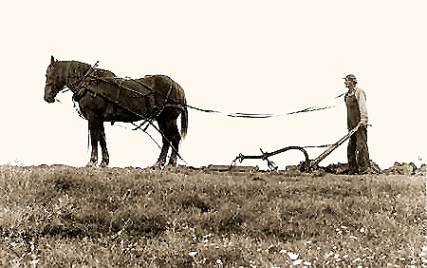
A farmer slowly walks behind his plow. The ground is hard and unyielding, but the steel cuts the heavy sod like a knife. He is preparing the soil for receiving the seed. He knows that what he is doing is imperative and he shouts out to encourage the horse. Its getting late and he wants to cut another furrow before night.

Plodding behind the plow he thinks many things. He can break up the ground, till and fertilize it, sow the seed— and then wait. He is powerless it get the seed to germinate and grow. He is limited to cultivating the soil and waiting. That is all he can really do, and he accepts this powerlessness. He can do everything right, and still not have a crop. All he can do is his part.

The farmer works in partnership with God. He is dependent on Him to grow the seed. The farmer must rely on the weather to meet and engage the planted seed. There are no shortcuts here. He does all he can, and then hopes that it is enough.

Farming is a joint endeavor between man and God. The man does what he has to do. God takes what the man has done and then finishes it. The crop will grow because He wills it. The farmer plays a part for sure, but ultimately God must become involved. Afterall, He makes the seed to sprout and grow.

We can say decisively that the pursuit of holiness in a Christian’s life is a joint endeavor between a believer and God.

Each have made the effort. The Christian does what is necessary, and then the seed is finally sown. It is then up to God to make the seed become the seedling. But each must work to finish the growth.

No one can attain holiness in their life apart from the work of preparation (it’s indeed work). The man must prepare the ground through plowing and cultivating. The farmer works the ground in order to make the ground ready. On the other hand, God provides both the environment and the growth needed to grow the seedling. Both the farmer and God must do their work.

A life of holiness is not automatic. It will never come at measured pace, trickling into our souls at a mechanized rate. (It would be nice if it would). Rather it wheat-field-landscape-picture_1920x1200_79595seems to come, in fits and spurts, sputtering rather than simply flowing.

Holiness is like a steamy Amazon jungle, vibrant and full of life. It is saturated with things living and green. It is not like an arid and sterile desert. Holiness is pulsating and powerful, full of lush growing things.

Becoming a person of holiness is the grandest adventure for the human soul. It defies our tendency to be rigid and legalistic. It is quite the opposite. It is tapping into life itself, and who is up to the task? Our morbid ideas of what holiness are not worthy of what really is.

Yes, to be holy is to work. Just as the farmer must prepare the soil for the seed, we too must guide our plows. God is ready to sow, and we should be ready to be ready. That is if we want to be fruitful and productive.

“Oh, the fullness, pleasure, sheer excitement of knowing God on earth!”

 Jim Elliot

bry-signat (1)

cropped-christiangraffiti1.jpg

Different Ways to Fall Out of a Tree

boy-falling
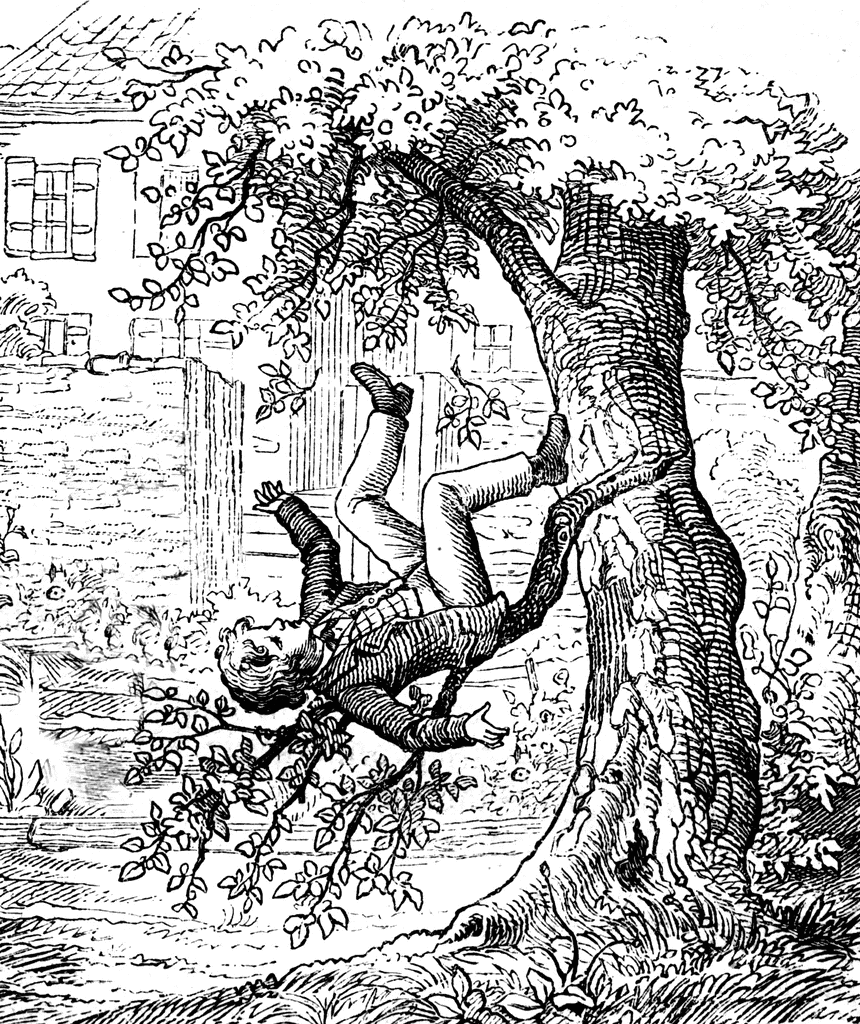
Imagine climbing up to the top of a very tall tree. You work your way up to the highest point– you can go no further. The view is completely glorious, it’s more than you hoped for. You want to post it on Facebook, so you dig into your pocket to get your camera-phone. You suddenly slip, and because your arms are occupied getting your camera, you fall. And you fall fast.

As you plummet, you realize that you’re hitting every branch on the way down. The smaller ones break, and the bigger ones, well– you just bounce off. The trip down is very fast, and perhaps even a bit illuminating.

  1. First, you think of death.
  2. Then you think about the pain each branch causes, and wonder about your imminent arrival on terra firma.
  3. Perhaps you consider how stupid you are, and how you are going to explain it.
  4. Lastly, I suppose, you wonder if you have clean underwear on, like your mother always told you to wear.

This is how my life has gone, the last 20 years. This metaphor is a good way for me to process things, and to find some understanding. I now believe that some of us go through life sideways, or horizontal. We careen off of every branch on the way down, and it seems we are hitting branches that we didn’t even know were there. Tree limbs are snapping, as we are dropping.

Others who are wiser (or maybe more experienced,) try to fall more vertically. As they fall, they use their hands to try to slow their descent. (This does work!) They will take their fair share of jolts, no doubt. But their journey to the forest floor is way less traumatic. They may end up in the hospital– but not in emergency surgery like the first guy.

It sometimes seems like every trouble I have faced I have gone into it sideways. I have broken a lot of branches on my way down. I suppose I’ve entertained some who have watched me plummet, and seen me careen and spiral my way to the bottom. These have been some painful times, I have inflicted considerable amount of bruises on myself.

People who go through life sideways will invariably suffer. They seem to hit every obstacle and trial that could be in their flight path. The existence of pain in this life cannot be disputed.

“I have told you all this so that you may have peace in me. Here on earth you will have many trials and sorrows. But take heart, because I have overcome the world.”

John 16:33, NLT

Jesus understands. Especially if you are one of those people who are “trial magnets” going through life horizontal. (You just seem to collect them.) My hope for you that as you break your branches on the way down (for maybe the 100th time). You will try to plummet vertically. Not that it is any easier, life will hurt. But perhaps it won’t be as agonizing. And I suppose that would be a good thing.

“Now unto him that is able to keep you from falling, and to present you faultless before the presence of his glory with exceeding joy,”

Jude 24

Just hanging on!bry-signat (1)

cropped-christiangraffiti1.jpg


kyrie elesion.

Led Aside by Jesus, [Consideration]

“He took the blind man by the hand and led him outside the village. When he had spit on the man’s eyes and put his hands on him, Jesus asked, “Do you see anything?”

–Mark 8:23, NIV

Here I can imagine the gentleness and the kindness of Jesus–we see Him leading this man out of town to a quieter place. Showmanship?  Not on your life.  Jesus has made the decision to avoid the theatrics of a blind man given sight, and ducked the paparazzi for a moment to touch this man.

In a way, we are all like this blind man.  We stumble around and try to make our way.  But it is raucous confusion– the fields of philosophy, religion, psychology, politics and art are not much more than a blind men tapping with his cane, trying to find their way into the light.  This may be rather simplistic, but I believe it’s more true then we care to admit.  The entire social history of humans is based on confusion and conflict.

We grope in the gloom, and there is none to take our hand and lead us out of the darkness.  We stumble and fall, and come no closer to understanding then when we first started.  It is hopeless.  Our striving borders on madness and insanity.

The blind man in Mark 8 entrusted himself to Jesus’ care.  He willingly went with Jesus, following down the path and out of the village.  Jesus carefully leads him by the hand, which is quite remarkable.  (I guess I’m envious.)  Jesus would have led this man past every obstacle.

Each of us have to encounter Jesus for ourselves.

We are born blind, having no awareness (zero, zilch, nada) of spiritual truth.  We must be taught to see.  At the airport in Salt Lake City recently, I saw a young blind man being led through large crowd.  I was fascinated by his trust in his guide as people jostled to try to make their connections.  There was a quiet composure in him.  (In his place, I would be terrified.)

We must trust Jesus, with that same composure and grace.  When we cannot see, we must trust.

“I do not try to see my way,
Before, behind, or left, or right;
I cannot tell what dangers gray
Do haunt my steps, nor at what height
Above the sea my path doth wind:
For I am blind. 

“Yet not without a guide I wend
My unseen way, by day, by night;
Close by my side there walks a Friend,——
Strong, tender, true: I trust His sight;
He sees my way before, behind,
Though I am blind.”

by an Unknown Author

bry-signat

cropped-christiangraffiti1-3