Is it Wrong to Get Angry with God?

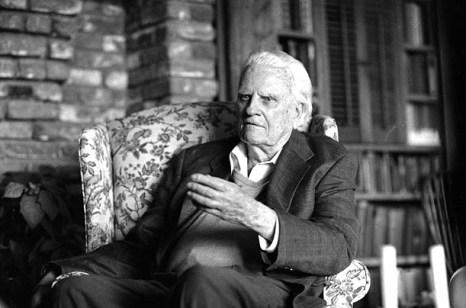
Evangelist Billy Graham

Interview with Dr. Billy Graham

Q: Is it wrong to get angry at God?

I’ve beten through some very hard times recently and I feel like God has let me down. I’d like to get past this, I guess, but right now I can’t help feeling angry at God.

A: The real question is this: Will God get angry at you if you get angry at Him, and refuse to have anything more to do with you?

The answer is “No”! Even when we’re angry at Him, He still loves us and yearns for us to turn to Him for the comfort and encouragement we need. And that’s what I pray you will do.

jonah-sulkingDo you remember the prophet Jonah in the Old Testament? Some have called him “the reluctant prophet,” because he tried to flee when God called him to preach to his enemies. Later (after God sent a large fish to stop his flight), he reluctantly obeyed God and preached to his enemies. To his surprise they repented and turned to God.

He should have rejoiced – but instead “Jonah was greatly displeased and became angry” (Jonah 4:1). Gently God explained to him that He loved even Jonah’s enemies – and so should Jonah. What is the point? Simply this: Jonah was angry at God – but God didn’t reject him. Instead, Jonah needed to learn to trust God, even if he didn’t like what was going on.

Perhaps this is one of the lessons God wants to teach you. Life doesn’t always go the way we want it to. But God still loves us; He loves us so much that He sent His only Son into the world to die for us. Put your life into Christ’s hands, and then ask God to help you begin to trust Him, no matter what happens to you.

_______________________________


 Affectionately known as the “World’s Preacher” for more than 60 years, the Rev. Billy Graham is one of the most influential and respected spiritual leaders of the 20th century. He has been a friend and spiritual advisor to ten American presidents and has preached the Gospel to more people in live audiences than anyone else in history — nearly 215 million people in more than 185 countries and territories — through various meetings. Hundreds of millions more have been reached through television, video, film, and webcasts.

cropped-christiangraffiti1.jpg


Send your queries to “My Answer,” c/o Billy Graham, Billy Graham Evangelistic Association, 1 Billy Graham Parkway, Charlotte, N.C., 28201; call 1-(877) 2-GRAHAM, or visit the Web site for the Billy Graham Evangelistic Association:  http://www.billygraham.org.

Entertainment or Encounter?

14199781_10154058282424102_1430717110717713750_n

“Then he said, “Do not come near; take your sandals off your feet, for the place on which you are standing is holy ground.”

Exodus 3:5

Moses was a man who encountered God in a special way. He was called up a mountain to meet with God for an uniqus purpose.

Isaiah, the disciples at the Transfiguration, Paul and John all had face-to-face meetings with the Lord. From these special times came their power for faith and ministry.

The New Testament believer has access to God’s presence unknown to most believers previously.

“Therefore, brothers, since we have confidence to enter the holy places by the blood of Jesus.”

Hebrews 10:19

Will it be entertainment or an encounter? I wonder sometimes about my own heart. I know there are times when I settle on something else than a meeting with the Lord God, my Father.

Sometimes I wonder about this. Perhaps our pews need seatbelts and our ushers need to hand out life jackets. Maybe a fire extinguisher and a pastor trained in CPR would be wise. Who knows what will happen if God decides to really show up?

He forgives me, and that I suppose the principal thing. He seeks me out to come into His presence. His blood opens the way.

1brobry-sig4 (2)


cropped-christiangraffiti1-3

An Eternity With God, [Get Ready]

eternity-1

18″ So we don’t look at the troubles we can see now; rather, we fix our gaze on things that cannot be seen. For the things we see now will soon be gone, but the things we cannot see will last forever.”

2 Corinthians 4:18, (NLT)

This dear ones, is an awesome verse with some pretty profound implications. The more I marinade in it, the better it gets.

But more importantly, it refuses to give in to the temporary. The earthly reality that swirls around us is brief. Its provisional purpose is an exclusive one; it exists to prepare us for an eternity with God. That hope ‘rewires’ us. We must be prepared for this encounter, we must be changed.

The spiritual realities are the ones that are truly real,

And the ‘Bible truths’ are the ones that are really authentic.

Issues must be settled in the temporary ‘here-and-now.’ You might say, without being too audacious, that we’re being groomed to be royals. And maybe we truly are. Perhaps this is the fuller implication of having eternal life? We seem to be destined for a throne. And God is eager enough to make it happen.

C.S. Lewis writes: “We are so little reconciled to time that we are even astonished at it. ‘How he’s grown!’ we exclaim, ‘How time flies!’ It’s as strange as if a fish were repeatedly surprised at the wetness of water. And that would be strange indeed; unless of course, the fish were destined to become, one day, a land animal.”

Eternity is the real world. It is quite unlike anything else. Our present situation is one of preparation: a new ‘language,’ new attitudes, new relationships– in short, a new life. Someday we will shine like a newly minted penny! And some, are starting to shine already.

C.S. Lewis also wrote, “Creatures are not born with desires unless satisfaction for those desires exists. A baby feels hunger: well, there is such a thing as food. A duckling wants to swim: well, there is such a thing as water.  If I find in myself a desire which no experience in this world can satisfy, the most probable explanation is that I was made for another world. If none of my earthly pleasures satisfy it, that does not prove that the universe is a fraud. Probably earthly pleasures were never meant to satisfy it, but only to arouse it, to suggest the real thing.”

bry-signat


flourish91

Devotions, [Eugene Peterson, Interview]

eugene-petersonInterview with Eugene Peterson

Why Can’t I Hear God? By Nancy Lovell

The musical group U2’s Bono quotes Eugene Peterson from the stage. Readers of the best selling Bible, ‘The Message,’ find themselves holding onto lines from his ‘fog-slicing’ Bible paraphrase, and many other works. For several years now, TheHighCalling.org has provided a daily prayer and reflection by Eugene Peterson. Recently, we asked the man himself: What are devotions and why do they matter in our daily work?

Why do so few people who believe in God bother to know Him?

The most obvious answer is that we’re in a hurry and not used to listening. We’re trained to use our minds to get information and complete assignments; but the God revealed to us in Jesus and our Scriptures is infinitely personal and relational. Unless we take the time to be quiet, in a listening way, in the presence of God, we never get to know him.

The same question is why so few married couples really know their spouses. People get divorced after 20 years of marriage, and the rejected spouse says, “I never knew this was coming. I thought everything was fine.” But there was not much listening in those 20 years. Devotions are the discipline of being quiet and listening for what we don’t hear in the streets, in the media, in the workplace.

What about people who sincerely set apart time, read the Bible, stay still, and hear nothing? They ask themselves whether God’s voice is anything more than their own thoughts.

We’re not good at this. We’ve had no practice doing it. No wonder we only hear our own thoughts. This is why the church is so insistent that we do this whether anything happens or not. Supported by 2000 years of history, we know that God does commune with us in our listening. But because we’re so unused to this way of communion, we don’t hear it. So it takes time.

How would you direct someone trying to start?

I would say: Get your Bible and find a place. If you can’t do this daily (some people can’t because of their life circumstances; mothers with young children are obvious instances), try for at least 20-30 minutes, two or three times a week, or four. Don’t make demands on yourself too high. Don’t ask questions about, “How long is this going to take?” Believe that something does happen in that silence—usually through Scripture, but not always—in prayerful, attentive listening, knowing that you’re in the presence of God.

I ask for a commitment of six months; so don’t come back in three weeks and say nothing’s happened. I’ve never had anyone who’s done this at least six months who came back to me and said, “I did it and nothing happened; I’m going on to something else.” Not many who give this a fair test ever say that nothing happens. Also, when I’ve asked people to do this as their pastor, I also ask them to worship regularly. This is a place where the whole community is gathered and listening and being in the presence of God.

Is that how you started?

I was lucky. In the family I grew up in, I started when I was about 14 …mostly with the Psalms, but all the Scriptures become part of it.

In your writing and speaking, you must have seen moments when a person realizes, “Yes, I want more and I want God.” What turns on the light for people?

Often the motivation is that people are tired of the way they’re living. They think there’s got to be more than just the motions they’re going through and the work they’re doing. There’s a craving and hunger that they identify with God. There’s enough pain or boredom or something to motivate them to do something that the culture’s not telling them to do. I got a letter recently from a friend of 40 years. She had been a parishioner of mine for a long time. Then she was ill, and divorced; and she quit, just gave up. She quit reading the Bible, quit going to church. Six months ago she wrote me a lovely letter that she was sitting with a group of friends and, in her words, “a rooster crowed”—it all came back and she was a Christian again and aware of the presence of God. Isn’t that a wonderful phrase? ‘A rooster crowed.’

Who knows what went into that statement of hers? Twenty years of unhappiness, pain, suffering, disillusionment …but still there was the need.She would have said during that time she didn’t believe in God. But the rooster crowed. That’s why we use the term the Holy Spirit to explain times like this. Given that it’s hard to discipline ourselves to silence, listening—and to daily time in quiet—tell us about your devotions on this website. I wrote those in the early morning for 20 years, maybe 25 years. And what I was trying to do was be present to the Scripture, listen to God, and to write as honestly as I could. I wasn’t thinking about anybody else but me.

It’s really hard to be honest as a writer. You get these wonderful ideas, and you love to manipulate words and see if you can make it sound good. It’s hard to be honest, especially working for God. That was the thing I was most aware of. “Eugene: Don’t say anything that is not relational, immediate, honest; stay present to the text and be honest before God.” I believed if I could be honest, I could draw some other people to honesty, too.

To read the rest of this interview, you will need to follow this link: http://www.christianitytoday.com/workplace/articles/interviews/eugenepeterson.html

 

cropped-christiangraffiti1-3