Walking the Wire Again

I hope everybody can find a little flame
Me, I say my prayers,
then just light myself on fire
and walk out on the wire once again.”  

Counting Crows, “Goodnight Elizabeth”

Hope is a powerful thing— nothing compares. It truly is the ‘anchor of the soul.’ Without it, life would be hopeless, and that is intolerable to a human being.

We will implode without hope. The psalmist was well aware of this tendency; he speaks to himself about this. He ‘talks to himself’ which can seem a little weird to some.

“Why are you discouraged, my soul?
    Why are you so restless?
        Put your hope in God,
            because I will still praise him.
                He is my savior and my God.”

Psalm 42:11

Day-to-day life can be arduous. Sometimes faith falters and hopelessness becomes a real and deadly option. For those of us with debilitating illnesses this can be significant hazard. Depression can severely hinder us.

The writer of Psalm 42 understood this. Discouragement was a real issue, especially when he wondered what was swirling around him. (And I daresay he is not alone in this.)

He insists a certitude. He refuses to give in to the idea that failure is final. He will not allow himself to accept the finality of hopelessness. He will not surrender himself to this idea that ‘all is lost.’ The way he battles back is seen in an inner conversation with his soul. He speaks to himself directly concerning the great faithfulness of God to his situation.

It is real, it’s definitely not fluff. He operates in reality. He can’t pretend that the feeling of despondency is imaginary, it is far too cruel and real for it not to be.

However having a hope will cement me in the goodness and mercy of God. It is the sterling silver (.925) belief that He cares for me. The verse in 42:11 ties in with praise and worship. This is not a minor thing. When we praise, we break the bonds of hopelessness, in a way that our souls can know, and appreciate. It decisively disarms the depression, and fills the embattled soul with hope.

Pain can be a powerful indicator of depression unchecked. But hope changes the manner of which we live.

–John Piper

I wish you the best even as the battle intensifies. Jesus is enough. Look around, see Him and run right to Him. Your faith will hold you.

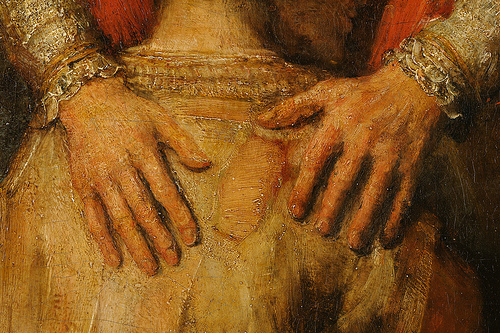
Rembrandt’s Prodigal Son

Rembrandt-The_return_of_the_prodigal_son
Rembrandt, “The Return of the Prodigal Son,” c. 1661

17 “But when he came to himself, he said, ‘How many of my father’s hired servants have more than enough bread, but I perish here with hunger! 18 I will arise and go to my father, and I will say to him, “Father, I have sinned against heaven and before you. 19 I am no longer worthy to be called your son. Treat me as one of your hired servants.”’ 20 And he arose and came to his father. But while he was still a long way off, his father saw him and felt compassion, and ran and embraced him and kissed him. 21 And the son said to him, ‘Father, I have sinned against heaven and before you. I am no longer worthy to be called your son.’ 22 But the father said to his servants, ‘Bring quickly the best robe, and put it on him, and put a ring on his hand, and shoes on his feet. 23 And bring the fattened calf and kill it, and let us eat and celebrate. 24 For this my son was dead, and is alive again; he was lost, and is found.’ And they began to celebrate.

Luke 15:17-24, ESV

Two hundred and eighty-nine words– these describe the life of every man, woman, and child who has ever lived. These 289 words reveal to us a God who loves far too much, way too easy. Perhaps we sort of expect that he will ‘appropriately’ punish his son– at least put him on probation at least. It only makes sense. But we find that is legalism talking.

“Every saint has a past, and every sinner has a future.” 

Many of us have lived as prodigals, and we have spent our inheritance like ‘drunken sailors.’ We really have nothing at all to show for it. The prodigal, completely destitute, takes the only work he can find. (Imagine a good Jewish boy feeding hogs.)

He is so far gone that he starts inspecting the filthy slop buckets for something to eat.

Many of us will understand his despair. Often there comes to us a crystalline moment of simple awareness. The prodigal, sin-crusted and impoverished, still has a lingering memory of the Father’s house.

The servants there had far more than him right now. Sometimes I wonder if in our captivity, we instinctively want to go home, if only in our minds, to be a servant there.

The Father has dreamed of this precise moment.

The parable says, “He saw him–felt compassion–ran out to him–embraced him–and kissed him.” The Father is a whirlwind of agape love. I’ve read the Parable of the Prodigal Son a hundred times or more. It never loses its punch. I simply want to bring some observations: 

  • We see that his father receives him with a tender gesture. His hands seem to suggest mothering and fathering at once; the left appears larger and more masculine, set on the son’s shoulder, while the right is softer and more receptive in gesture.
  • The son’s head is downy, almost like a newborn’s. We must enter the kingdom like little children. 
  • The Prodigal Son seems to be protected by his father. He snuggles near the Father’s breast. It’s love that holds him there.
  • Consider his sandals. It has taken a long time for him to come home. 
  • Standing at the right is the prodigal son’s older brother, who crosses his hands in stoic judgment; we read in the parable that he objects to the father’s compassion for his brother.
  • We see his mother in the background in the painting, and a seated steward or counselor. One stands in profound joy, the other in sits in stunned perplexity.

But Rembrandt had painted the Prodigal once before, when he was considerably younger. And it is a very good painting. The prodigal is happy and gay; there is absolutely no indication of the consequences of sin.

The Prodigal Son in the Brothel, 1635

He’s a charming young man at the height of his popularity, and we see him at a happy party. He is spending the inheritance of his father.

But Rembrandt chooses at the very end of his life to re-paint it to reflect reality.

This is one of the last paintings he will do, and it is the Prodigal Son–destitute and repenting. I can only imagine; the years have taken a toll and he doesn’t really feel his first painting is enough. He wants to paint what is true.

He now is painting our spiritual condition.

We are given a work that some critics call as the greatest painting ever completed. The painting is now in St. Petersburg, Russia. It is seldom seen by visitors. It is a clear echo of the grace of God for fallen men and women. Like the father in the painting, He’s ready to forgive every sin saturated son and daughter.

The Father’s Prodigal

bry-signat (1)


The Deep Pit

“I waited patiently for the Lord to help me,
    and he turned to me and heard my cry.
He lifted me out of the pit of despair,
    out of the mud and the mire.
He set my feet on solid ground
    and steadied me as I walked along.”

3″He has given me a new song to sing,
    a hymn of praise to our God.
Many will see what he has done and be amazed.
    They will put their trust in the Lord.”

Psalms 40:1-3, NLT

Psalm 40 is jam packed with great and wonderful truth. It contains freedom for the Christian– a way out for the broken believer. We do well when we use it, and that’s what it’s there for. The deep pit has been used over many centuries as the way God teaches us to sing certain songs. But that doesn’t make it easier, does it?

Verse 1

I waited patiently for the Lord to help me, and he turned to me and heard my cry.

Waiting is a critical word, it should not be regarded as trivial. In our daily walk we must be patiently seeking the Lord, that comes first. Admitting you need help is the first step. And guess what? You need help. 😁

The word ‘wait’ is special, it’s kawvah in Hebrew. It can mean ‘to bind together by twisting.‘ It can be used with the idea of braiding strands of rope together. It is never a passive act that just happens. Waiting on God is to be done with intentional purpose.

Remember that the Lord is not some distant deity on a hill far away.

He’s not hiding from you. It’s really quite the opposite.

He is closer to you than you think. He is responsive and aware. He hears your cries and wants to act; He is not deaf, but our patience is critical. Waiting on Him is crucial to being free. We must bind and twist our hearts and live our life to His desires.

Verse 2

He lifted me out of the pit of despair, out of the mud and the mire. He set my feet on solid ground and steadied me as I walked along.

The seeable terrain can be awful, with muddy paths and mucky pits. Things that pull you down and suck you in. They’ll trap the traveler. But the Holy Spirit is quite able to lift us out. He picks us up and secures us. He uses the rope of God’s Word.

He is way more willing to save us, than we are to being saved.

Solid ground is where we are meant to be. It’s become a place of firm standing and secure footing. He makes us steady and He keeps us safe. The Holy Spirit now has intimate care over your soul.

Verse 3-4

“He has given me a new song to sing, a hymn of praise to our God.

Many will see what he has done and be amazed. They will put their trust in the Lord.

Some of the greatest songs are the ones that come from those just delivered from the pit.

These are ‘pit songs,’ offered to God from sincere and true hearts that have once been trapped. There’s something solid heard from the hearts of those redeemed from disaster.

These songs no longer sound religious or contrived.

“YOU CAN SEE GOD FROM ANYWHERE IF YOUR MIND IS SET TO LOVE AND OBEY HIM.”

A.W. Tozer

From our deepest pits come our greatest praises.

There is a passionate quality that saturates these ‘pit praises’ that is highly treasured by God, and esteemed and valued by the Church– a sense of authenticity starts to be finally heard. We can finally start to see that our pits become ‘launching pads’ of true songs of deliverance.

When Brutality Smashes Into Grace

photo, by Jonny Jelnek- Flickr

“Don’t waste your pain; use it to help others.  Your greatest ministry will most likely come out of your greatest hurt.” 

Rick Warren

Nothing I can say will cause your pain to go away. Any words or counsel are nice but weak when applied to that grievous wound or disability. Fellow believers will want to guide you, they mean well. They love Jesus and their hearts are good. I know this.

But it can be like two Tylenol to a man with a broken leg.

Pain, in every way I can think of, is always evil. It raises its head to either nibble at our edges or devour us completely.

I have friends who struggle with migraines and others with Lou Gehrig’s disease.  A few friends have been incredibly injured, and a few others have impaired disabilities.  Two or three have severe diabetes. One has a painful degenerative hip syndrome.  Also, I have a dear elderly saint in her later stages of Alzheimer’s. One of my friends has cerebral palsy. 

(Enough already?!)

I must tell you I also walk in chronic pain and am permanently disabled. My own discipleship hasn’t been easy. Pain has only shown me my need to invite His powerful presence of Jesus, and to become fully His. I’m learning this.

We who hurt deeply are given the option of becoming truly gentle people. 

Gentleness is not an easily given gig– the lessons can be rude and hard and even with possible tears. Faith lifts the rough veil of this ugly circumstance and finds the merciful God beaming with love.

And we are taught the hard reality of human beings. Looking eye to eye we connect with people and grasp their struggling lives. We see their needs and want to alleviate pain.  We want to serve and give and love, finally.

Love shows me how it should be done; and suddenly a profound mystery, I’m loving like Jesus! I’m doing what He would do. Our hearts swell at this revelation. We understand. 

And our hearts will decide that issue. Is it real?

So few really understand and discern, and even fewer can help you. Love them all. Love Jesus. Stay broken, gentle, and faithful to Loving Father.

A few years ago some asked me if I had the faith to be healed, they challenge us, “where’s your faith, brother?” 

Hmm. But what about having faith in God even when you stay sick? To actively trust the special kindness of Him no matter what?  

If you had never known afflictions in your own life, how do you think that you can properly touch those ‘nail-scarred’ hands which Jesus meets you with?  And the apostles, and all those martyrs from every generation in an unbroken line of suffering. 

And what about their crosses?

Our own?? 

“Ah, afflicted one, your disabilities were meant to unite with God’s enabling, your weakness to combine with His power. God’s grace is at hand –sufficient– and at its best when human weakness is most profound.”

F.B. Meyerbry-signat (1)