How Things Grow, [Work]

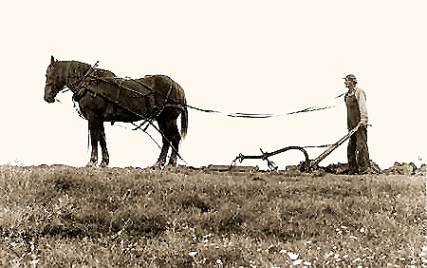
plow1930s

A farmer slowly walks behind his plow. The ground is hard and unyielding, but the steel cuts the heavy sod like a knife. He is preparing the soil for receiving the seed. He knows that what he is doing is imperative and he shouts out to encourage the horse. Its getting late and he wants to cut another furrow before night.

Plodding behind the plow he thinks many things. He can break up the ground, till and fertilize it, sow the seed— and then wait. He is powerless it get the seed to germinate and grow. He is limited to cultivating the soil and waiting. That is all he can really do, and he accepts this powerlessness. He can do everything right, and still not have a crop. All he can do is his part.

The farmer works in partnership with God. He is dependent on Him to grow the seed. The farmer must rely on the weather to meet and engage the planted seed. There are no shortcuts here. He does all he can, and then hopes that it is enough.

Farming is a joint endeavor between man and God. The man does what he has to do. God takes what the man has done and then finishes it. The crop will grow because He wills it. The farmer plays a part for sure, but ultimately God must become involved. Afterall, He makes the seed to sprout and grow.

We can say decisively that the pursuit of holiness in a Christian’s life is a joint endeavor between a believer and God.

Each have made the effort. The Christian does what is necessary, and then the seed is finally sown. It is then up to God to make the seed become the seedling. But each must work to finish the growth.

No one can attain holiness in their life apart from the work of preparation (it’s indeed work). The man must prepare the ground through plowing and cultivating. The farmer works the ground in order to make the ground ready. On the other hand, God provides both the environment and the growth needed to grow the seedling. Both the farmer and God must do their work.

A life of holiness is not automatic. It will never come at measured pace, trickling into our souls at a mechanized rate. (It would be nice if it would). Rather it wheat-field-landscape-picture_1920x1200_79595seems to come, in fits and spurts, sputtering rather than simply flowing.

Holiness is like a steamy Amazon jungle, vibrant and full of life. It is saturated with things living and green. It is not like an arid and sterile desert. Holiness is pulsating and powerful, full of lush growing things.

Becoming a person of holiness is the grandest adventure for the human soul. It defies our tendency to be rigid and legalistic. It is quite the opposite. It is tapping into life itself, and who is up to the task? Our morbid ideas of what holiness are not worthy of what really is.

Yes, to be holy is to work. Just as the farmer must prepare the soil for the seed, we too must guide our plows. God is ready to sow, and we should be ready to be ready. That is if we want to be fruitful and productive.

“Oh, the fullness, pleasure, sheer excitement of knowing God on earth!”

 Jim Elliot

bry-signat (1)

cropped-christiangraffiti1.jpg

God Will Sustain You

elijah-2

“Some Christians are called to endure a disproportionate amount of suffering. Such Christians are a spectacle of grace to the church, like flaming bushes unconsumed, and cause us to ask, like Moses: ‘Why is this bush not burned up?’

The strength and stability of these believers can be explained only by the miracle of God’s sustaining grace. The God who sustains Christians in unceasing pain is the same God — with the same grace — who sustains me in my smaller sufferings. We marvel at God’s persevering grace and grow in our confidence in Him as He governs our lives.”

— John Newton, 1725-1807, Author of “Amazing Grace”

“The angel of the Lord appeared to him in a blazing fire from the midst of a bush; and he looked, and behold, the bush was burning with fire, yet the bush was not consumed.”

Exodus 3:2, NASB

u

u

cropped-christiangraffiti1-3-1

Discernment and Your Ministry

zebras

“He begs God on behalf of a human
as a person begs for his friend.”

Job 16:21, NCV

I’ve been thinking about a class I had in Bible School.  The instructor made a comment that has stuck in my thinking for over 30 years now.  I have relied on it countless times in ministry since. It has helped me piece together certain issues of the heart.

When we “preach” to a person, we are actively accelerating the judgement of God in their life. When we pray for that same person, we delay this judgement and allow more room for the Holy Spirit to work.


Preaching

Now I know this is a generalization, and yet the basic premise of preaching and praying has a specific action.  When you preach, you are calling that person to make a decision.  They meet up with the truth and must decide for themselves.  This is a very sensitive moment.  If they consider your message at all– you must understand, one way or the other, that it will require a decision.  Either they act on it, or they’ll decide to reject it.

Within the Bible we often see judgement coming to someone, and very often it comes right after a “declaration of the truth” by a witness or a sermon.  Those who hear the word must choose to believe it, or spurn it.  Even a neutral position is a position. A decision must be made on all light that comes their way.

Prayer

Perhaps this may be easier to see.  The Word is full of men and women who interceded for others.  If preaching accelerates God’s judgement on a person (or group,) than prayer decelerates it.  In a sense, authentic intercession can give them more time.  It delays things, without approving them.

A classic case is Abraham.  He intercedes, and by doing so desires to save and deliver God’s own.  He “stands in the gap” for the unaware.  We see him “negotiating” with the Lord, trying to make a deal of sorts. He is bold and somewhat presumptuous. And actually, this is a regular occurrence with different circumstances.  Many in scripture do seem to get intensely involved in the lives of the people they represent.

“I will surely not stop praying for you, because that would be sinning against the Lord. I will teach you what is good and right.” 

1 Samuel 12:23

 Conclusion

Should we preach or pray?  We must consider, I think, the certain obligations of both.  I believe at the end of a person’s life, they have had both dynamics working.  Its like the tide– it ebbs and then advances, and perhaps that will help us to do the right thing at the right time.  We understand the necessity of preaching, and just as important the work of prayer.  We must do both, but grasp the issues behind each work.  Both are necessary for one to come to faith in Jesus.

Seeing the effects of our actions brings us into a deeper understanding of the life in the Spirit.  It motivates and will guide us.  We start to understand the Lord’s ways and become aware of what is happening in the world that is around us. This new discernment can only sharpen our work.

bry-signat

flourish9


What is it for you to be a Christian? –J.R. Miller

What is it for you to be a Christian?

We ought to seek to gather in this world — treasure that we can carry with us through death’s gates, and into the eternal world. We should strive to build into our lives — qualities that shall endure. Men slave and work to get a little money, or to obtain honor, or power, or to win an earthly crown — but when they pass into the great vast forever, they take nothing of all this with them!

Yet there are things — virtues, fruits of character, graces — which men do carry with them out of this world. What a man IS — he carries with him into the eternal world. Money and rank and pleasures and earthly gains — he leaves behind him; but his character, he takes with him into eternity!

This suggests at once, the importance of character and character-building.

Character is not what a man professes to be — but what he really IS, as God sees him.

A man may not be as good as his reputation. A good reputation may hide an evil heart and life. Reputation is not character. Reputation is what a man’s neighbors and friends think of him; character is what the man IS.

Christ’s character is the model, the ideal, for every Christian life. We are to be altogether like Him; therefore all of life’s aiming and striving should be towards Christ’s blessed beauty. His image we find in the Gospels. We can look at it every day. We can study it in its details, as we follow our Lord in His life among men, in all the variations of experience through which He passed.

A little Christian girl was asked the question,What is it for you to be a Christian?

She answered, “It is to do as Jesus would do, and behave as He would behave — if He were a little girl and lived at our house.”

No better answer could have been given. And there is scarcely any experience of life — for which we cannot find something in Christ’s life to instruct us. We can find the traits and qualities of His life, as they shine out in His contact . . .
with temptation,
with enmity,
with wrong,
with pain,
with sorrow.

The next thing, when we have the vision of Christ before us, is to get it implanted into our own life. We cannot merely dream ourselves into godly manhood or womanhood; we must forge for ourselves, with sweat and anguish, the beautiful visions of Christ-likeness which we find on the Gospel pages! It will cost us self-discipline, oftentimes anguish, as we must deny ourselves, and cut off the things we love. SELF must be crucified.

It is not easy to become a godly man, a Christlike man.

–J.R. Miller, (1840-1912)


cropped-christiangraffiti1-3-1