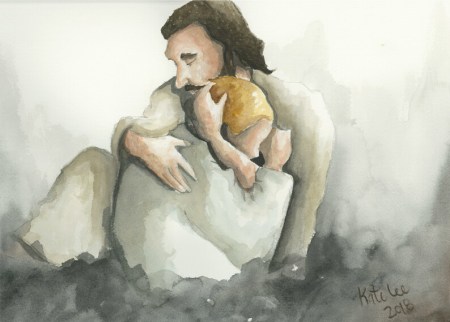
Jesus Wept

When I was a kid I learned no one wanted to hear me cry.

When I was little, I had a temper like a small hurricane. I didn’t like to be teased and would become angry and cry if anyone teased me. I was always told, “Go to your room and cry. No one wants to hear you crying.” So I did.

But my temper tantrum just didn’t end there.

You see, the way our house was designed, my bedroom was, I think, supposed to be a family room. It had two doors opposite one another so that it functioned as a hallway between the dining room and the back hallway where the bathroom and other bedrooms were. When I was sent to my room, I would run into the room and slam one of these two doors.

Because of some principle of physics that I don’t even remotely understand, the door would not completely close and the slamming would cause the other door to fly open and hit the closet. So then I would run over and slam that door, with the same result, until my mom yelled, “Quit slamming those G** damned doors!”

The belief that no one wanted to hear me cry or witness my temper tantrums stuck with me for a long time. The way I always interpreted that statement was that no one cares how I feel. When bad things happened to me later in life, I told no one because I didn’t think they would care. When I was the most depressed, I kept it a secret because I was ashamed of feeling so bad and didn’t want to waste anyone’s time.

It turns out that many of the things we learn as kids just aren’t true.

This is one of those things. Okay, so maybe there are people who don’t care. A lot of them. But there are also people who do care. People, like me, who when they ask “How are you?” they really want to know, even if how you are is horrible. The world is full of loving, compassionate people who have struggled just like you and me, and want to help us find a way through the temper tantrum of the day.

And even if you can’t find anyone in your life who cares, Jesus cares.

John 11:35 records that “Jesus wept.” Why was He weeping? Not because Lazarus was dead, for He knew death was not the end of Lazarus. Jesus wept out of compassion for those who mourned the death of Lazarus.

In 1 Peter 5:7, the apostle wrote, “Cast all your anxiety on him because he cares for you.” He really does, you know. And so do His followers, though sometimes they don’t know how to show it.


Messed Up People

Elijah was suicidal. Job wished he had never been born. David understood deep depression. Moses was anxious. Hannah was barren. Jonah was angry. Paul was all alone in a prison cell.

And actually, this is only a brief list. The Bible is loaded with flawed people who stumbled trying to be faithful. God uses imperfect people, because there really isn’t any other kind to be found. And there were others.

Noah got spectacularly drunk. Abraham lied. Jacob repeatedly deceived others. Rahab was a whore. Samson lusted. David committed adultery and was a murderer. Peter denied Christ.

Why does God favor and love people who are so disturbed? Honestly, none of us measure up. It seems He uses the weak to carry out a plan and a purpose of redeeming others, and establishing a Kingdom. He takes messes and gives them His message.

He is Love– 100% of the time, and He loves you, and He loves me, He loves the world. (John 3:16.)

Messed up people of faith become instruments and vessels of grace to other messed up people. We carry a treasure that is not ours. Sometimes it takes years to see this. I hope you can understand this. I hope it doesn’t take long.

And nothing is ever really wasted. Our mistakes (sins) become useful things to Him. For example, David’s sin would be transformed into Psalm 51 and 32. Yes, his disobedience had consequences, I won’t dispute that, but something wonderful also came when he repented.

David paid an awful price for his sin. That disobedience almost destroyed him. Not only did it separate him from God, but his family felt the effects of his evil actions.

Yes, you need to repent. But when sin is destroying you, it does seem you need to turn from it, and leave it now.

The first two verses of Psalm 51 can bring tears when we finally understand their profound beauty, for they came out of David’s personal evil:

Psalm 53:1-2, ESV

For thousands of years people of real faith have come and drawn beauty and grace from this song. David knew his sin was real, and incredible pain emerged from that, but the Psalm did also.

Please do not try to hide or excuse your sin, it always has the most awful consequences.

Broken people can be forgiven, redeemed and used. Sometimes I think God gets special enjoyment out of picking the worst and patiently loving us to wholeness. If you really know Him, and know your flaws, you’re well on your way of usefulness in His kingdom.

“But we have this treasure in jars of clay, to show that the surpassing power belongs to God and not to us.”

2 Corinthians 4:7

Testimony of the Scars

At the crucifixion, Jesus suffered incredible pain.

He was beaten, flogged, spat upon, and had a crown of thorns jammed into his brow. Then He was nailed to the cross through His feet and hands and then pierced in the side with a spear causing blood and water to flow from His body. He was covered in welts, bruises, and blood so that He was almost unrecognizable.

After His resurrection, He appeared to His disciples in the upper room.

The welts, bruises, and blood were gone. His body showed very little of the pain and suffering He had endured. He did not have scars on His face or across His back. He was once again beautiful. His resurrected body testified to the resurrection we will all one day know with new, healed bodies that are once again beautiful, even in our own eyes.

The exceptions to this miraculous healing of His body were the nail scars on His hands and feet, and the scar from where He was pierced with the spear.

“Then he said to Thomas, ‘Put your finger here; see my hands. Reach out your hand and put it into my side. Stop doubting and believe.’”

John 20:27 (NIV).

These scars testified to His death and suffering on the cross. They testified to the love and mercy we find there. They testify even now to the greatest gift God has ever offered mankind: the knowledge that He was one of us, faced death as we do, and came out on the other side victorious as we one day will be if we trust in Him.

We all experience suffering and injury.

We all bear scars, some physical, and others emotional or spiritual. We tend to hide our scars from the world, thinking we are the only ones who bear them. But that’s not exactly true.

Our own scars long to testify to the love and mercy of a God who saw us through our trials and helped us come out victorious on the other side. They long to testify that we were not defeated because God was on our side.

What if, instead of hiding our scars from the world, we shared them for all to see just as Jesus bid Thomas touch the scars on His palms and His side? What if we let our scars testify to the love and mercy of our God? What if we helped share the greatest gift God has ever given mankind, a gift that our scars testify to?

What victory do your scars testify to? Please dear one, share it with others. People are waiting to hear from you.

Take a look at my own website. You’ll be blessed I think–anotherfearlessyear.net.

Walking in the Darkness

  • We are afflicted in every way, but not crushed
  • perplexed, but not driven to despair
  • persecuted, but not forsaken
  • struck down, but not destroyed;

2 Corinthians 4:8-9, ESV

The issues we face can be formidable. Our relationships and our circumstances can bring daunting obstacles to joyful Christlike living. We live out at times from unpleasant realities and less than ideal situations. We are broken believers who follow Jesus through our deadly minefields.

Struggling with mental illness is just as much a challenge as with any other handicap. The young man struggling with bipolar disorder or someone else who faces a clinical depression, may seem to be tangled up in something quite brutal and very hopeless. “Will I ever find normal again?

I know that struggle and at times it has ripped me apart. But I suppose the grinding hopelessness is the worst part of that.

I want to encourage you in this. The issues we face on a daily basis are hard. And we don’t minimize their complexity or diminish their bitterness. They can be awful. But the Holy Spirit is with you in the midst of your issues. That’s a promise.

There is a wisdom emanating from the fire. It’s only waiting for discovery. The flames can not destroy us when God shows up.

I believe that the constant presence of difficulty produces a faith and tenderness that can’t be just prayed for.

The most kind and gentle people are those who themselves have been afflicted.

Please understand we have a real challenge. We have to walk through the trials or tests, not around them. We see a mountain, and God gives us a shovel. But He also gives us the strength we need.

But I’ve discovered a tenuous joy in these issues— more precisely, a joy because of them. Our illness is not meant to destroy us. That is not why God has allowed you to be afflicted.

I definitely did not choose this path I’m on.

Think about Jesus’ great love for people with hard issues:

Luke 7:21

Jesus has special spot for the afflicted, we see him repeated touching them. He drew them like a magnet draws iron. And he is the same today in our time. It is comforting to know that he cares for us and that we are understood. Let him draw you into his caring presence.

Our disabilities do not trouble him. Yes, I know the issues are formidable. But your obedience in them is an exquisitely special commodity to Jesus. I believe He values the shaking faith of broken people far more than the happy shiny people with no pain or scars.

Faith is precious in his sight and holds its value for all eternity.

Understanding this should be a cause for joy for the broken believer. Having the lightness of heart, right in the middle of our disability, often transforms these issues into a lighter burden. We are  beaten but not totaled. Incredibly challenged but not completely devastated. The apostle wrote this in his letter to the Corinthians, and it gives us hope.

I have learned that if I can bless a difficult thing it will bless me.

If we curse it and it will curse us. If you bless a situation, it has no power to hurt you, and even if it is troublesome for a time, it will gradually fade out, but only you can only sincerely bless it.  

There’s a deep joy waiting for those who choose to do this.

I guarantee it!