Faith: Make Me Thy Fuel

“Give me the love that leads the way, The faith that nothing can dismay, The hope no disappointments tire, The passion that will burn like fire, Let me not sink to be a clod: Make me Thy fuel, Flame of God.”

– Amy Carmichael

“Seek not to understand that thou mayest believe, but believe that thou mayest understand.”

 –Augustine

“Faith, as Paul saw it, was a living, flaming thing leading to surrender and obedience to the commandments of Christ.”

  –A.W. Tozer

“Faith shows the reality of what we hope for; it is the evidence of things we cannot see.”

Hebrews 11:1


Melancholy in Amber

melancholy-1874halfhd

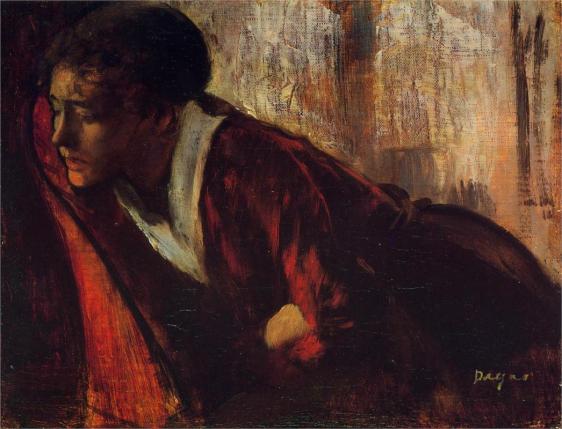
Edgar Degas, Melancholy/ c. 1874, oil on canvas, Phillips Collection, Washington D.C.

The sadness flows from this painting. Degas caught the dark despondency of his model. Her inertia becomes something we can gaze on carefully and at leisure.

This is one of my favorite paintings. For me, it captures an essence of what depression “looks” like. The anguish and the whole sense of being is seen in the expression of her face. She is frozen in her despair.

Depression immobilizes and then lays waste all that it touches. It is a vicious blight on the human soul.

amberI remember as a boy seeing a prehistoric bug caught in amber. It struck me as a bit macabre. This poor insect frozen for all to see.

Little did I realize that this was going to happen to me.

For almost 20 years I’ve tangled with clinical depression. It was initiated by a brain tumor in 2002 and has been evident since then.

Depression to me is like being frozen in a deep sadness that clings to my soul. It shows me no mercy when it is active, but I can go several weeks at a time without it being an issue.

There is a dual aspect to this. My experience is like a complete suppression of the good and optimistic, combined with an increase of despair and despondency. I despair of any future good that might occur. Everything becomes bleak and black.

My life becomes a meltdown; a cascading effect of worsening feelings.

A few points that have helped me:

  • A main point for me is to doubt the “certainties of despair.” I believe that God’s promises to me contain a “future and a hope.” This is vital. At times I feel too far gone, and completely irredeemable. I must doubt the lies of the enemy.
  • Freedom come through a real faith in God’s grace. I believe that His Holy Spirit empowers the weak. He holds my hand as I stumble in the path. My confidence is in His promises to this “weak lamb.”
  • Scripture tells me that Jesus’ present ministry is one of intercession for my soul. “Who then is the one who condemns? No one. Christ Jesus who died—more than that, who was raised to life—is at the right hand of God and is also interceding for us” (Rom. 8:34.)
  • Jesus has the power to keep His flock. He also gives me a few select companions. I meet with some of “my fellow sheep” at my local church. These know me, and their friendship encourages me. They don’t condemn.

I hope that some of this helps, if anything I hope you have a window into my convoluted faith. I don’t want pretend to have all the answers. I’m not a guru. I’m a “work in progress,” and some ways far behind you, the reader.

“Wherefore he is able also to save them to the uttermost that come unto God by him, seeing he ever liveth to make intercession for them.”

Hebrews 7:25

ybic, Bryan


cropped-christiangraffiti1 (3)


The Judas’ Kiss

The Judas Kiss

“Judas came straight to Jesus. “Greetings, Rabbi!” he exclaimed and gave him the kiss.”   

Matthew 26:49

Kiss–  verb (used with object)  1. to touch or press with the lips slightly pursed, and then often to part them and to emit a smacking sound, in an expression of affection, love, greeting, reverence, etc.:  He kissed his son on the cheek. 
   –Dictionary.com
“A man’s kiss is his signature.”
Mae West

This singular verse (v. 49) should cause us to pause and think. It is part of an amazing account of the events surrounding the death of Jesus.  At this point Judas leans over and kisses him. Now, a kiss can be used when you show affection and commitment for someone. Kisses are like a ‘x-ray’ into your very being, opening and quite revealing.

Judas shows everyone exactly what he is all about.  The kisser declares to the kissed the intent and desire of their heart. It also says things to those who witness it.

This kiss of Judas set into motion a whole series of events.  But more importantly, this kiss was an evil kiss.    We kiss and are kissed.  Its the way we tell others of our friendship and fidelity.  It has always been so.  The mechanics of it all seem a bit odd, when you think about it.  Touching lips?  (Ok. That’s odd.)  But a real kiss goes further, injecting love and esteem and other intangibles into another.

Also, we should understand that a kiss has intense power.  The kiss of Judas had this power.  It wasn’t done to convey his commitment or affection, rather it was a powerful act of betrayal.  Judas had drained this particular kiss of all its goodness and only evil remained. 

It very well could be that Judas was attempting to manipulate a sequence of events to allow Jesus to become the messiah/king by force.  He may have thought that this was a politically expedient thing to do.  Maybe a good thing in his thinking. (But who can know?)

A “Judas kiss” is perhaps the most dastardly way one can be betrayed.  It is not real common, but it happens, and it is devastating.  Some have told me that it was like having your heart ripped out of your body.  Betrayal with a “Judas kiss” is almost always a surprise, coming out of the blue, hitting you when you’re most vulnerable.

The English poet Milton envisioned hell with many levels.  The very deepest level is reserved for Satan.  Interestingly, Milton puts Judas at the bottom with Satan.  They share the punishment of hell together, forever.  I guess that this is as awful as it can get.    In studying the character and the sin of Judas the following lessons may be brought out:

  1.  We must not be surprised if some bad men enter the Church, for even among the twelve was one Judas.
  2.  It is no proof that Christianity is untrue when some of its believers prove hypocrites. The defection of Judas did not leave a stain on the name of Christ, nor did it disprove the loyalty and fidelity of the other disciples.
  3. One may be very near to Christ and not be made holy in character. Judas was three years with Christ, heard His words, lived in the atmosphere of His love, and remained unchanged. An empty bottle, hermetically sealed, may lie long in the ocean and continue perfectly dry within. A heart sealed to Christ’s love may lie near Him for years and not be blessed. Only when the heart is opened to receive His grace does closeness to Him change the heart.
  4. Sin grows, and we never can know to what terrible and awful extent a wicked thought or desire may reach.  Extrapolated, it has a vast magnitude of evil possibilities and potentialities beyond anything we would have ever dreamed.
    88

1brobry-sig4

cropped-christiangraffiti1 (1)

Chosen, (But Chastened Nevertheless)

“God never punishes his children in the sense of avenging justice. He chastens as a father does his child, but he never punishes his redeemed as a judge does a criminal. It is unjust to exact punishment from redeemed souls since Christ has been punished in their place. How shall the Lord punish twice for one offense?”

–CH Spurgeon

“He remembers our frame and knows that we are dust. He may sometimes chasten us, it is true, but even this He does with a smile, the proud, tender smile of a Father who is bursting with pleasure over an imperfect but promising son who is coming every day to look more and more like the One whose child he is.”

  –AW Tozer