Blind From Birth

John 9:1-7

As he was walking along, he saw a man blind from birth.

“Master,” his disciples asked him, “why was this man born blind? Was it a result of his own sins or those of his parents?”

“Neither,” Jesus answered. “But to demonstrate the power of God. All of us must quickly carry out the tasks assigned us by the one who sent me, for there is little time left before the night falls and all work comes to an end. But while I am still here in the world, I give it my light.”

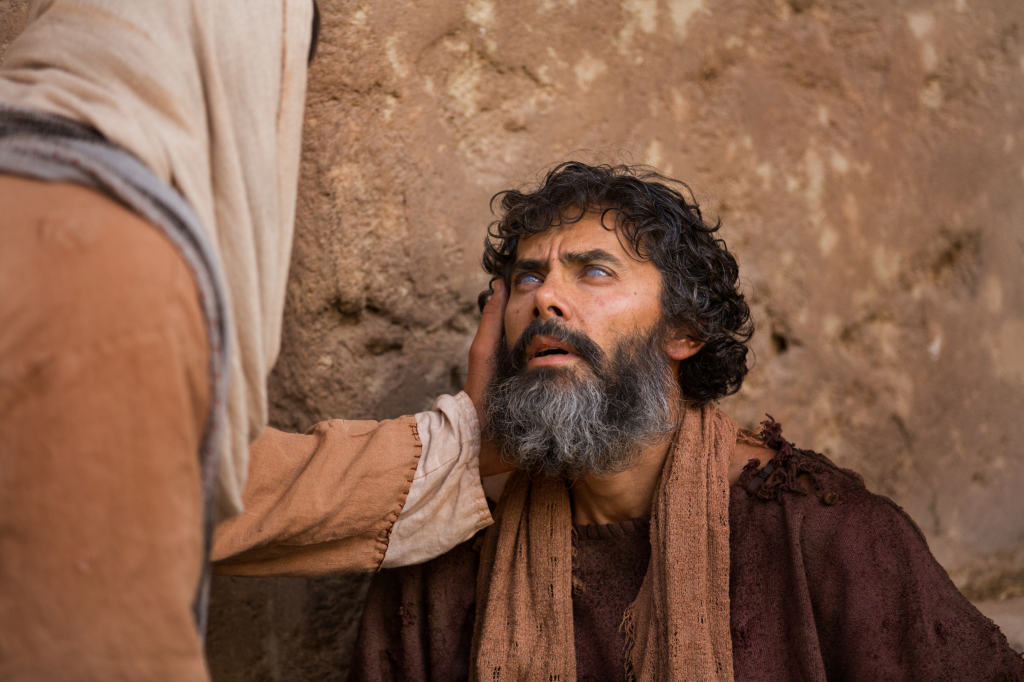
Then he spat on the ground and made mud from the spittle and smoothed the mud over the blind man’s eyes, and told him, “Go and wash in the Pool of Siloam” (the word Siloam means “Sent”). So the man went where nd washed and came back seeing!

Up to now I’ve tried to approach these posts from the first person viewpoint. Ihoped to understand those who met face-to-face with Jesus. I wanted to grasp what they were seeing through their own eyes. But I intend with this post to revert back to a more traditional approach to this passage.

First, we’re introduced to a man who is blind from birth.

I can’t even imagine what that would be like (just as he probably could imagine having sight). I’ve been told that he probably didn’t have a “dream” life–that requires having seen images (a dog, a tree, a mean person) and this wasn’t available to him. He never saw the color red, or seen a mountain. (He didn’t have the circuitry.)

I suppose we can only imagine what blindness like this would be.

Somehow I’ve come to an idea that this represents fallen men–we’re spiritually blind to the workings and truths of Jesus’ Kingdom. It seems a pretty good explanation of each of us–“blind from birth.”

Secondly, notice the response of the disciples who first met this unfortunate man. They don’t see his needs, rather they want to know the theology behind this. Perhaps that’s how we respond much of the time–we don’t see the needs, we only want to know the reasons. We’re not wise or discerning enough to see what’s going on–in short we’re not equipped to love or show mercy. (We haven’t got the circuitry.)

Perhaps this is how we operate as immature Christians.

We don’t engage the need, but rather we like having great theology over understanding compassion. If we really don’t love needy people, we miss so much. We don’t ever grow up. It’s easy to philosophize–it’s hard to get down and serve and really love others.

It’s funny but Jesus declares Himself to be the light of the world while speaking to the man who is born blind.

Third, we discover the gentle mercy that Jesus has when He meets needy people. Now the Lord does accommodate His followers, but not at the expense of engaging the need of the moment. Jesus is full of compassion–most especially when He meets broken people–and as His followers, we must grasp this.

Good theology is not the primary calling of Jesus’ followers.

As I mature in Christ I’m learning (slowly) that people are His real focus. He has come, not to theologize or philosophize, but to meet needs! Sure the reasons why become clearer, but that really isn’t Jesus’ primary goal. People are, not having impeccable theology.

Classes in systematic theology are good, but soup kitchens are better.

The miracle happens, and Jesus’ love and desire to restore this man is ‘front and center.’ The Lord’s methodology is interesting. Spit and mud, wiped on the blind man’s eyes. In Genesis we discover that God made man out of dirt and dust of the ground. Perhaps what He’s doing here mirrors that work.

And it’s also important to understand that Jesus never performs the exact same healing in the exact same way. For some reason He ‘tailors’ His work to the individuals deepest need. I suppose He doesn’t want us to grab a hold of a formula, as that’s what we want to have.

The story is primarily about a blind man’s healing.

It’s not theology, and it certainly isn’t about what is proper and acceptable. We really must understand this, and we really need to understand the tremendous mercy and power of God to both heal and restore.

Image: MCCC. Text from the “Living Bible,” published by Tyndale House

Does Your Sickness Bless You?

“A man was lying there who had been sick for thirty-eight years.”

John 5:5

That’s an incredibly long time to be sick. It must be difficult to be an invalid year after year, with no real hope of ever being healed. This passage describes the scene, (see John 5:1-15). Apparently there was a large group of invalids waiting for the stirring of the waters. That misplaced hope was all they had.

I’ve often wondered why Jesus didn’t heal them all. Why just one when there were so many?

Perhaps the issue was their spiritual state. Most were focused on the pool, they felt that this was their only hope. They could see nothing else. So many today are distracted, we look at those things that might save us instead of looking at Jesus.

Perhaps Jesus would return to the Pool of Bethesda on another day. We’re not told but we know Jesus did quite a few miracles that aren’t recorded. (John 21:25.)

It was the Sabbath, and the healing violated the religious rules of the Pharisees. Jesus refused this man-made edict, and did the will of God. This decision meant healing this paralyzed man.

God doesn’t make mistakes in dealing with His own children.

Our Father does His will, and as believers we must trust in Him and what He promises. By faith, we however believe in His goodness and love. We reject the lies the evil one tells us about our spiritual Father.

My confidence is that He knows in which school I will learn the best lessons

He knows what experiences are necessary for me to grow up. Knowing this doesn’t make it easier, but it does make it eternal. There’s a graduation day coming soon.

We have no power in ourselves to do Christ’s will, but if we do begin to obey what He asks the needed grace is given. Young people often say that they are afraid to enter into a Christian life because they can not do what will be required. In their own strength, they cannot. Plain and simple. 

Human strength in itself is basically inadequate for what life throws at us.

I’m convinced that sick-rooms should be seen as holy places, especially set apart for believers who are becoming more like Jesus everyday. It’s hard, but we remember that God has summoned us there for some special work upon our souls. We must be very careful here or we will miss the good He wants us to receive.

It’s really only those who are trusting Christ and crying out for grace that become blessed by their sickness. I hate to say it but as a believer I’ve found pain to be the best teacher I ever had. I’ve also wasted these opportunities.

But even in that hard place, look for His lessons.

“Too many invalids grow discontented, unhappy, sour, and fretful. Sickness oftentimes fails to do good to those who suffer. There are few experiences in which we so much need to be watchful over ourselves and prayerful toward God.

Be sure to keep the sickness out of your heart, and keep Christ there with His love and peace.”

JR Miller

The Angels are Bewildered

457

“When the Japanese mend broken objects, they aggrandize the damage by filling the cracks with gold. They believe that when something’s suffered damage and has a history it becomes more beautiful.”

~Barbara Bloom

Just a short word of encouragement to all my suffering brothers and sisters. 

I believe God loves you (it’s not a cliche) and has a tremendous plan for you.  Scripture tells us that we will reign with Him (and the last time I looked, there is no disqualification for being mentally or physically ill). 

Having suffered through your whole life will be just an enhancement, a bonus when you finally are held by Jesus, and you can rest in His arms.

Those of us who struggle with depression, mania, and paranoia know a lot about cracks and brokenness.  Mixed states, anxiety, and social withdrawal all have taken their toll. Some of us hear voices. Addictions and suicide attempts have made up our past life (and even sometimes try to intrude on the present.)

I once had a dear friend with advancing Alzheimers She understands little of what is happening to her,  but she still worshiped God with the rest of the congregation. Before dementia, she was a dynamic spiritual marvel.  Without a doubt one of the astonishing women I had ever met.

Now however, when she raises her hands, I believe the angels step back in a deep awe. 

I just realized this–the angels understand worship, they really do. Praise seems to be their specialty. Each angel that surrounds the throne has a PhD in “worshipology.”

But you know what? The angels really don’t understand our worship out of our pain, weakness, and brokenness. Since they have never experienced it, I don’t think they understand.

Let’s worship God with our cracks and brokenness.  In John 12:1-7, a woman breaks open a jar of nard on Jesus’ feet, while the other disciples hang back and complain. 

But always remember this dear one–it’s only by brokenness and then being poured out that one can release the perfume.

bry-signat (1)

*

He Loves the Sick

The good physician treats the disease; the great physician treats the patient who has the disease.” 

– Sir William Osler, 1849-1919

I wrote this poem the other day for ‘Thankful Thursday’ on my own blog. Knowing that many who visit Broken Believers struggle with illness and pain, I thought this would be good to share here as well.

There are plenty of cracked clay pots that find this place, and God’s in the business of putting the pieces back together. It’s His special supernatural work, and only He can do it properly.

He loves helplessness. He cures the sick. It’s what He’s been called to do.

“And when Jesus heard it, he said to them, “Those who are well have no need of a physician, but those who are sick. I came not to call the righteous, but sinners.”

Mark 2:17

Our Great Physician

Illness comes to everyone –
pain, fever, fatigue, and tears
Chronic or acute, it’s such a trial –
these clay pots we inhabit
are so incredibly fragile
even in the hands of the Potter

But our Great Physician
provides strength, comfort –
Sometimes He brings doctors,
nurses, and medication –
Wisdom and talents used
to do His will, to heal, to mend

Sometimes all it takes
is to touch the hem of His robe –
Like the woman who bled
for twelve long years, outcast
one moment, then healed
completely and wholly

The greatest good –
spiritual health and salvation
for the least of us, for all –
each clay pot is used to help others
as grace leaks out of cracks –
Cracks that never seem to heal

Sometimes what the Physician
has in store is our ultimate healing –
A new body, new life eternal
in a place of no more pain,
no tears, energy galore –
as death brings everyone home

“But we have this treasure in jars of clay to show that this all-surpassing power is from God and not from us. We are hard pressed on every side, but not crushed; perplexed, but not in despair; persecuted, but not abandoned; struck down, but not destroyed.”

2 Corinthians 4:7-8

Check out Linda’s blog.