*Dis–joint-ed Ideas* Out of Matthew 25:1-13

Ten-virgins-parable
 
KJV—————————->
 
Then shall the kingdom of heaven be likened unto ten virgins, which took their lamps, and went forth to meet the bridegroom.

2 And five of them were wise, and five were foolish.

3 They that were foolish took their lamps, and took no oil with them:

4 But the wise took oil in their vessels with their lamps.

5 While the bridegroom tarried, they all slumbered and slept.

6 And at midnight there was a cry made, Behold, the bridegroom cometh; go ye out to meet him.

7 Then all those virgins arose, and trimmed their lamps.

8 And the foolish said unto the wise, Give us of your oil; for our lamps are gone out.

9 But the wise answered, saying, Not so; lest there be not enough for us and you: but go ye rather to them that sell, and buy for yourselves.

10 And while they went to buy, the bridegroom came; and they that were ready went in with him to the marriage: and the door was shut.

11 Afterward came also the other virgins, saying, Lord, Lord, open to us.

12 But he answered and said, Verily I say unto you, I know you not.

13 Watch therefore, for ye know neither the day nor the hour wherein the Son of man cometh.

King James Version


NLT—————————>
 
“Then the Kingdom of Heaven will be like ten bridesmaids who took their lamps and went to meet the bridegroom. 2 Five of them were foolish, and five were wise. 3 The five who were foolish didn’t take enough olive oil for their lamps, 4 but the other five were wise enough to take along extra oil. 5 When the bridegroom was delayed, they all became drowsy and fell asleep.

6 “At midnight they were roused by the shout, ‘Look, the bridegroom is coming! Come out and meet him!’

7 “All the bridesmaids got up and prepared their lamps. 8 Then the five foolish ones asked the others, ‘Please give us some of your oil because our lamps are going out.’

9 “But the others replied, ‘We don’t have enough for all of us. Go to a shop and buy some for yourselves.’

10 “But while they were gone to buy oil, the bridegroom came. Then those who were ready went in with him to the marriage feast, and the door was locked. 11 Later, when the other five bridesmaids returned, they stood outside, calling, ‘Lord! Lord! Open the door for us!’

12 “But he called back, ‘Believe me, I don’t know you!’

13 “So you, too, must keep watch! For you do not know the day or hour of my return.

 New Living Translation

In recent years I have heard nothing relevant from Matthew 25. Zilch. Why? I honestly don’t know.

The language he uses in this chapter is not only important– but also quite evocative. Even winsome, like the resplendently gorgeous flowers you just have to pick from your neighbors flowerbed. They are the solar plexus kind of trouncingly beautiful.

goldilocks_tarrantWhichever version you like best must carry the authority of the original speaker– his imprimatur if you will– to be real, and valid and even significant. Now Jesus Christ is not speaking out some “weirdy nursery tale” to comfort us. This isn’t “Goldilocks and the Three Bears.” Not even close.

This group of parables, spoke from the mouth and mind of the Lord Jesus Christ (the Creator and Savior and Lord) is meant to connect with us. Try running out in a empty field, with a steel fence post in a the middle of a fierce, lightning storm– you’ll get connected with– real quick! Now back on the farm, you know that you take the needed shelter in a bad storm. One of my great-Aunties was electrocuted in a cast iron bed while sleeping (this led to the conversion of my Uncle Art, who became a prolific evangelist.)

The words of Jesus are not meant to be ignored, or even trifled with. Maybe minimized or entertained or even played with. His words are meant to sizzle, or “crisp us up.” Either way we dare not disregard, or demean them. If we even try, we will end up as very foolish virgins. gotoil

It must be duly noted that 50% missed it completely. But to their credit they really tried to make it work, having the awareness to try to “fix” things, and become available. But the painful part of these 13 verses was the stark-mad fear of not being able to “catch up.”

idea-light-icoBut run this through your “hopper.” MAYBE, I am missing something here? (It wouldn’t be the first time.) Let me know, ok?


*
kyrie eleison, Bryan

(Lord, have mercy)

*

Hell and Hope

inferno

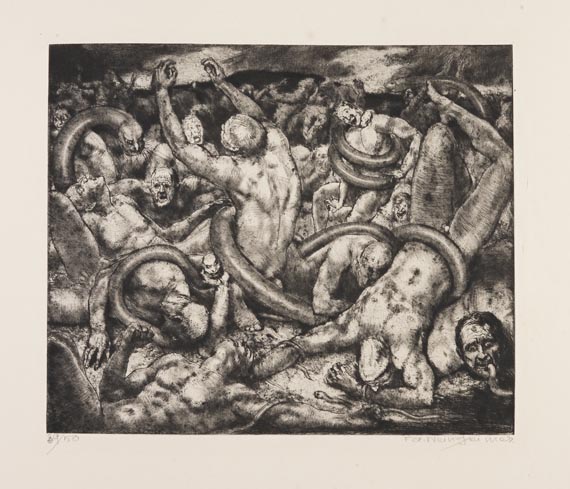
Sometimes, I feel like a tour guide for believers that are walking through hell. I point out the different strugglers, and urge each one not to linger too long but to keep moving. We look on those trapped (they have no hope within them) but we hope that they are yet to reach out for the Savior. It is distressing, and yet somehow we understand them just a little bit.

Our journey out and down each sad corridor can be painfully disturbing for us. There are so many different types of prisons and chains used to confine and control. Dante wrote his “Inferno” (Italian, for hell), and somehow he in some curious way walks through the different levels (varieties) of hell with us. Virgil (Dante’s own tour guide) takes Dante through some pretty hairy stuff, and they pass through the very gate, which bears an inscription, of the infamous phrase “Lasciate ogne speranza, voi ch’intrate“, or “Abandon all hope, ye who enter here.”

Our own rescue from this dreadful place is based on that singular word, “hope”. Somehow, hope has distilled inside us, and that alone can enable us to walk out as the freed. We have chosen not to abandon hope, but to use it as our passport out of the bottom of hell itself. We show it to each guardian, and then pass through without any hinderance.

  • And so at last the poor have hope. (Job 5:16)
  • Having hope will give you courage. You will be protected and will rest in safety. (Job 11:18)
  • Lord, you know the hopes of the helpless. Surely you will hear their cries and comfort them. (Ps. 10:17)
  • All day long I put my hope in you. (Ps. 25:5)
  • Let your unfailing love surround us, Lord, for our hope is in you alone. (Ps. 33:22)
  • O Lord, you alone are my hope. (Ps. 71:5)
  • Your word is my source of hope. (Ps. 119:114)
  • “Listen to me, all who hope for deliverance— all who seek the Lord!” (Isa. 51:1)
  • And his name will be the hope of all the world.” (Matt. 12:21)
  • Even when there was no reason for hope, “Abraham kept hoping.” (Rom. 4:18)
  • We, too, wait with eager hope. (Rom. 8:23)
  • Rejoice in our confident hope. (Rom. 12:12)
  • The Scriptures give us hope and encouragement as we wait. (Rom. 15:4)
  • Three things will last forever—faith, hope, and love. (1 Cor. 13:13)
  • That you can understand the confident hope he has given us. (Eph. 1:18)
  • Our hope is in the living God, who is the Savior of all. (1 Tim. 4:10)
  • In order to make certain that what you hope for will come true. (Heb. 6:11)
  • This hope is a strong and trustworthy anchor for our souls. (Heb. 6:19)
  • Let us hold tightly without wavering to the hope we affirm. (Heb. 10:23)
  • They placed their hope in a better life after the resurrection. (Heb. 11:35)
  • You have placed your faith and hope in God. (1 Pet. 1:21)
  • If someone asks about your Christian hope. (1 Pet. 3:15)

I suppose we must say (it’s clear) that hope is what sets us free from the difficulty that rests in our minds. Whatever DSM-IV has branded us, whatever a psychiatrist has declared us to be, and whatever our therapist has told us– our hope, that’s in Christ, will open all doors that are closed and locked.

Hope really is the Christian’s freedom from hell. Those of us who have been freed from our incarceration from our mental illness are amazingly liberated. I know the lostness of being very much lost. But hope is everything. When our hope somehow connects with Jesus, our souls are set free. We walk out of hell, with our souls soaring clean.

kyrie elesion, Bryan

*

The Blessings of a Long Struggle

falteringfaith

It’s a familiar story. A person has become a Christian in recent years and is engaged in spiritual practices–prayer, Bible study, meditation, church attendance, fellowship, tithing, and/or the sacraments. They’ve listened closely to their priest or pastor and have developed some formulas that are supposed to help them overcome the problems, sins, and weaknesses in their lives.

They’ve heard sermons and/or read books that have titles that start with “Three Steps,” “Five Keys,” and “Four Ways,” that are supposed to lead them to the abundant Christian life. They see progress in their lives but are discouraged because they still struggle with certain sins, problems, and/or weaknesses. Some feel like they can’t overcome the very deep negative legacy from the unhealthy family they grew up in.

Church leadership would do many believers a service by teaching them about how God can bring good out of their protracted struggle. No , it’s not God’s will for us to habitually sin , but God, in his tender mercies can work redemptively in this long and frustrating battle.

One of the first good things that can come out of a long battle with a character flaw or problem is deliverance from a formulaic Christian faith. “Do these three things and your problem will go away” you learn from a best–seller, but your problem doesn’t go away. The fallen human heart is a complex and formidable thing, and these canned approaches are a little like taking a squirt gun to a forest fire.

When people experience sustained adversity, their lives feel out of control, and they will often grab on to formulas to give them a sense of righting a ship that’s taking on water. Unfortunately, they end up trusting in the formulas more than God himself. Faith in formulas will always eclipse faith in God. The Christian life is more about a restful trust in a Person than embracing a set of principles no matter how spiritual those principles may sound.

The New Testament is clear on the centrality of faith (not self–effort or formulas) in the overcoming life:

When asked by his disciples what they must do to do the works God requires, Jesus answered, “The work of God is this: to believe on the one he has sent” (John 6:28, 29). When describing the person who overcomes the world, the Apostle John said, “He who believes that Jesus is the Son of God” (I John 5:4, 5).

The failure of formulas is a good experience because it drives the believer to faith in the living God. In this faith, there is a wonderful exchange: I give Christ my pitiful attempts to live the victorious Christian life and he gives me his transforming power to overcome sin. However, this exchange may not happen overnight; it may be a process that takes years.

For those of you in a long struggle, please be comforted by the mercies of God that endure forever. If he can forgive a murderer and adulterer like David, he can forgive you and me. Please take the advice that Winston Churchill gave the British people during World War II: “Never, never, never, never give up ” or listen to the lyrics from a U2 song called “Miracle Drug” : ” There is no failure here, sweetheart/ Just when you quit.” Even better is C.S. Lewis from The Business of Heaven:

“I know all about the despair of overcoming chronic temptations. It is not serious, provided self–offended petulance, annoyance at breaking records, impatience, etc. don’t get the upper hand. No amount of falls will really undo us if we keep on picking ourselves up each time. We shall of course be very muddy and tattered children by the time we reach home, but the bathrooms are already, the towels put out, and the clean clothes in the airing cupboard. The only fatal thing is to lose one’s temper and to give it up. It is when we notice the dirt that God is most present in us: it is the very sign of his presence.”

Amen.

ybic, Jonathan

Jonathan is a old friend of mine. He writes like I wish I could. You would do well to visit his site. http://www.openheavensblog.com/ –Bryan

Scare the Bullies: Psalms 86

14 O God, insolent men have risen up against me;
    a band of ruthless men seeks my life,
    and they do not set you before them.
15 But you, O Lord, are a God merciful and gracious,
    slow to anger and abounding in steadfast love and faithfulness.
16 Turn to me and be gracious to me;
    give your strength to your servant,
    and save the son of your maidservant.
17 Show me a sign of your favor,
    that those who hate me may see and be put to shame
    because you, Lord, have helped me and comforted me.

Ps. 86:14-17, ESV

This the last of three parts, and we should be impressed with its diversity. There are vista points here, where we can stop and wonder. I remember lounging in the California redwoods, just meandering and soaking it in. It basically undid me. And after awhile, I found it hard to speak. (Itself a minor miracle!)

But scripture can do this as well. When we really start looking, and praying, and meditating we start to appreciate all the Father has done for us. And it’s not just “deep thinkers,” who can do this.  Actually, deep thinking is a liability. It is the simple, the humble, the slow, those who have absurd patience– they are the ones who can do some serious reflecting. Children do it best I think.

Commentary

V. 14, is pretty much David’s reality. He is on Satan’s “hit list.” He has a “contract’ on his life. He must deal with this as he moves through his day. I can imagine that this could be quite corrosive and detrimental to your soul; your heart and your mind. He must have thought, ‘Can I really trust this person, does he have a dagger?’ I would have been a mess, twisted up with paranoia and fear.

V. 15, each word used in this verse is quite precise, each phrase carefully used. This is not David flattering God, it is not “boot-licking” mush. Rather, this verse is an accurate portrayal of the Lord God’s character. It is David’s appraisal of how he has experienced God, the things he has found out about Him. David has a long history with the Father, and he reminds himself of how good God really was.

V. 16, in this verse we see David appealing to God on the basis of relationship. Also, David speaks of a kind of “future grace.” Yes, good things have happened in his life, God things. But that isn’t enough for the present moment, and the future. David needs freshness, a grace tailored just for today, custom built.

David’s source for his survival is in God’s cupboards. He knows this, and boldly steps up and asks for it. Interestingly David doesn’t come as an anointed king, having a majestic aura. When he refers to himself, it is as ”the son of your maidservant.”

V. 17, “The Message” Bible is interesting in how it translates this particular verse:

“Make a show of how much you love me 
      so the bullies who hate me will stand there slack-jawed, 
   As you, God, gently and powerfully 
      put me back on my feet.”

ybic, Bryan

kyrie elesion. (Lord, have mercy.)

_________________

I wrote this on Feb. 21, 2012 and it was posted on my second website, “Psalmslife.com.” If you happen to like this kind of teaching, there is a “whole boatload” on that site, 70-80 posts just on the Psalms. I would be honored if you would check it out.  –B.