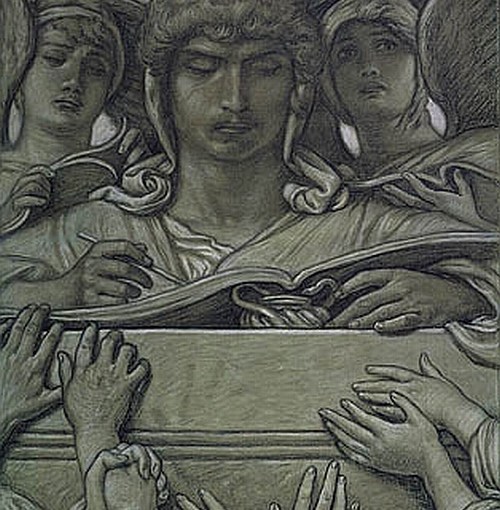
Walking With the Lord Jesus, [Humility]

jesuschrist_mary_marymagaleneandthedisciples_20130319

The subject and emphasis on is becoming obscure— “just like Jesus.” I suppose my main contention is this– our understanding of discipleship has too much “me, and not enough Him.” This can be a gentle error of a young believer.

When Jesus who was the fullness of God in bodily form came, He came as a lowly slave. We see Him stripping down, filling a basin, and scrubbing dirty feet. He actively made Himself a broken and humble servant. It was deliberate and conscious.

Read Philippians 2. It will blow you away!

I think we learn this from Him. The disciple never exceeds his master. He made it very clear that we were to follow Him in this. It’s processed by us when we are very firmly aware that the One who knows us. To be loved by Him is enough (or is it?)

Exceptional effort is made by the Holy Spirit to help us understand. There is a repeated thought given to us in various permutations. In one of my favorite verses King David, standing in front of God, and his people, declared,

“But who am I, and who are my people, that we could give anything to you? Everything we have has come from you, and we give you only what you first gave us! 15 We are here for only a moment, visitors and strangers in the land as our ancestors were before us. Our days on earth are like a passing shadow, gone so soon without a trace.”

1 Chronicles 29:14-15, NLT

“We don’t remember what happened in the past, and in future generations, no one will remember what we are doing now.” This is the cheery assessment found in Ecclesiastes 1. This view irks us big time. Especially if we have invested so much in our wealth, gifts, experiences and accomplishments.

“Our days on earth are like grass;  like wildflowers, we bloom and die.  The wind blows, and we are gone— as though we had never been here.”

Psalm 103:15-16, NLT

In the New Testament, the emphasis is only stronger. Remember when James and John tried to get the corner on the authority and honor of being on “the right and left?” (My, but they were ambitious lads!)

“When the ten other disciples heard what James and John had asked, they were indignant. 42 So Jesus called them together and said, “You know that the rulers in this world lord it over their people, and officials flaunt their authority over those under them. 43 But among you it will be different. Whoever wants to be a leader among you must be your servant, 44 and whoever wants to be first among you must be the slave of everyone else. 45 For even the Son of Man came not to be served but to serve others and to give his life as a ransom for many.”

Mark 10:41-45, NLT

There are two certain issues here:

  • The first is authentic discipleship.
  • The second is a decided and eager servanthood.

Both ideas are often missing in our churches, and in our teaching. Somehow we are not communicating the real transferable concepts. Their simplicity evades us.

I intend to return to this fairly soon. Again, I appreciate any constructive criticism, your own thinking on this, and your prayers.

*

1brobry-sig4


cropped-christiangraffiti1 (1)


Change is Mandatory, [Transformation]

coal-diamond

“The Lord your God will change your heart and the hearts of all your descendants, so that you will love him with all your heart and soul and so you may live!”

Deuteronomy 30:6, NLT


8 “So all of us who have had that veil removed can see and reflect the glory of the Lord. And the Lord—who is the Spirit—makes us more and more like him as we are changed into his glorious image.”

2 Corinthian 3:18, NLT

Geologists tell us that a lump of coal can be transformed into a diamond.  It is not an easy process, and there is little economic value. But it can be done, but with much effort and time. This involves tremendous heat, and incredible pressure.

Something is happening to us and we are being transformed. This is part of God’s plan for us. This takes action on His part, it is a special work of His Holy Spirit.  Slowly, but very surely, “we are becoming.”

Becoming is not an easy process. It is not a skill to be mastered but a new life to be lived. We are called to deny ourselves and bear our cross and follow Him every day. His Spirit comes along side and encourages us to believe God is changing us. We are slowly becoming like Jesus. We are growing “more and more like him.”

“And I am certain that God, who began the good work within you, will continue his work until it is finally finished on the day when Christ Jesus returns.”

Philippians 1:6

We should conclude that God is surely working on us until Jesus returns, or we die. If you are a believer, you can have faith that His work is ongoing. It may seem delayed, or stalled but be assured that you’re His special project and He is not going to give up on you.

He is making ‘diamonds’ out of lumps of coal.

1brobry-sig4

cropped-christiangraffiti1 (1)

OCD: Rituals and Obsession

“I couldn’t do anything without rituals. They invaded every aspect of my life. Counting really bogged me down. I would wash my hair three times as opposed to once because three was a good luck number and one wasn’t. It took me longer to read because I’d count the lines in a paragraph. When I set my alarm at night, I had to set it to a number that wouldn’t add up to a ’bad’ number.”

“I knew the rituals didn’t make sense, and I was deeply ashamed of them, but I couldn’t seem to overcome them until I had therapy.”

“Getting dressed in the morning was tough, because I had a routine, and if I didn’t follow the routine, I’d get anxious and would have to get dressed again. I always worried that if I didn’t do something, my parents were going to die. I’d have these terrible thoughts of harming my parents. That was completely irrational, but the thoughts triggered more anxiety and more senseless behavior. Because of the time I spent on rituals, I was unable to do a lot of things that were important to me.”

People with obsessive-compulsive disorder (OCD) have persistent, upsetting thoughts (obsessions) and use rituals (compulsions) to control the anxiety these thoughts produce. Most of the time, the rituals end up controlling them.

For example, if people are obsessed with germs or dirt, they may develop a compulsion to wash their hands over and over again. If they develop an obsession with intruders, they may lock and relock their doors many times before going to bed. Being afraid of social embarrassment may prompt people with OCD to comb their hair compulsively in front of a mirror-sometimes they get “caught” in the mirror and can’t move away from it. Performing such rituals is not pleasurable. At best, it produces temporary relief from the anxiety created by obsessive thoughts.

Other common rituals are a need to repeatedly check things, touch things (especially in a particular sequence), or count things. Some common obsessions include having frequent thoughts of violence and harming loved ones, persistently thinking about performing sexual acts the person dislikes, or having thoughts that are prohibited by religious beliefs. People with OCD may also be preoccupied with order and symmetry, have difficulty throwing things out (so they accumulate), or hoard unneeded items.

Healthy people also have rituals, such as checking to see if the stove is off several times before leaving the house. The difference is that people with OCD perform their rituals even though doing so interferes with daily life and they find the repetition distressing. Although most adults with OCD recognize that what they are doing is senseless, some adults and most children may not realize that their behavior is out of the ordinary.

OCD affects about 2.2 million American adults, and the problem can be accompanied by eating disorders, other anxiety disorders, or depression.  It strikes men and women in roughly equal numbers and usually appears in childhood, adolescence, or early adulthood. One-third of adults with OCD develop symptoms as children, and research indicates that OCD might run in families.

The course of the disease is quite varied. Symptoms may come and go, ease over time, or get worse. If OCD becomes severe, it can keep a person from working or carrying out normal responsibilities at home. People with OCD may try to help themselves by avoiding situations that trigger their obsessions, or they may use alcohol or drugs to calm themselves.

OCD usually responds well to treatment with certain medications and/or exposure-based psychotherapy, in which people face situations that cause fear or anxiety and become less sensitive (desensitized) to them.

Source: http://www.nimh.nih.gov/index.shtml

cropped-christiangraffiti1 (1)

Traveling Mercies, [The Journey]

Things can get pretty grim just living life.  But add a disability, and suddenly blam! It gets worse.  A mental illness intensifies life, and the weird concoction of symptoms and hospitals, therapists and medications and family/friends is a bit daunting for anyone. Imagine, that it’s a bit like running through the wilderness slathered in ‘bacon grease,’ trying to stay ahead from the bears (I’m writing this from Alaska, hence the bear imagery, lol.)

My walk with Jesus has extreme variations (at least, on my part.)  I’m up, and then I’m down.  I’m on fire and then I’m cold.  I struggle to attempt at least a modicum of consistency, wishing I could just put two ‘good days’ together.  I am ashamed by this volatility.  The apostle Peter, or David are probably the only guys in scripture I can really understand.

The impulsivity of my mental illness has driven me to turn my credit cards over to Lynn.  I try to avoid liquor stores, porn sites, and urges to strip off my clothes and run down Pioneer Avenue.  I definitely try to go to Church, read the Bible and pray.  But I have been known to hallucinate, I hear things, and get awfully paranoid.  I’m always, it seems just one step ahead of my psychiatrist in avoiding the hospital.  (And I want to keep it that way.) And suicidality is an almost real monster– always lurking for me under my bed.

But I have also learned many other things from being a mentally ill believer:

  • When its really dark, His love always comes through. He understands me. He intentionally ‘looks’ for me. He’ll never quit on me.
  • My discipleship is not about the externals of my theology, but it’s about romance from my heart.
  • In my pathetic brokenness, He is my strength and my shield. Always.
  • Worship and prayer are more like invasive “medical procedures” that keep me alive.
  • Love. I’m learning to be kinder and more aware of others then ever before.
  • I want to live in the Light and respond to others in Christlike way. Never out of my fallen sinfulness.

I suppose I could add more, if I thought about it.  Ultimately, it all comes down to the presence of Jesus Christ coming to meet me, to forgive me and to change me.  This simple blog is saturated with posts that other Brokenbelievers can wade through, and some just might help, lol.

The title of this post alludes to a quote I found. I’ve gently modified it. Not sure where I found it. But it gives the explanation for all that I’ve said:

“Life should NOT be a journey to heaven with the
intention of arriving safely in an attractive and well
preserved body, but rather to skid in sideways,
with bruises and band-aids, and some tears as well, body thoroughly used up, totally worn out and screaming… “WOO HOO what a ride!”

bry-signat (1)

cropped-christiangraffiti1.jpg