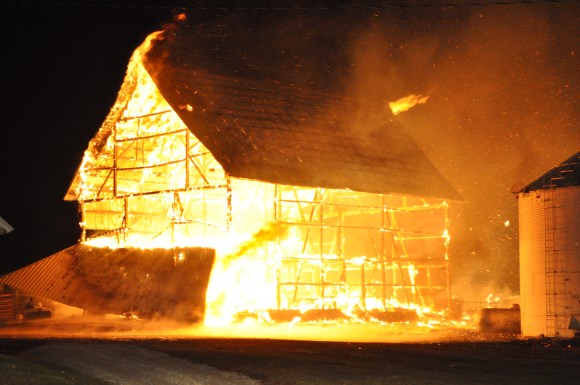
Five Barn Burners


“Barnburning for Dummies”

There are some who may not understand the term, but back on the farm in Wisconsin, “barnburning” meant one of two things:

1. A person who burns down a barn, (obviously literal.)
2. Something amazing or noteworthy. To be strong, impressive, or of interest, (metaphorical.)

The following verses have made a tremendous influence on me. Here are five “barn burners” — incendiary verses that have directed me and given me support in challenging times.  I hope at least one will fire up your heart.

It is a challenge to limit myself to just these five, so much has blessed me over 40 years–I should have at least 500.  Scraping up five was really not the problem, there could be so many more.

So here are five which have made a definite impact on my thinking. (I reserve the right to change my mind as necessary, LOL.) All verses are from the English Standard Version (ESV), such as it is. Get ready for some “spiritual napalm.”

*****

ONE: “Strengthening the souls of the disciples, encouraging them to continue in the faith, and saying that through many tribulations we must enter the kingdom of God.” Acts 14:22

This is a very precise chapter in my mind.  A great deal of attention is given to Paul and Barnabas’ relationship to the people.  At first, they are deified, but moments later the crowds pick up rocks to stone him.  However Paul’s message to the local church was impressive.  He strengthens, and he encourages.  The reality of difficulty and tribulation has become the very doorway for them to come into the kingdom.  This encourages me, and helps me in the conflicts I deal with.


TWO: “Fear not, little flock, for it is your Father’s good pleasure to give you the kingdom.” Luke 12:32

This verse tells me of God’s commitment to me.  First, I’m part of a little flock.  Nothing of any significance.  The world evaluates me, but I’m just a simple guy involved with a simple group of people, nothing more.  However in this verse, fear is the primary issue.  “Fear not, little flock.”  Our fear is supposed to be eradicated and extracted.

The word “pleasure” is an interesting choice of words.  We understand pleasure, or at least we think we do.  This verse implies that the Father has put into play His intensity. Pleasure is often a way of doing intensity.  God is “ultra-involved” and is exceptionally extravagant in His treatment of us.  We are brought into this place of grace, by His kindness and grace.  He can’t wait to pour out his love on us.


THREE:   “And I am sure of this, that he who began a good work in you will bring it to completion at the day of Jesus Christ.”  Phil. 1:6

What confidence!  That is a vital ingredient in our lives,  this confidence and boldness.  Our God is active in bringing us to a deeper place of  maturity.  Paul understands this, and uses God’s diligence as the basis for his growth.  This verse is a real confidence builder for me.  A promise that He will continue His work in me, no matter what.  This is a great promise for young Christians.  I often look at my own issues, and I give up after I accrue a certain frequency–a certain “sin-ratio.”

Shortly before I became a Christian, I spent a lot of time with Fred Tsholl who was the night-shift announcer at a nearby Christian radio station.  He was so patient and kind to me.  I would sit with him in the studio, all night long.  When it was time for me to leave he would quote this verse to me.  Looking back, this verse became quite significant.  I would take it as a promise from the Lord Himself.


FOUR:  “But we have this treasure in jars of clay, to show that the surpassing power belongs to God and not to us.” 2 Cor. 4:7

‘Jars of clay,’ really nothing more than this.  We are weak and vulnerable, we so easily can be broken.  But a treasure, I don’t think we grasp the value of treasure.  But, if it resides in us, we become a repository of great significance.  This magnificent work is not of our own effort.  It belongs to God.  It is nothing we can claim from any working on our part.


FIVE: “Who is that coming up from the wilderness,
   leaning on her beloved?” Song of Sol. 8:5

This world is a tangled place, it is a dense and difficult wilderness. There doesn’t seem to be a smooth road anywhere.  We make our way slowly, through much suffering and personal doubt.  This particular verse gives me an assurance of His presence, even in the middle of hardship and challenge.  He is present with me.

We come up out of this ugliness, precisely because of that close presence.  We lean on the Lord, as we traverse this hard place.  His dear presence will bring us through this darkness, He gives me the amazing strength to do this journey.


bry-signat-1

cropped-christiangraffiti1 (2)

A Retrograde Faith

Loveonthewall

ret·ro·grade

  [re-truh greyd]  (ret·ro·grad·ed, ret·ro·grad·ing.)

adjective

1. moving backward; having a backward motion or direction; retiring or retreating.
2. inverse or reversed, as order.
3. Chiefly Biology. exhibiting degeneration or deterioration.
*
Dictionary.com Unabridged. Random House, Inc. 16 Jul. 2013. <Dictionary.com http://dictionary.reference.com/browse/retrograde>.
%
flourish1
*

24 “But my people would not listen to me. They kept doing whatever they wanted, following the stubborn desires of their evil hearts. They went backward instead of forward.”

–Jeremiah 7:24, NLT
*
I seldom seek out things like this to write about. In my 30 years following the Lord Jesus, I have been bludgeoned more than a few times by people wielding Jeremiah like a cudgel. Mostly, these are good people who I liked and honored. (But maybe they had too much coffee that day, IDK.)
W
But there is a real issue here. Many who start out strong and brave end up on the scrap heap. Somehow, I suppose they were never able to tune their “ear” to His voice. But to be really honest– this can be a hard thing. And many of these dear ones end up with a retrograde walk in the Spirit. They would deny this, but if we look for a passion, we will see that a “first love” it will be absent.
W
That passion is the pulse, the blood pressure of a walk that is so vital and so authentic. We can measure our own walk by this singular means– “first-love.”  Rev. 2:4-5 shouts to us,
w
“But I have this against you, that you have abandoned the love you had at first. 5 Remember therefore from where you have fallen; repent, and do the works you did at first.” 
w
A retrograde faith may not deny Him, but it can often draw us into the place where our denial isn’t necessary. And that I suppose may be the scariest part of becoming apostate. We just slip; we slip right off of the map into an “almost-discipleship.” We would never dream of speaking an outright denial (never, ever) but we end up in this grey zone, nevertheless.
W
I have no desire to manipulate you through nice sounding words and phrases. But I feel duty bound to tell you up-front. Having a “first-love” will protect you. A “first-love” will cover you and lead you through many diverse issues. Revelation 2 was the Father’s plea to a Church that had seemingly advanced in every way. (As a pastor I would have loved to oversee this Church.) But the Father spoke a clear word of correction to them. And  I’m sure that it was hard to accept.
W
The “retrograde Church” exists. Unfortunately, it is alive and well, but we must share with these dear ones about the true freedom which comes from the “first-love” relationship with the Lord Jesus. Our love for Him, and His love for us will protect us from something that goes “backward” and not forward. I can only say, love Jesus, and make Him your “first-love.”
*
“Whom should we love, if not Him who loved us, and gave himself for us?“  –Unknown

*W

ybic, Bryan

kyrie elesion.

Pouring Oil on the Waves (Peace)

“Storm Warning”

“…And through him God reconciled everything to himself.  He made peace with everything in heaven and on earth by means of Christ’s blood on the cross.”

Colossians 1:20, NLT

Jesus has brought a complete peace into God’s world. Everything is now reconciled, taken care of by what Jesus has done. The precise word is “shalom.” It has within it the idea of ‘wholeness, or healthiness.’ It is in a general sense, being ‘made whole or complete.’ This present ‘sickness’ has become obsolete. That is our message.

There is no room really for any “peace” without completeness, it just isn’t possible. The “peace” that the Bible teaches is far more comprehensive, and total. The word in Hebrew, has a strong attachment to health, harmony and prosperity. It has the sense of being well, with the complete absence of turmoil or conflict.

“And he will be called:
Wonderful Counselor, Mighty God,
    Everlasting Father, Prince of Peace.
7 His government and its peace
    will never end.”

Isaiah 9:6-7, NLT

Peace is more than a snazzy marketing approach. At its basic sense it is what He fully intends for the “peoples of the earth.” But this all comes to us with a price. In Isaiah 53:5, (ESV)

“But he was pierced for our transgressions;
he was crushed for our iniquities;
upon him was the chastisement that brought us peace,
and with his wounds we are healed.”

The brutalization of Jesus had a purpose. He “brought us peace.” And we needed peace, desperately. But, oh, the cost!

In ancient times, sailors in a nasty tempest, would pray to their gods, and then pour oil on the waves. They believed the oil, poured out in barrels would settle the violent seas. (I suppose they figured the viscosity of the oil on the waves, would give them some time to manage their ship.)

Today, we know that it doesn’t work this way. Our storms however, are just as bitter, and challenging. Things get so tumultuous, and savagely extreme. But somehow, we want to pour God’s peace on our awful storm. Inherently we know that His peaceful presence can restore some sanity on our crazy lives.

Jesus is “the Prince of Peace.” We look right at Him when things get so ugly. He has come to do this. He is God’s solution to our sad conflict. He brings the oil, for our storm.

bry-signat (1)

cropped-christiangraffiti1.jpg

Luther and His Salvation

Martin Luther, 1483-1546

“If ever a monk could get to heaven through monastic discipline, I was that monk. And yet my conscience would not give me certainty, but I always doubted and said, ‘You didn’t do that right. You weren’t contrite enough. You left that out of your confession.’ The more I tried to remedy an uncertain, weak, and troubled conscience with human traditions, the more I daily found it more uncertain, weaker, and more troubled.”

“Is it not wonderful news to believe that salvation lies outside ourselves?”

 –Martin Luther

“But we believe that we will be saved through the grace of the Lord Jesus, just as they will.”

Acts 15:11, ESV