Out of a Far Country, [Younger Son]

grace1

“And not many days after, the younger son gathered all together, journeyed to a far country, and there wasted his possessions with prodigal living.”  

Luke 15:13

When a man or woman gets to this point, we shake our head at that one’s future. Often they will make a long journey, without comfort and aid.  And yet the prodigal will not be dissuaded or relent.  He leaves it all behind, with a gleam in his eye for the future pleasures ahead. He thinks it’ll be different for him.

‘The far country is his vague destination.  He has been told of the ‘bed of roses’ that can be his.  He has anticipated this moment and savored it.  He will finally be free to pursue everything that might come his way.  There is a deep sense that he has arrived.  He is now a man, with all the prerogatives and benefits of manhood.

The prodigal fully intends to savor these moments of freedom.  He has broken free from his past which only stifled him.  He has come to the place where all that really matters is being ‘cut loose’ from his old life.  He is a man who is running, trying to escape all that he was, and actually looking forward to a future separated from his father’s influence.

He has burned all his bridges.  He  intentionally will not look back.  In his mind he is free, and he will never again have to serve his father.  He doesn’t walk, he struts.  There is an arrogance and confidence that he has taken control.  In his small world we find an ignorance and a foolishness that is truly an astonishment.  We see his precarious situation.  We want to shout to him, ‘watch out’, be very careful!  But he fully intends to press through, and to make his fantasy work.

Several months ago I met an old friend outside Safeway. He is a prodigal who is still ‘slopping pigs.’ He is a gifted musican and played in a worship band. He was so happy to see me; he gave me a big hug and introduced me to all his equally lost friends. He has been drinking a lot lately, but he called me his ‘pastor’ when he took me around to meet everyone. It’s been cold here and I worry about him. He is now homeless.

For every prodigal there are ‘bumps in the road.’ Over time the prodigal gets ‘taken in,’ and is vulnerable.  He rationalizes and attempts to figure it out himself.  This only increases the tension.  He realizes nothing, and will receive nothing.  The prodigal has been sabotaged by his own choices.

Often we are confused as we come to this terrible place of personal weakness. We were the ones who made the awful choices; we did it to ourselves. We have become, truly desperate and needy.  We are at a place where only Jesus can make it work.

Our machinations and maneuverings have brought us to a lostness and desperateness.

The prodigal teaches us, and we learn from his commitment that brings us to an authentic walk with Him.  Our pretenses will dissolve.  There will be nothing which will penetrate or advance over Him.  He has conquered us, and has brought us to this rich and lush place. The Father is eager to bring him all the way home. The Lord will finish what He has started. Isn’t it time to return?

 “And I am certain that God, who began the good work within you, will continue his work until it is finally finished on the day when Christ Jesus returns.”

Philippians 1:6, NLT

bry-signat (1)

cropped-christiangraffiti1.jpg

*

Present Tense Prodigals

prodigal-podcast-1

“So he returned home to his father. And while he was still a long way off, his father saw him coming. Filled with love and compassion, he ran to his son, embraced him, and kissed him. 21 His son said to him, ‘Father, I have sinned against both heaven and you, and I am no longer worthy of being called your son.

Luke 15:20-21, NLT

The Parable of the Prodigal Son has typically been taught as a ‘once upon a time’ event in the life of one wayward youth. We understand it to be such. The prodigal returns to his Father, case closed. It is a remarkable story that resonates to every broken believer.

But what if I told you that this parable is present tense. That we are continuously wandering, spending our inheritance and living off the wealth of our Father. We feel bad about this, we repent and return, only to embark on another foray into sin of our own choosing. It happens all the time.

My point is this. We seem to be always the prodigal. We never seem to outgrow this. We are constantly coming to our senses, and returning home. We seem to never get the point that our personal sin as eternal consequences. We live like there is no tomorrow, except we have to sober up and realize we have wandered far from our home.

The story of the prodigal is written to us who have repeatedly (that means very often) find themselves a good distance from where we should be. We find ourselves feeding the pigs again. We abhor our choices, and wonder again if our Father will take us back just one more time. Reason says ‘No!,’ but faith says ‘Yes!’

God’s love for us is greater than all our evil wanderings. It extends to the ups and downs of our vacillating discipleship. He sees it all and fully accepts us as His returning son. We will never tire out His constant love. We can feel ashamed of our recent behavior, but that changes nothing. We belong to Him, even if we feel wretched.

There are belivers who are overwhelmed by their sense of sin. Some of this is inflated by the devil. And yet they feel estranged from the Church. They know what they’ve done, and they can find no excuse for their actions. They’ve wandered again (for the 100th time).

The Father’s love is not subject to your obedience.

Grace is not some meager thing doled out in some stingy manner. It is given outrageously to each son or daughter without limits. Rascals are included. God is not a miser.

“But his father said to the servants, ‘Quick! Bring the finest robe in the house and put it on him. Get a ring for his finger and sandals for his feet. 23 And kill the calf we have been fattening. We must celebrate with a feast, 24 for this son of mine was dead and has now returned to life. He was lost, but now he is found.’ So the party began.

Luke 15:22-24

‘One, and your done’ doesn’t apply to your heavenly Father. His love for you can’t be reduced to this level. Pick yourself up, leave the pigs, and come home again.

bry-signat (1)

cropped-christiangraffiti1.jpg

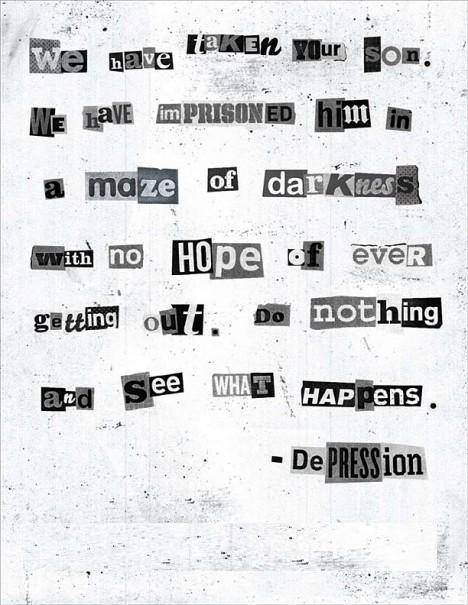
The Ransom Note

depression-note

“We collapse in the dust,
    lying face down in the dirt.
26 Rise up! Help us!
    Ransom us because of your unfailing love.”

Psalm 44:25-26, NLT

“For even the Son of Man came not to be served but to serve others and to give his life as a ransom for many.”

Mark 10:45

“God chose him as your ransom long before the world began, but he has now revealed him to you in these last days.”

1 Peter 1:20

I think that God has more or less ransacked the human language in His effort to get through to us the critical nature of what exactly has been done just for us. When it comes to our salvation and what that means to the universe, the word, “ransom” is used.

The connection for us, as we consider the implications, has mainly a connection with the crime of “kidnapping.” This is when someone is captured by other men, and held in captivity until certain terms are met. When the kidnapper feels his needs are fully met, then the hostage is released.

In the Bible sense, we should work through several verses. There are at least three Hebrew words. In the N.T. Greek just a single word to explain “ransom” is seen. And yet we can say, each word is linked back to the idea of being “helpless.” And helpless is far more than a definition, rather it is a description of a “state of being.”

We come to understand that helplessness is the natural state of human beings. We each have been captured, taken away and are being held, until terms are met for our release. I suppose that some see this helplessness easier than others. (And I’m sure a few will never acknowledge it at all). But nevertheless, it is real and it describes every single person that has ever lived.

Being completely helpless is hardly a situation we would ever choose. Having ransom demands being made to set us free is mostly awkward. And it’s an affront. Perhaps, we feel we are worth more? But the issues here are eternal, and currency concepts are never the consideration.

But there is a present need, to purchase back those who are being held as captives. The absolute clear position is that the Lord Jesus Christ, died in our place. Choosing to die for us, he was essentially tortured before his cruel death. In this decision, he himself paid my ransom. In doing this, I was set free and fully able to return home.

There are many who have been free. But there is a thing called “the Stockholm Syndrome.” This refers to those in captivity who somehow “connect” with their kidnappers through a prolonged captivity. This is to the point where they begin to act less than the victims, and more like the captor. It is confusing. They seem to go out of their way to act “pro-kidnapper”. This can get very disturbing.

We must look to our children, and closest family and our friends. They are toiling for Satan, the captor of our souls (past-tense). Many different tactics are being used– depression, addictions, lust, greed, anger, gluttony, pride, guilt and many other deceitful things. They are being held, until faith (the key) “springs” them out of their prison.

Thank you Jesus, for coming to free us. Thank you for forgiving us. We have been released, and now walk away free. You died, so we might live. We desperately want to see the others we love set free.

*

ybic, Bryan


cropped-christiangraffiti1 (3)

*

The Lost & Found Department of the Universe

 istock_000011738379small


“What man among you, who has 100 sheep and loses one of them,  does not leave the 99 in the open field  and go after the lost one until he finds it?” 

Luke 15:4

I like ‘red letter’ editions of the Holy Scriptures.  I will personally pause when I read these selected verses, pausing to process the steady fact that these are Jesus’ own words.  They are different, and there is a quality to them that is not found in the thoughts of mere men.  I have no doubt of the inspiration of all of God’s Word.  I trust it implicitly.

When I make that pause, very often I reflect afresh on what I’m about to read, and my heart starts preparing to listen closer.  In Luke 15, everything is lost; a lost coin, a lost sheep, and a lost son.  All three link and give a common theme of

1) Something getting away,

2) The value of that lost thing, 

3) The diligent searching that follows,  

4) The apprehension of that which is lost,  

5)  The joy of the finder over the recovery of the thing which was lost.


These three parables strengthen each other.  Together they have the deep power of declaration.  They speak of the merciful heart of our Heavenly Father with a permanence and eloquence that defies any comparison. 

When we read Jesus’ words they reveal to us the intense searching that the Lord has for our lost souls, and that is the central theme of all history.  Jesus is looking for you– concentrating intently and focused.

It doesn’t matter how ensnared you are, or how deeply you have sunk.  God’s love for you compels Him to seek you.  He will reach into the thorns and thistles, if He has to.  Perhaps your sin has been frequent and you are stained deeply.  The declaration of Jesus’ words reveals the heart of God.  It is irrevocable and central to the way God deals with us.

What is the secret of the universe?  Why does reality exist?  What is the purpose of human history? 

I believe it is the apprehension and deliverance of human beings. 

That’s it.  What should the Church be doing?  Finding and rescuing people who are lost.  That is the purpose of everything, and that searching is to be our focus.

The question remains of what about God’s thinking?  Jesus’ words (in red) reveal the true essence of His dealings with us.  He will always act this way! He is constant and true.  He will always be this way.  Searching, finding, redeeming and celebrating.  Don’t doubt His love for you.

bry-signat (1)

cropped-christiangraffiti1.jpg

*