The Voice

My-Sheep-Hear-My-Voice_01

“My sheep listen to my voice; I know them, and they follow me.”

John 10:27, NLT

Do you hear him? He is always speaking to his own; with many things, some pertaining to guidance, and other issues. He delights in teaching us– through words of wisdom that encourage us to follow, or how to really love your neighbor.

He desires to point out things as we encounter them; your curiosity in the natural is meant to be spiritual as well. His soul is that of a teaching shepherd, and he delights in his ministry to us. And we need his instruction.

Regular time with him can not be separated from our daily routine. I have learned that he accommodates himself to us, the ‘grist’ of life is his blackboard. The events that I encounter are his ‘lessons.’ As I move through my life I ‘hear’ his voice. I begin to sense the need of those who I encounter.

“When he saw the crowds, he had compassion on them because they were confused and helpless, like sheep without a shepherd.”

Matthew 9:36

I have learned the joy of praying in the moment with 10 second prayers. Praying continually as I see the needs. I pray for the man who bags my groceries; and lift up the young mother pushing a stroller. I believe his voice prompts me to lift each need I encounter. When the Bible tells us to ‘pray continually’ this is what Paul has in mind.

He becomes my teacher– compassionate and kind to those I meet.

He ‘tunes me’ to see people from his viewpoint. He shows me of their struggles, hopes, and aspirations. I try to never judge what I’m shown; actually the opposite is true– I’m learning to love like he loves. I’m seeing what he sees.

I’m a work in progress. Very often my cares, sins, and disobedience nullify the voice of Jesus, Sometimes my personal issues hijack me and I swirl down into depression or paranoia. I am intensely flawed, but the Holy Spirit is gracious. He always meets me where I am. Slowly, I’m learning to hear his voice.


bry-signat (2)

flourish9

A Finder’s Fee of Joy

New Testament 3 Production Still Photography “Tax collectors and other notorious sinners often came to listen to Jesus teach. This made the Pharisees and teachers of religious law complain that he was associating with such sinful people—even eating with them!” (Luke 15:1)

“If a man has a hundred sheep and one of them gets lost, what will he do? ” (v. 4)

“Or suppose a woman has ten silver coins and loses one.” (v. 8)

“For this son of mine was dead and has now returned to life. He was lost, but now he is found.’ So the party began.” (v. 24)

flourish10

The lost sheep, the lost coin, and the ‘lost son’ tell us that this is a time for recovery. This is a unique period for the Church. It is a season of special grace that allows us to seek and find things that are valuable to us. It is a time of finding out things about ourselves as well.

What is precious to you? With the woman, it was a lost coin (probably a part of her dowry) and she made a substantial effort to get it back. With the shepherd, what was valuable was a lost sheep, and he would take a calculated risk to find it, and rejoin the flock. And the father lost his son, and he had to wait for him to return to his senses.

These three parables were directed to the different issues that effected the “notorious sinners.” But they also spoke to the pharisees who were present. Both groups understood and there were plenty of implications for everyone.

It’s a funny thing, Jesus never minced words. No one could be neutral around him. That is still the case today. I think God is seeking His lost children. This is what He is up to, this is His passion. Understanding this salient fact should enlighten us,

  1. to His will,
  2. to know His passion and love, (His pleasure in finding what was lost)
  3. and the true purpose of His Church.

As the Parable of the Prodigal Son develops, we see the pharisees equated to the ‘grouchy’ older brother. He begrudges his newly returned brother, and he really can’t see what is happening all around him. The idea of grace eludes him. Perhaps that is far more common than we think. Whenever ‘religion’ exerts control over a person or group, duty is almost always elevated over joy.

The Church is only as relevant as when it’s seeking out the lost.

The Church is meant to extend to the lost ‘sons’ of Adam, and the ‘daughters’ of Eve. This is God’s passion, and we must find out what He wants us to do to share His heart. It’s almost as if He wants to give us a chance to taste His joy.

aabryplain


Change is Mandatory, [Transformation]

coal-diamond

6 “The Lord your God will change your heart and the hearts of all your descendants, so that you will love him with all your heart and soul and so you may live!”

Deuteronomy 30:6, NLT


8 “So all of us who have had that veil removed can see and reflect the glory of the Lord. And the Lord—who is the Spirit—makes us more and more like him as we are changed into his glorious image.”

2 Corinthian 3:18, NLT

Geologists tell us that a lump of coal can be transformed into a diamond.  It is not an easy process, and there is little economic value. But it can be done, but with much effort and time. This involves tremendous heat, and incredible pressure.

Something is happening to us and we are being transformed. This is part of God’s plan for us. This takes action on His part, it is a special work of His Holy Spirit.  Slowly, but very surely, “we are becoming.”

Becoming is not an easy process. It is not a skill to be mastered but a new life to be lived. We are called to deny ourselves and bear our cross and follow Him every day. His Spirit comes along side and encourages us to believe God is changing us. We are slowly becoming like Jesus. We are growing “more and more like him.”

“And I am certain that God, who began the good work within you, will continue his work until it is finally finished on the day when Christ Jesus returns.”

Philippians 1:6

We should conclude that God is surely working on us until Jesus returns, or we die. If you are a believer, you can have faith that His work is ongoing. It may seem delayed, or stalled but be assured that you’re His special project and He is not going to give up on you.

He is making ‘diamonds’ out of lumps of coal.

1brobry-sig4

cropped-christiangraffiti1 (1)

How Things Grow, [Work]

plow1930s

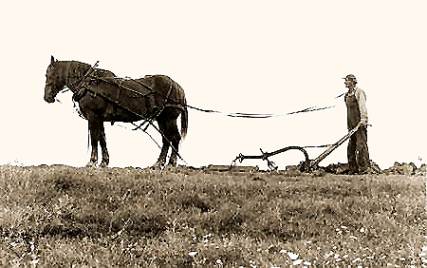
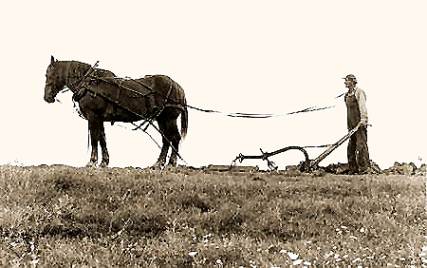
A farmer slowly walks behind his plow. The ground is hard and unyielding, but the steel cuts the heavy sod like a knife. He is preparing the soil for receiving the seed. He knows that what he is doing is imperative and he shouts out to encourage the horse. Its getting late and he wants to cut another furrow before night.

Plodding behind the plow he thinks many things. He can break up the ground, till and fertilize it, sow the seed— and then wait. He is powerless it get the seed to germinate and grow. He is limited to cultivating the soil and waiting. That is all he can really do, and he accepts this powerlessness. He can do everything right, and still not have a crop. All he can do is his part.

The farmer works in partnership with God. He is dependent on Him to grow the seed. The farmer must rely on the weather to meet and engage the planted seed. There are no shortcuts here. He does all he can, and then hopes that it is enough.

Farming is a joint endeavor between man and God. The man does what he has to do. God takes what the man has done and then finishes it. The crop will grow because He wills it. The farmer plays a part for sure, but ultimately God must become involved. Afterall, He makes the seed to sprout and grow.

We can say decisively that the pursuit of holiness in a Christian’s life is a joint endeavor between a believer and God.

Each have made the effort. The Christian does what is necessary, and then the seed is finally sown. It is then up to God to make the seed become the seedling. But each must work to finish the growth.

No one can attain holiness in their life apart from the work of preparation (it’s indeed work). The man must prepare the ground through plowing and cultivating. The farmer works the ground in order to make the ground ready. On the other hand, God provides both the environment and the growth needed to grow the seedling. Both the farmer and God must do their work.

A life of holiness is not automatic. It will never come at measured pace, trickling into our souls at a mechanized rate. (It would be nice if it would). Rather it wheat-field-landscape-picture_1920x1200_79595seems to come, in fits and spurts, sputtering rather than simply flowing.

Holiness is like a steamy Amazon jungle, vibrant and full of life. It is saturated with things living and green. It is not like an arid and sterile desert. Holiness is pulsating and powerful, full of lush growing things.

Becoming a person of holiness is the grandest adventure for the human soul. It defies our tendency to be rigid and legalistic. It is quite the opposite. It is tapping into life itself, and who is up to the task? Our morbid ideas of what holiness are not worthy of what really is.

Yes, to be holy is to work. Just as the farmer must prepare the soil for the seed, we too must guide our plows. God is ready to sow, and we should be ready to be ready. That is if we want to be fruitful and productive.

“Oh, the fullness, pleasure, sheer excitement of knowing God on earth!”

 Jim Elliot

bry-signat (1)

cropped-christiangraffiti1.jpg