Should I Take Medication?

What’s Your Take on Christians Using Antidepressants?

by Pastor John Piper

I’m going to say that there are times when I think it is appropriate, but I want to go there cautiously and slowly, with warnings.

Depression is a very complex thing.

It’s got many layers. I think we all would agree that there are conditions in which nobody would deny that certain people are depressed in a pathological way because they’re immobile. They’re not even able to function.

And then there’s a continuum of discouragements and wrestlings with having an ‘Eeyore-type’ personality, which may or may not be depressed.

So that means that I want to be so careful not to have a knee-jerk reaction. When you come into my office and describe to me your discouragements, I don’t want my first response to be, “See a doctor and get a prescription.”

I fear that is way too quick today. The number of people on antidepressants as a first course rather than the last course is large.

And the assumption is that you can’t make any progress in counseling unless you get yourself stabilized or something.

So I just want to be very cautious.

As a Christian who believes that Christ is given by the Holy Spirit to deliver us from discouragements and from unbelief and sorrow and to help us live a life of usefulness, what makes me able to allow for antidepressants is the fact that medicine corresponds to physical realities.

And the physical realities are that we get headaches that make us almost unable to think. Migraine headaches can put a man out. And we are pretty much OK if the doctor can help us find some medicine that would not let us get these immobilizing headaches.

And the headaches clearly have a spiritual impact, because they’re making me unable to read my Bible and function in relation to people that I want to love and serve. And so medicine becomes spiritually effective in that way.

In the short run especially, sometimes long term—then I think, in God’s grace and mercy, we should take it as a gift from his hand.

If that physical dimension could be helped by medicine.


So we apply this principle that we all use to depression, and then the fact that the body is included in depression. Whether we should use the terms “chemical imbalances”—I’ve read both sides on that. Some people say that there is no scientific evidence for such a thing and others say that it is a given. Whatever. Everybody knows that there are physical dimensions to depression.

Overcoming Your Fear of Death

Question: “How can I overcome the fear of death? How can I stop being scared of dying?”

Answer: Even the most secure, devout believer can have occasions when they fear death. It is hard-wired into our systems to avoid death. And death was not an original part of God’s plan for His creation. We were made to be whole and holy, living in paradise in communion with Him. The introduction of death was a necessary response to the admittance of sin into the world. It is a grace that we die. If we didn’t, we would have to live in a sinful world for all eternity.

Knowing that in your head doesn’t necessarily counteract the visceral reaction to the thought of your own mortality. The fragility of our physical bodies and the sudden cessation of life are violent reminders of our lack of control in a large, dangerous world. We do have a great hope, that He Who is in us is greater than he who is in the world (1 John 4:4). And He did go to prepare a place for us so that we can join Him (John 14:2). But it might help to consider the more immediate, practical considerations we’re faced with.

Beginning with, what is the actual fear? There are several aspects of death that can potentially cause fear. Fortunately, God has an answer for each of them.

Fear of the unknown
What exactly does it feel like to die? What can you see as your life leaves your physical body? How will it come about? Is it anything like people have reported—a bright light? A group of relatives?

No one knows for certain what it feels like, but the Bible does describe what happens. 2 Corinthians 5:6-8 and Philippians 1:23 say that when we leave our body, we are at home with the Lord. What a reassuring thought! We will stay in this state until Christ comes and resurrects the believers (1 Corinthians 15:20-226:14) when we will be given a new, glorified body.

Fear of loss of control
By the time humans reach adulthood, they have a pretty good idea how to interact with the world around them. They know how to find what they need, get to where they want to be, and interact with others in a way that fulfills their intent.

Many though, even those who profess a trust in God, are so fearful of not getting what they need that they feel they have no choice but to manipulate their surroundings and the people around them to their benefit. We have all met men and women who abuse and grasp out of fear. They don’t trust God to provide for their needs, so they take care of things themselves. They don’t trust others to give them consideration, so they demand what they think they need.

How much more they must fear the loss of control upon their deaths. As Jesus said to Peter, describing how he would die, “Truly, truly, I say to you, when you were younger, you used to gird yourself and walk wherever you wished; but when you grow old, you will stretch out your hands and someone else will gird you, and bring you where you do not wish to go” (John 21:18). Before Peter got this warning, he denied Jesus out of fear. Directly after, he reacted by demanding to know how John was going to die. But after Jesus returned to heaven, Peter took the gift of the Holy Spirit and became a new person—one whose passion for Christ’s message far out-stripped his need to control his surroundings (Acts 5:17-42). The Holy Spirit alone gave him the strength to face whatever challenges he might face.

Fear for those left behind
The Christian view of death is “separation.” Ultimate death is separation from God. With physical death, we will be separated from our loved ones on Earth for a time. If they are also Christians, we know that the separation will be a short blink of an eye compared to the eternity we’ll spend with them in heaven. If they are not Christians, that will not be the case. Our commission, then, becomes to use this time together to talk to them about where they will go when they die. Ultimately, however, the decision rests with them. Just as God gives them the room to choose, we must also.

Fear of the act of dying. Few of us know how we will die. Quick and painless, in our sleep, a long drawn out illness—the mystery of it, the inability to prepare, can be frightening. If we do know, if we’ve been diagnosed with a terminal illness, it can still be scary.

But it is only a moment. A moment nearly everyone has gone through or will go through. And, when that moment is over, we can claim Philippians 3:20-21: “But our citizenship is in heaven. And we eagerly await a Savior from there, the Lord Jesus Christ, who, by the power that enables him to bring everything under his control, will transform our lowly bodies so that they will be like his glorious body.

Often, being informed and actively participating can help assuage fear. You can take steps to prepare yourself and those around you.

Overcoming the fear of death – Practical steps
Many people believe they shouldn’t die because they have too much to live for. Often, this means they have responsibilities and unfinished business that wouldn’t be taken care of if they were gone. But having people and things you are responsible for won’t keep you from dying if it’s your time. Doing what you can to make sure they’re seen to can alleviate fear.

If you have a business or children or other dependents, consider their care. Decide who will take over your role and work with that person to come up with a plan. Look into a will or a trust. Make sure all of your necessary paperwork is organized and easy to find. Reconcile broken relationships before you’re unable to. But don’t live for dying. There’s a difference between taking reasonable steps and obsessing.

Overcoming the fear of death – Physical steps
If you have strong feelings about what you want to happen to you should you become incapacitated, express them now. It’s entirely possible that during the course of an illness or injury, you’ll lose control over the situation and be unable to make your wishes known. Get a living will. Let those closest to you know what you want—or at least tell them where it’s written down. Choose someone you trust to be authorized to make decisions for you should you become unable.

Overcoming the fear of death – Spiritual steps
These are all steps to keep up responsibilities or maintain a measure of control in the worldly realm, but they don’t get to the meat of the matter. The most important thing to remember regarding death is the truth about life. You love your family and care for them, but God loves them more. You may worry about your Earthly legacy, but God’s more concerned with a kingdom perspective. All the paperwork in the world won’t bring the peace of mind of once simple action: abide.

In the middle of living this life, with these people, in this world, it’s difficult to keep in mind that this is just a temporary condition, and not a very good one at that. 1 John 2:15-17 says, “Do not love the world nor the things in the world. If anyone loves the world, the love of the Father is not in him. For all that is in the world, the lust of the flesh and the lust of the eyes and the boastful pride of life, is not from the Father, but is from the world. The world is passing away, and also its lusts; but the one who does the will of God lives forever.” How we remember this is by abiding (1 John 2:24). Staying in the truth of His Word, believing what He says about us and the world around us, will give us the proper perspective regarding this life and the one we will receive.

When we are able to keep that kingdom perspective, we’ll be able to fulfill 1 John 3:1-3: “See how great a love the Father has bestowed on us, that we would be called children of God; and such we are, for this reason the world does not know us, because it did not know Him. Beloved, now we are children of God, and it has not appeared as yet what we will be. We know that when He appears, we will be like Him, because we will see Him just as He is.” It will be so evident that we do not belong in this world that others will see it, too. We will so take ownership of our position as children of God that we will actively seek the day we can be like Christ and see Him as He is.

This is derived from a wonderful site– gotquestions.org. I rarely share something this bold or lengthy but this sort of connected and so I simply pass on what I’ve received. No editing, crimping or adjusting.

Recommended Resource: One Minute After You Die, Updated Edition by Erwin W. Lutzer.
1brobry-sig4 (2)

cropped-christiangraffiti1-3-1

Memories That Shame Us

And they heard the sound of the LORD God walking in the garden in the cool of the day, and the man and his wife hid themselves from the presence of the LORD God among the trees of the garden. But the LORD God called to the man and said to him, “Where are you?” 10 And he said, “I heard the sound of you in the garden, and I was afraid, because I was naked, and I hid myself.” 

Genesis 3:6-10, ESV

There is a good chance that some of your memories are pretty awful.

When we get looking back we can see shameful, dark things.  Some of us carry things that are profoundly evil, and they go with us wherever we go.

It’s no secret that guilt and mental illness travel hand in hand, for they are brothers. They have tormented us for a terribly long time. They are like playground bullies who have no fear– they only have hatred for us.

I’m quite convinced that the only way to move on is to have Jesus Christ fully cleanse you, and that includes your dark humiliations.  The human tendency is for concealment. We take considerable effort to conceal and cloak our past lives. (Both Adam and Eve understood personal shame.)

I remember back when my dad discovered that one of our dogs had killed a chicken.  He took that dead chicken and wired it around that dog’s neck. That dog wore that chicken for weeks.  It was awful, and it began to putrefy. The smell was terrible.  I can still see that dog, staggering and tongue lolling out and slobbering.  My dad said it was the only cure for a “chicken killer.”  The dog would get very sick, attached to this rotting carcass.  It was a sobering lesson for a young boy to see.

Somehow, that is what our past disgrace has done to us.  

Sure we have moments when we can almost forget.  But, for the most part, it is just a temporary reprieve.  We slide back and rediscover the pain; it’s just waiting for us.   The cost of our mental health is staggering.  

Many of us are driven by a mad movement toward drugs and alcohol.  We are compelled to escape the pain, and for a little while it seems to work. (This is called “co-morbidity.” Which is ‘fancy talk’ for a dual problem.)

It’s like filling a bucket with corrosive acid.  It will eat its way out.

Most of us would quickly trade this mental pain, this misery;  for a physical one. Something shameful that was done 20 or 30 or 50 years ago continues its destructive work.  Our conscience will not allow us to dispose of our self-disgust in this easy, cavalier manner.  We need a ‘hazmat’ crew to help us clean up mentally and spiritually.

You have to forgive yourself.  

You must, or you will destroy yourself and those closest to you as well!

Often we believe these things are simply moldy walls; they seem to just need a coat of paint. Our problem is that it will only cover for a short time.  After 20-30 layers are applied, we realize this isn’t really the answer. Nothing we can do is ever enough.  We must have Jesus– we must!

-Bryan Chapell

Full repentance is critical. Don’t scuff off this first step.  The blood of Jesus isn’t some nicety. It is foundational for salvation. We are to, by faith, start the obedience. Our blistering sin and guilt are absorbed in Jesus’ death and resurrection.

“When someone becomes a Christian, he becomes a brand new person inside. He is not the same anymore. A new life has begun!”

2 Corinthians 5:17, LB

Go Lower Yet

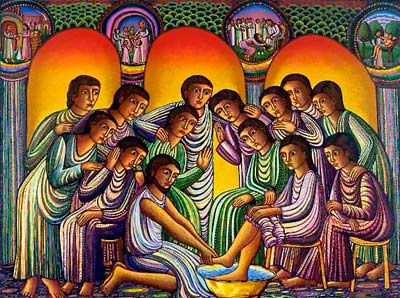
footwashing

“Now that I, your Lord and Teacher, have washed your feet, you also should wash one another’s feet.”

John 13:14

Some Christians reading this part of scripture, have concluded that foot washing should be part of the Churches customary routine.  Their case is compelling, and they may be right in their interpretation.  There is as much support for this as with other things, and Lord knows we could use the humility by getting on your knees with a basin and towel before a brother. 

It probably would relieve issues between saints. It may even heal Church splits. (Oh my!)

Jesus pronounced that His act of service was to be imitated by everyone who would follow.  He further would assert that His example would be emulated by every believer that followed after Him.  Our service to our brother, or sister is to help them become clean Christians. 

We have this ministry of the basin and towel to remove the dirt and filth that comes from walking in this world.  Of course, we cannot remove sins.  But we can serve as Jesus would and intervene with His power.

Cleansing people that we meet will be a challenge. 

It will call us to strip our lives down to a minimum, and to get lower.  We need to get so low that we’re on the floor.  This requires much grace and discipline.  We must weed out every pretense and pride–especially the kind that says, “Look at me serving; am I not wonderful?  I am a true disciple now.”  We are to shake off thoughts like that. 

We are to love others, and perhaps be honestly brutal on ourselves. (Not in a morbid way, just less of ‘yourself.’)

While in my first year of Bible college, I developed a bitter dislike for a classmate.  He had been a lead guitarist; he was handsome and popular, and he oozed pride from every pore (at least I could see it).  I actually took it on myself to be God’s hand in humbling him.  I became antagonistic and scorned him every chance I could.

Within days, my prayer life shut down and the heavens became brass.  One day I was praying and the Holy Spirit graciously zapped me.  I became aware of my sin toward my brother, and I repented. There was a real definite leading, to find a basin and a towel, and then to wash his feet.

God reconciled us, as I knelt at his feet in that dorm room.  From that point on we became very good friends.

We must go lower still.   Water always finds the lowest point, were it pools and gathers into the place of healing others. Perhaps the Holy Spirit will not lead us ‘deeper’ until we start practicing true humility.

When we lower ourselves even deeper we find His presence waiting for us.  But we must cleanse our own hands first, and His blood must work its ministry on me. It’s then I can proceed to clean the filth off of their feet.  If I am not clean myself I will only perpetuate the dirt on to my brother with my dirty hands.

We must scrub our way into the heart of our sister or brother with a basin, some soap and a towel. 

The challenge for us will be a super-challenge.  Christlikeness will always demand this humble grace.  When we think about being like Jesus we must make sure we are following the Jesus in the Bible.  The Jesus who washed dirty feet as a slave.

But let’s not have any foolish nonsense of a discipleship that doesn’t kneel before our brothers in humility.