Call To All Sons

12624 “For it was fitting that he, for whom and by whom all things exist, in bringing many sons to glory, should make the founder of their salvation perfect through suffering.”
Hebrews 2:10, ESV

“God is the One who made all things, and all things are for his glory. He wanted to have many children share his glory, so he made the One who leads people to salvation perfect through suffering.”

Hebrews 2:10, NCV

There is complexity embedded in this verse. But that shouldn’t stop us from understanding its scope and meaning, yet there is the compelling question.

How did Christ learn obedience through suffering when he was already perfect?

Christ was human and “tempted in all points as we are and yet perfect and without sin,” and thus Christ was sinless.  The humanity of Jesus can be seen throughout the gospels. He hungered, and he got thirsty. We see him very tired, and sleeping in the back of a boat in a storm, which reveals his humanity. However, “He committed no sin, neither was their deceit found in his mouth” (1 Peter 2:22).

Only humans need to learn obedience. And everyone of us have faltered. Yet he didn’t. He had to learn, but He didn’t fail. As a man, He met every issue and every obstacle with a solid and a profound obedience. He learned how to obey, but without any failure, or fault.

In every person’s life, we are challenged to obey. There are so many twists and turns, and each of us has stumbled. It can be quite painful. We are also learning “obedience through our suffering.” It seems our own trials and suffering are the tutors teaching us about our Father, and His kingdom.

This thought, “bringing many sons to glory” is of significant consideration. It reveals the intent and purpose of Jesus coming and doing all of this. He wanted to open the doors for all those who come to salvation. In a direct way, His intention was to become our escort, or safeguard to make a way for us into the Presence.

The words, “many sons,” shows the breadth and width of His work. It is considerable. The idea of “sons” is just as astonishing. We are not slaves, forced to labor in the quarries or mines. We are sons and daughters, His own children. Eternity is too short of time, I suppose, for us to hold and occupy this kind of glory.

“They strengthened the believers. They encouraged them to continue in the faith, reminding them that we must suffer many hardships to enter the Kingdom of God.”

Acts 14:22, NLT

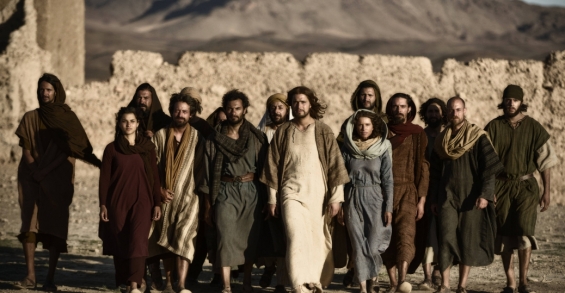
Walking With the Lord Jesus, [Humility]

jesuschrist_mary_marymagaleneandthedisciples_20130319

The subject and emphasis on is becoming obscure— “just like Jesus.” I suppose my main contention is this– our understanding of discipleship has too much “me, and not enough Him.” This can be a gentle error of a young believer.

When Jesus who was the fullness of God in bodily form came, He came as a lowly slave. We see Him stripping down, filling a basin, and scrubbing dirty feet. He actively made Himself a broken and humble servant. It was deliberate and conscious.

Read Philippians 2. It will blow you away!

I think we learn this from Him. The disciple never exceeds his master. He made it very clear that we were to follow Him in this. It’s processed by us when we are very firmly aware that the One who knows us. To be loved by Him is enough (or is it?)

Exceptional effort is made by the Holy Spirit to help us understand. There is a repeated thought given to us in various permutations. In one of my favorite verses King David, standing in front of God, and his people, declared,

“But who am I, and who are my people, that we could give anything to you? Everything we have has come from you, and we give you only what you first gave us! 15 We are here for only a moment, visitors and strangers in the land as our ancestors were before us. Our days on earth are like a passing shadow, gone so soon without a trace.”

1 Chronicles 29:14-15, NLT

“We don’t remember what happened in the past, and in future generations, no one will remember what we are doing now.” This is the cheery assessment found in Ecclesiastes 1. This view irks us big time. Especially if we have invested so much in our wealth, gifts, experiences and accomplishments.

“Our days on earth are like grass;  like wildflowers, we bloom and die.  The wind blows, and we are gone— as though we had never been here.”

Psalm 103:15-16, NLT

In the New Testament, the emphasis is only stronger. Remember when James and John tried to get the corner on the authority and honor of being on “the right and left?” (My, but they were ambitious lads!)

“When the ten other disciples heard what James and John had asked, they were indignant. 42 So Jesus called them together and said, “You know that the rulers in this world lord it over their people, and officials flaunt their authority over those under them. 43 But among you it will be different. Whoever wants to be a leader among you must be your servant, 44 and whoever wants to be first among you must be the slave of everyone else. 45 For even the Son of Man came not to be served but to serve others and to give his life as a ransom for many.”

Mark 10:41-45, NLT

There are two certain issues here:

  • The first is authentic discipleship.
  • The second is a decided and eager servanthood.

Both ideas are often missing in our churches, and in our teaching. Somehow we are not communicating the real transferable concepts. Their simplicity evades us.

I intend to return to this fairly soon. Again, I appreciate any constructive criticism, your own thinking on this, and your prayers.

*

1brobry-sig4


cropped-christiangraffiti1 (1)


The Diary of a Bible

dusty-bible-600x345

JANUARY: A busy time for me. Most of the family decided to read me through this year. They kept me busy for the first two weeks, but they have forgotten me now.

FEBRUARY: Clean-up time. I was dusted yesterday and put in my place. My owner did use me for a few minutes last week. He had been in an argument and was looking up some references to prove he was right.

MARCH: Had a busy day first of the month. My owner was elected president of the PTA & used me to prepare a speech.

APRIL: Grandpa visited us this month. He kept me on his lap for an hour reading I Cor 13. He seems to think more of me than do some people in my own household.

MAY: I have a few green stains now. Some spring flowers were pressed in my pages. I suppose this was bound to happen– after all, it is spring!

JUNE: I look like a scrapbook. They have stuffed me full of newspaper clippings – one of the girls was married. I get to hold the “glad tidings.”

JULY: They put me in a suitcase today. I guess we are off on vacation. I wish I could stay home; I know I’ll be closed up in this thing for at least two weeks.

AUGUST: Drat. Still in the suitcase.

SEPTEMBER: Back home at last and in my old familiar place. I have a lot of company. Two women’s magazines and four comic books are stacked on top of me. I wish I could be read as much as they are.

OCTOBER: They read me a little bit today. One of them is very sick. Right now I am sitting in the center of the coffee table. I think the Pastor is coming by for a visit.

NOVEMBER: Back in my old place. Somebody asked today if I were a scrapbook.

DECEMBER: The family is busy getting ready for the holidays. I guess I’ll be covered up under wrapping paper & packages again … just as I am every Christmas.

I recently came across a statistic claiming that only about 10% of professing Christians have read the entire Bible. Does the other 90% include you? Guilt is not the reason for this post, but I do want to encourage my readers to pick it up and read. It is not an ordinary book.

16 “All Scripture is inspired by God and is useful to teach us what is true and to make us realize what is wrong in our lives. It corrects us when we are wrong and teaches us to do what is right.”

2 Timothy 3:16

“The vigor of our spiritual life will be in exact proportion to the place held by the Bible in our life and thoughts.”

— George Muller

1brobry-sig4 (2)

cropped-christiangraffiti1-3

%


Version Choices, [Your Bible]

types-of-bible-translations


  • Word-for-word is a literal translation from the original languages.
  • Thought-for-thought is considering context in English to translate.
  • Paraphrase is meant to convey a throughly modern language translation.

What are you looking for in your Bible? Personally I use an ESV, but I also like the NLT. I have used almost every translation listed above, but no matter what you use you should read it. You might have what you believe is the “best” translation known to man, but if you don’t read it you’ll be sorely mistaken.

___________________________

 “All Scripture is breathed out by God and profitable for teaching, for reproof, for correction, and for training in righteousness,”

2 Timothy 3:16, ESV

“Odd, the way the less the Bible is read the more it is translated.”

  –C.S. Lewis

“A readiness to believe every promise implicitly, to obey every command unhesitatingly, to stand perfect and complete in all the will of God, is the only true spirit of Bible study.”

 — Andrew Murray

“The Word of God well understood and religiously obeyed is the shortest route to spiritual perfection. And we must not select a few favorite passages to the exclusion of others. Nothing less than a whole Bible can make a whole Christian.”

–A.W. Tozer

“Where one man reads the Bible, a hundred read you and me.”

  –D.L. Moody

1brobry-sig4

cropped-christiangraffiti1 (1)