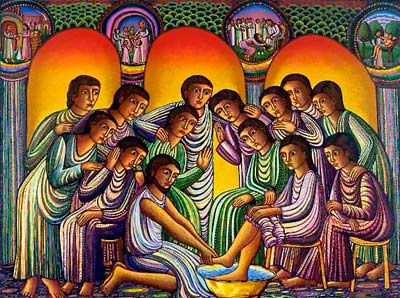
Go Lower Yet

footwashing

“Now that I, your Lord and Teacher, have washed your feet, you also should wash one another’s feet.”

John 13:14

Some Christians reading this part of scripture, have concluded that foot washing should be part of the Churches customary routine.  Their case is compelling, and they may be right in their interpretation.  There is as much support for this as with other things, and Lord knows we could use the humility by getting on your knees with a basin and towel before a brother. 

It probably would relieve issues between saints. It may even heal Church splits. (Oh my!)

Jesus pronounced that His act of service was to be imitated by everyone who would follow.  He further would assert that His example would be emulated by every believer that followed after Him.  Our service to our brother, or sister is to help them become clean Christians. 

We have this ministry of the basin and towel to remove the dirt and filth that comes from walking in this world.  Of course, we cannot remove sins.  But we can serve as Jesus would and intervene with His power.

Cleansing people that we meet will be a challenge. 

It will call us to strip our lives down to a minimum, and to get lower.  We need to get so low that we’re on the floor.  This requires much grace and discipline.  We must weed out every pretense and pride–especially the kind that says, “Look at me serving; am I not wonderful?  I am a true disciple now.”  We are to shake off thoughts like that. 

We are to love others, and perhaps be honestly brutal on ourselves. (Not in a morbid way, just less of ‘yourself.’)

While in my first year of Bible college, I developed a bitter dislike for a classmate.  He had been a lead guitarist; he was handsome and popular, and he oozed pride from every pore (at least I could see it).  I actually took it on myself to be God’s hand in humbling him.  I became antagonistic and scorned him every chance I could.

Within days, my prayer life shut down and the heavens became brass.  One day I was praying and the Holy Spirit graciously zapped me.  I became aware of my sin toward my brother, and I repented. There was a real definite leading, to find a basin and a towel, and then to wash his feet.

God reconciled us, as I knelt at his feet in that dorm room.  From that point on we became very good friends.

We must go lower still.   Water always finds the lowest point, were it pools and gathers into the place of healing others. Perhaps the Holy Spirit will not lead us ‘deeper’ until we start practicing true humility.

When we lower ourselves even deeper we find His presence waiting for us.  But we must cleanse our own hands first, and His blood must work its ministry on me. It’s then I can proceed to clean the filth off of their feet.  If I am not clean myself I will only perpetuate the dirt on to my brother with my dirty hands.

We must scrub our way into the heart of our sister or brother with a basin, some soap and a towel. 

The challenge for us will be a super-challenge.  Christlikeness will always demand this humble grace.  When we think about being like Jesus we must make sure we are following the Jesus in the Bible.  The Jesus who washed dirty feet as a slave.

But let’s not have any foolish nonsense of a discipleship that doesn’t kneel before our brothers in humility.


Under Quarantine

quarantine

Quarantines are a real possibility, even to this day. A quarantine is imposed when a disease is contagious enough that it would harm a society: Measles, Smallpox, and the recent COVID-19 are just a few physical diseases where isolation must be imposed.

It can be severe— an epidemic, with desperate consequences if not adhered to; in some rare cases, the use of deadly force has been authorized to maintain a quarantine until the disease is no longer communicable.

This may surprise you, but there are examples of ‘quarantines’ in the Bible.

The term ‘unclean’ was used for ‘leprosy.’ Those afflicted had to isolate themselves; they had to ‘announce’ their presence when in contact with society. Lepers lived in groups away from the general populace, as a result of their disease.

In Paul’s epistle to the Corinthians, he addresses another kind of ‘quarantine.’ The situation was dire; the church had advocated a Christian living with his father’s wife.

“I have already passed judgment on this man in the name of the Lord Jesus. You must call a meeting of the church. I will be present with you in spirit, and so will the power of our Lord Jesus. Then you must throw this man out and hand him over to Satan so that his sinful nature will be destroyed and he himself will be saved on the day the Lord returns.”

1 Corinthians 5:3-5, NLT

Understanding the Principle of Usefulness

Now in a large house, there are not only gold and silver vessels, but also vessels of wood and of earthenware, and some to honor and some to dishonor.”

2 Timothy 2:20, NASB

Found in God’s pantry are lots of pots and pans of various uses.  Paul writes Timothy about the ‘large house’ which is the Church inclusive. Look around Timothy, there are gold ones, and there are silver ones. They have a noble purpose fitting for such a great house. These are the ones the guests will use; they befit the significance of the Lord himself. These vessels have great value for they are made of precious metals.

There are vessels of different categories. These are the ones made of wood, and of clay. These are part of the household, make no mistake about it. But their use is one of function, they’re utilized in common and ignoble ways. (A clay ‘bed-pan’ perhaps?!)

21 “Therefore, if anyone cleanses himself from these things, he will be a vessel for honor, sanctified, useful to the Master, prepared for every good work.”

2 Timothy 2:21

Paul, the author of the New Testament doctrine of grace emphasizes the place of personal holiness. We are to ‘cleanse’ ourselves to become a vessel of honor. There is good news here:

  • All are vessels in the Father’s house. Each of us belongs to Him. He alone determines their use.
  • Things are not yet in their final state. Changes in status can be experienced. In God’s economy, clay pots can become ‘golden.’ Silver can become ‘wood.’

Some sin is contagious.

It affects believers, and the Church becomes compromised by what we’ve done. And then sometimes we are quarantined by the Holy Spirit–until the contagion passes. This spiritual disease must not be permitted.

I have experienced this several times in my own discipleship. These are not pleasant times, but there is no condemnation. I’m still His servant, His love for me stays outrageously constant. He has never turned away a sinning child who repents of their sin.

“Yes, I am His servant, but I must wait out in the hall. I haven’t been faithful. So I sit in His waiting room, waiting for His call. This is for my good. And my Father knows what is best.” 

Testimony of the Scars

At the crucifixion, Jesus suffered incredible pain.

He was beaten, flogged, spat upon, and had a crown of thorns jammed into his brow. Then He was nailed to the cross through His feet and hands and then pierced in the side with a spear causing blood and water to flow from His body. He was covered in welts, bruises, and blood so that He was almost unrecognizable.

After His resurrection, He appeared to His disciples in the upper room.

The welts, bruises, and blood were gone. His body showed very little of the pain and suffering He had endured. He did not have scars on His face or across His back. He was once again beautiful. His resurrected body testified to the resurrection we will all one day know with new, healed bodies that are once again beautiful, even in our own eyes.

The exceptions to this miraculous healing of His body were the nail scars on His hands and feet, and the scar from where He was pierced with the spear.

“Then he said to Thomas, ‘Put your finger here; see my hands. Reach out your hand and put it into my side. Stop doubting and believe.’”

John 20:27 (NIV).

These scars testified to His death and suffering on the cross. They testified to the love and mercy we find there. They testify even now to the greatest gift God has ever offered mankind: the knowledge that He was one of us, faced death as we do, and came out on the other side victorious as we one day will be if we trust in Him.

We all experience suffering and injury.

We all bear scars, some physical, and others emotional or spiritual. We tend to hide our scars from the world, thinking we are the only ones who bear them. But that’s not exactly true.

Our own scars long to testify to the love and mercy of a God who saw us through our trials and helped us come out victorious on the other side. They long to testify that we were not defeated because God was on our side.

What if, instead of hiding our scars from the world, we shared them for all to see just as Jesus bid Thomas touch the scars on His palms and His side? What if we let our scars testify to the love and mercy of our God? What if we helped share the greatest gift God has ever given mankind, a gift that our scars testify to?

What victory do your scars testify to? Please dear one, share it with others. People are waiting to hear from you.

Take a look at my own website. You’ll be blessed I think–anotherfearlessyear.net.

Don’t Waste Your Sorrows

“You have given me many troubles and bad times, but you will give me life again. When I am almost dead, You will keep me alive.”

Psalm 71:20, NCV

“He was despised and rejected by men,
    a man of sorrows and acquainted with grief;”

Isaiah 53:3, ESV

Everyone hurts sometimes. We all will face our special sorrows. But there are times when our pain pounds us intensely, and it can get really bad. The darkness rolls in on our souls like a caustic fog. We might devastatingly discover that there are things that are worse than terrible.

I have never spoken out like this, but my wife and I had a daughter who died— she was stillborn. She was doing great, up to a week before her due date. We knew that in seven days, we would be able to see her– face-to-face.

Elizabeth Grace Lowe died shortly after birth from strangulation. It was a sudden and unexpected tragedy that left us devastated.

We were completely undone. 

“For the Lord will not reject forever,
For if He causes grief,
Then He will have compassion
According to His abundant lovingkindness.
For He does not afflict willingly
Or grieve the sons of men.”

Lamentations 3:32-33, NASB

There is pain, but there are also promises.

There can be brutal sadness, but there are also Psalms. There is a blessing for all those who grieve. This topic deserves far more attention than this simple post. (If you’re in the thick of things, I’m trusting the Holy Spirit will help you to your next step.)

There can be such sorrow in this life.

Much more than the human heart can possibly contain. But our Savior has a title (one of many.) He is the “Man of Sorrows.” He is the one who is “on point.” He leads us through such intense hostility. He is there when the switch is flipped and it becomes instantly dark. We can’t, won’t, and will not leave you to face your pain alone.

There are a few things that I want to communicate to you.

These have come out of great darkness. I have tried awfully hard to be a disciple, even through the worst of it. They may be right, wrong or just okay, I don’t really know…

  1. God takes the full blame for our pain and sorrow. He doesn’t shift the blame or deny His presence in our sufferings. Sometimes you need to adjust your theology. Maybe it’s hard to trust Him right now–that’s more than understandable. In eternity, I believe, it’ll make perfect sense.
  2. Jesus has fully shared our sorrow. All that you are feeling right now, He feels. If you feel you are at a minus 10, then He does as well. As you suffer, He is your shadow. He knows.
  3. Nothing is ever wasted. We really shouldn’t treat these moments of sorrow as a waste. Have you ever wondered at Jesus’ ‘economy’ after the 5000 were fed?  He assigns value to the leftovers. The disciples pick up their baskets and collect everything again. Nothing will go to waste. Nothing.
  4. This pain, this sorrow is the intensive crash course in becoming a person of mercy. You now will always walk with a limp. At times the scars will be quite visible to those who can really see. This will become forever a healed wound (but a wound nevertheless.) It helps to seek out others who have walked this same path. I don’t think I will ever fully trust a person who doesn’t walk with some kind of limp.
  5. You will need (but maybe not accept) the transformation of your suffering into glory. This will take some time, and it almost feels like your not progressing at all. I encourage you to re-think each of these simple points. The Holy Spirit may be working, perhaps behind the scenes.
  6. Finally remember this: God is not a monster, stomping on us like a boy crushes ants. He has carried all of our pain and illness. He clearly comes alongside every suffering believer.

It is Satan who would suggest to you that God is a Celestial Menace, not worthy of our love. I will be very blunt with you, that idea has to be implicitly rejected. Its origins are satanic.

“The moment an ill can be patiently handled, it is disarmed of its poison, though not of its pain.”

    Henry Ward Beecher

“The LORD is close to the brokenhearted; he rescues those whose spirits are crushed.”

Psalm 147:3, NLT