Front and Center

John 8:3-11

Then the scribes and the Pharisees brought a woman caught in adultery, making her stand in the center. “Teacher,” they said to him, “this woman was caught in the act of committing adultery. In the law Moses commanded us to stone such women. So what do you say?” They asked this to trap him, in order that they might have evidence to accuse him.

Jesus stooped down and started writing on the ground with his finger. When they persisted in questioning him, he stood up and said to them, “The one without sin among you should be the first to throw a stone at her.” Then he stooped down again and continued writing on the ground. When they heard this, they left one by one, starting with the older men. Only he was left, with the woman in the center. 10 When Jesus stood up, he said to her, “Woman, where are they? Has no one condemned you?”

11 “No one, Lord,” she answered.

John 8:3-11

I remember how Jesus defended me. I had been led through the crowds. The temple was filled with people who were there for the festival. It was a time of joy and feasting, but not for me.

Especially not for me.

The temple police escorted me to Jesus. I was now the focus of everyone’s attention. I felt dirty and ashamed. Standing there I could feel the lustful looks from the Pharisees; but there was something else as well, a look from Jesus that I had never seen before. There was compassion there, something quite extraordinary.

I’m ashamed, I committed adultery, I had slept with another man who wasn’t my husband.

I was to be stoned, to have hard rocks thrown at me by “holy” men. The Law had pronounced my guilt, and I knew how I was to be punished. And I deserved it. Yet the man who I slept with was never charged, he escaped and it was I that would be put to death. I didn’t blame him.

My shame was now public knowledge–everyone knew, the Pharisees made sure of that.

They put me front and center. They were going to test Him. They were going to destroy me.

These men who brought me had ulterior motives, they desperately hoped Jesus would stumble. I think they wanted to prove once and all to the crowds that were watching that Jesus really wasn’t the Messiah. They wanted to trap him.

Jesus seemed to understand the implications of this satanic effort.

Only Rome had the power of execution, and yet the Mosaic Law declared that I was to die. I stood waiting, expecting the worst. What else could I do?

It’s funny, but Jesus understood all of this. He seemed to look right through this theological trick, and He responded in a way that really shocked everyone. He never spoke, but bowed low and began to write in the dirt with his finger. Amidst their vicious accusations, they pressed their case.

Jesus bent down again, and he wrote some more.

I never knew what he wrote–but I had to believe it must have been something that revealed the sin in the hidden hearts of the men who were accusing me. In that moment, they quickly dropped the case against me. They all filed out, one by one, in dramatic fashion. I now stood alone with Jesus.

And it was then that Jesus looked directly at me.

I was still afraid, but it was strange, I felt a wave of peace as well. I quietly waited, not knowing what He was going to say to me. I suppose I half expected the worst.

Yes, he did confront me. But He wanted me to acknowledge that those accusing men had left. I saw it and understood. Jesus was asking me to believe that I was now really free. But then he wanted me to understand something that seemed quite crucial.

“Neither do I condemn you,” said Jesus. “Go, and from now on do not sin anymore.”

That dear one was a powerful moment. He set me free with the understanding that He did not condemn me. But my freedom from judgement came with a catch–sort of. I knew then that my sin must be renounced. My freedom came with a price. But knowing I was completely released, meant I was now a free woman.

At that moment I understood completely.

“God pardons like a mother, who kisses the offense into everlasting forgiveness.”

    Henry Ward Beecher

My Facebook page: https://www.facebook.com/bryan.lowe
Making a List

This is a scary list. We’re told repeatedly that love is the evidence that disciples are to be identified. Love is the blood of the body. It’s that necessary. It’s critical. We’re called to love (one another) that proves we’re real and authentic.

Some of us are handicapped, either mentally or physically. Our issues are truly formidable, very few understand.

I pretty much live in physical pain now. I struggle with depression. I have some battles that few understand. And I get terribly self-absorbed by all of it. If love is the blood of the Christian then I absolutely need a transfusion. I’m anemic. I’m the proverbial 95 pound spiritual weakling! 😁

“Love one another.” I believe I’m missing this in my spiritual walk. For the most part I operate as “to tolerate one another.” It’s easy to love those who love me, but that’s not how discipleship to Jesus works. He wants us to find enemies to love. (At least I think it does.)

Our Teacher, the Holy Spirit, knows how ignorant we really are. But He is patient and oh so very kind. He has lessons that fit us and our needs. I want to love (usually) and I’m counting on Him to tutor me. How do I do this?

You learn to love by loving.

A few things (I know it’s a terribly incomplete list):

  • To love you must walk in discernment. Learn to “see” the needs of specific people. Contrary to church opinion, discernment is not to pass judgement on another, rather it’s all about seeing needs. Not everyone can do this.
  • To love takes availability. You need to be “ready for use.” This takes a certain amount of skill. I’m a terrible kind of introvert. Sometimes I won’t answer the phone or go to a home group. I sorta resent it. The Spirit keeps putting me in spots that require interaction with others, and I hate it.
  • Love creates humility in us (which takes some doing). As I learn to love I find myself stripped down and washing somebody’s feet. I become a servant who is learning to scrub between the toes if that’s what it takes.
  • To love you must love others just like Jesus loves you. (Yikes!) “The extra mile,” all of that. So tell me, how much has He loved you? Isn’t that supposed to teach you something? Remember, love is a fruit of Him living inside of you.
  • To love creates growing joy. This joy will protect us from legalism. When joy is operational every burden is light–we do our tasks smiling. I heard a preacher speak about J.O.Y. Jesus, Others, and You. In order of importance.
  • To love is to learn how to pray. Intercession is like oxygen to a fire. It’s like one of those old fashioned bellows to a sputtering flame. It pumps air into the pile of twigs and wood to spread the fire and ignite a blaze. We pray and love starts spreading.

To live with hard mental and physical issues as an authentic Christian is profoundly difficult. We get so self-absorbed at times. But being a disciple of love isn’t just for healthy believers, it’s also for us who struggle.

Grace is increased exponentially to those of us with deep physical problems.

I totally believe this. God takes special care as He works on and in us. We can count on Him to give us the extra attention we need as we learn love.

I’ve found that suffering is like learning another language. Changed by His love we are speaking to others in a way they understand. We can communicate with others because we’ve learned how to “speak their language.” We have been taught by God to speak into broken lives because we’ve been broken too.

1 John 4:19

Understanding Your Pastor

PASTORING

I think that most of us in the Church fail to get a real grip on what pastoring is all about. And that is sad and bad. Not only do we stunt our pastor’s growth, but we cripple ourselves, and flunk some important spiritual lessons.

Three things (there are more, believe me)–

1) Our pastors are sinners.

Surprise! They are just like you and me– definitely not superheroes and certainly not always saintly. They will have their moments and struggles. We really need to understand this to fully receive from their giftings. Just knowing this about them, prepares us to receive deeply and sincerely from their ministries. It seems that their own battles work a brokenness and humility within.

2) Our pastors need to be prayed for.

What they do is probably one of the hardest, most challenging work on planet Earth. The good pastors know this. But they still wade courageously into the thick of things. Our real prayers can buttress and stabilize their lives. They substantially encounter the darkness and do warfare for us. Most have a family to pray for, but they also have a Church they must cover too. A local pastor must have active intercessors, or they will certainly stumble and fall.

Read the story of Moses and his intercessors.

3) Our pastors must be empowered by the Holy Spirit.

God’s work must be done His way. And He repeatedly insists they be filled with the Spirit. They receive power right from the true source. Again, Jesus, the True Shepherd gives power and wisdom and grace for each singular moment. A good pastor over time and much prayer– develops discernment and an awareness for his flock. He learns to love them as he watches over them.

Much, much more could be written. There are so many facets to ponder. I only want to encourage you to love and honor your pastor. When you do this, it will probably activate the gift, and fresh ministry will become available. Real work will be done, inside of you and inside your pastor.

“Then I will appoint responsible shepherds who will care for them, and they will never be afraid again. Not a single one will be lost or missing. I, the Lord, have spoken!”

Jeremiah 23:4, NLT

ybic, Bryan

5

My Pastor, David and Karen Taylor, CCC, Homer Alaska

Little Pieces of Obedience

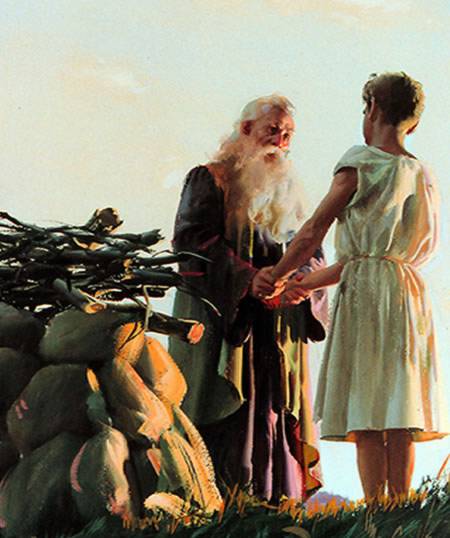
abraham_isaac_1

“It was by faith that Abraham offered Isaac as a sacrifice when God was testing him. Abraham, who had received God’s promises, was ready to sacrifice his only son, Isaac, 18 even though God had told him, “Isaac is the son through whom your descendants will be counted.”19 Abraham reasoned that if Isaac died, God was able to bring him back to life again. And in a sense, Abraham did receive his son back from the dead.”

Hebrews 11:17-19, NLT

The faith of Abraham is understood by believers everywhere. This simple man followed God to a obscure mountain in Judea. He came fervently, and yet logically to the command of the Lord. Abraham’s confident assurance would carry him to Mt. Moriah were he would sacrifice his son. He would prefigure God’s own sacrifice of Jesus Christ, His only Son.

There were many steps Abraham had to take: the knife, the rope, the firewood, the donkey. There was a dozen details to arrange. Abraham would have had to plan ahead of time to prepare. I’m relatively certain he had ample time to consider what he was doing. The enormity of it all would’ve been staggering.

Hebrews reveals that ‘faith’ was what enabled Abraham. It was faith followed by a dozen little obediences that strengthened him to follow God’s instructions. Abraham would obey God, through faith, by doing many little things. All would lead up to the ‘big thing,’ the offering up of his only son.

I believe that no act is too small. Heavy doors swing on small hinges. Tiny obediences make for big ones. And sometimes we can’t tell them apart. It seems that several times during our daily grind we face little choices that often determine a far greater meaning. I’ve been told that there are flowers in alpine valleys that no man will ever see. Their sole beauty is visible only to God. Obedience is often like this. But the Lord knows.

God meets every act of obedience to Him with a smiling grace.

Hebrews 11 is known as the believer’s ‘hall of fame’. In its verses we’re pounded by the idea that the faith is visible only through obedience. What we do is as significant as what we believe. It has always been so.

“…but the people who know their God shall be strong, and carry out great exploits.”

Daniel 11:32, NKJV

Little obediences prepare us for big ones. If we won’t obey in the small ones, how will we in the big ones? The prophet Daniel spoke of a remnant that would do astonishing things, and that the core of their fame would come from knowing God. This is faith made visible. The ‘great exploits’ spring out of a faith in a strong God. To be regarded in this way would be wonderful, but faith needs those little obediences to be able to do the great ones. 

We must reclaim the reality that the details of our lives are not trivial.

bry-signat (1)


cropped-christiangraffiti1.jpg