Can a Mother Forget? [Love]

Gods-love

Yet Jerusalem says, “The Lord has deserted us;  the Lord has forgotten us.”
Never! Can a mother forget her nursing child?  Can she feel no love for the child she has borne? But even if that were possible,    
 I would not forget you! 16 See, I have written your name on the palms of my hands. Always in my mind is a picture of Jerusalem’s walls in ruins.”

Isaiah 49:14-16, NLT

Some of us need to be persuaded of God’s love. We are unconvinced. But Isaiah understands. We grasp the theology, but not the meaning. Our own native ideas keep us in disbelief. Perhaps the greatest liability we have as believers is this doubt that God really feels this way about us. But, He does.

Isaiah claims the impossible, yet grounds himself in what is real. The Father loves us and we’re His very own. Even if we don’t seem as holy as we ought to be. In His out reached hands, we discover scars.  This is the price He has purchased us with. We once were blind, and very lost— but now we are His own children.

We are given the impression that He more than ‘loves’ us; He ‘likes’ us. That dear ones, is not a point I’m prepared to support with scripture— it doesn’t exist except in my own thinking. I know that He theologically loves me.

But I also believe God also likes me as well. Surely, there is such a fine line here, between ‘like’ and love. The more I walk with the Lord, and it’s been almost 35 years now, the more I do love/like Him. I have learned to like Him as much as I love Him. And if God doesn’t like me, I think it diminishes His love.

Some of us must be persuaded again and again of God’s love.

Regardless, Isaiah speaks for the Lord with tender things. Among the people they had the mindset that God had somehow forgotten them. They thought that they were ‘the lost ones.’ God uses the analogy of a mother. A nurturing mother. This metaphor is strong and sure. No, God hasn’t forgotten His people. Look at His hands, your name is ‘tattooed’ on them. You’re His, forever.

“In math, if you divide an infinite number by any number, no matter how large, you still have an infinite quotient. So Jesus’ love, being infinite, even though it is divided up for every person on earth, is still infinitely poured out on each one of us!” 

Charles Spurgeon

bry-signat (1)

cropped-christiangraffiti1.jpg

The Real Battle

Then it happened in the spring, at the time when kings go out to battle, that David sent Joab and his servants with him and all Israel, and they destroyed the sons of Ammon and besieged Rabbah. But David stayed at Jerusalem.
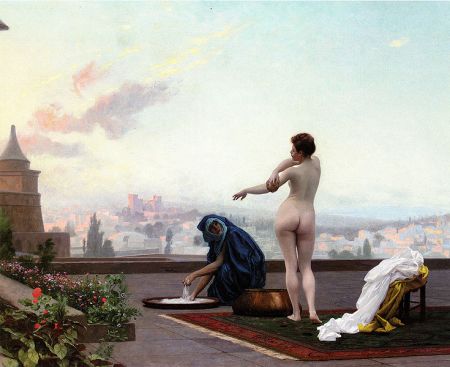
Now when evening came David arose from his bed and walked around on the roof of the king’s house, and from the roof he saw a woman bathing; and the woman was very beautiful in appearance. So David sent and inquired about the woman. And one said, “Is this not Bathsheba, the daughter of Eliam, the wife of Uriah the Hittite?” David sent messengers and took her, and when she came to him, he lay with her; and when she had purified herself from her uncleanness, she returned to her house.

2 Samuel 11:1-4, NASB

Where was the real battle being fought? David walks the rooftop and engages the enemy; it was within his own heart. He puts himself right into sin.

Perhaps he couldn’t sleep. It was a warm spring night, and he needed air and to stretch his legs. His troops and his generals were out to war. Maybe he was anxious about how things were progressing. Perhaps he was not where he should be.

Little did he know but he would face his own battle up on his roof.

David was a seasoned veteran; a trained warrior with skill on the battlefield. But he was also king– with kingly perks. He had wives and concubines at his ‘beck and call.’ His “appetites” were sufficiently met. That is the prerogative of kings.

She was naked– and more beautiful than he had ever seen. A servant was near, and he wanted to know more about her. He began to plan how he could have this exceptionally beautiful woman.

She was also the wife of Uriah, one of his elite warriors and one of his “mighty men,” (2 Sam. 23:39).

But he burned for her, and wanted her now. He had lost the battle.

Even kings “reap what they sow,” (Galatians 6:7-8).

“Father, keep us in the battle and protect us from sin. We want to please you. Don’t let us walk in sin and disobedience. Amen.”

[Suggested reading: Proverbs 4]


cropped-cropped-cropped-christiangraffiti1-11.jpg

The Blessings of a Long Battle, part 2

brutal-boxing

 “Do not fear the conflict, and do not flee from it; where there is no struggle, there is no virtue.”   John of Kronstadt

Part 1 of this post highlighted how God can bring good out of a long struggle with a sin, weakness, and/or problem by helping the Christian make the transition from putting their faith in formulas (e.g., “Do these three things and your problem will go away”) to a restful trust in Christ. Again, no sane Christian advocates habitual sin but the benefits of a protracted battle are numerous:

(1)  After a long battle, in making the transition from formulas to faith in God, a new brokenness develops in the believer. They’ve come to the end of themselves, run out of “self–effort fuel”, and are beginning to learn what Christ meant when he said, “…apart from me you can do nothing” (John 15:5).

(2) During a long battle with sin or weakness, there is a pattern of falling down and getting up. Proverbs 24:16 says that a righteous man falls seven times but keeps rising again. In this process many Christians report that a new intimacy has emerged in their relationship to God. They’ve come to know the God of mercy and compassion as never before because they’ve been repeatedly forgiven after their many stumbles.

(3) “He who is forgiven much loves much.” Along with a new intimacy, a greater love for God can also develop, after a long battle, because we’ve been forgiven over and over.

(4) And since God has extended his tender mercies to us over and over, we then can extend his mercy and compassion to others who have a protracted struggle with some issue. If our heart is right, a long battle can inoculate us from self–righteousness and judgmentalism in relation to others who fall over and over. How can we not extend to them the same grace that God extended to us?

In extending this grace to others, we may become a wounded healer to them. The healing we received from Christ during our struggle is graciously passed on those often struggling with similar issues. Healing emerges from your wounds just as resurrection emerges from death.

(5) After a war, the soldier of Christ often emerges battle–tested and wise to the schemes of the enemy. If a person has been pulled down into the dust 27 different ways by the devil, then, if he or she is paying attention, they’ve learned 27 strategies the enemy of our soul uses to try to destroy us.

In Twelve Step programs, one often hears the acronym H.A.L.T. mentioned in discussing relapse back into addiction. These four letters stand for hungry, angry, lonely, and tired and emphasize how these conditions create fertile soil for relapse.

If you frame the issue a different way, these are four strategies the devil uses to bring us back into bondage. How was this acronym learned? By people relapsing over and over when these conditions were present. Recovering people became wise through their failures in their long battle with addiction.

*

Jonathan

posted from http://www.openheavensblog.com/

On Being Loved

risk-being-loved

“The human heart is the most deceitful of all thingsand desperately wicked. Who really knows how bad it is?”

Jeremiah 17:9

For the sinful nature is always hostile to God. It never did obey God’s laws, and it never will. That’s why those who are still under the control of their sinful nature can never please God.”

Romans 8:7-8

The reality is that we are in a real fix. The grim news isn’t changed simply because we graduated from a ‘charm school’ or become Eagle Scouts. We are fundamentally flawed, our hearts throughly contaminated. Any good we try to do is a ‘freak of nature,’ and astronomically beyond our ability. The race of men has failed. (Maybe that’s why history keeps repeating itself.) Without the presence of God, we would destroy ourselves. And each other.

The word “hostile” is used. That sort of sums it all up, doesn’t it?

God’s Constant Love for You

8 “But God showed his great love for us by sending Christ to die for us while we were still sinners.”

Romans 5:8

Although we’re in active rebellion, “God so loved the world…” His love for us is called ‘agape,’ it is a word used in the New Testament, and it’s a love marked by consistency and selflessness. God loves without any conditions or merit on our part. Agape is love undeserved. The word is full of mercy, a concept very hard for us to grasp.

God’s love for us the way the universe is run. Love is what empowers Him to save us from our sins. It is the Lord’s love that draws us to Himself. Love is like a magnet that pulls us out of darkness into the light. His love for you is infinite.

“In math, if you divide an infinite number by any number, no matter how large, you still have an infinite quotient. So Jesus’ love, being infinite, even though it is divided up for every person on earth, is still infinitely poured out on each one of us!”

  Charles Spurgeon

You can trust the Lord to be fully loving you right this minute. It is a full and constant love— there is scarcely a human parallel. The ‘prophets’ exhaust language seeking a metaphor to explain God’s love to a doubting and disobedient people. I imagine they are frustrated; they can’t explain what they’ve seen. They try, and end up explaining God’s love by type: marriage, and motherhood.

Over and over, these two metaphors are used extensively. And over and over you can see the love of God for people (flesh and blood, like you and I) for us. He loves us like a husband loves his straying wife. He loves us like a father loves his struggling child. We stray and struggle, and we will find no peace apart from His love. After all we are His, and we really can’t ‘work right” apart from His guiding presence.

Look at His heart. See His hands.

They both bear us witness of a supreme love. He loves you right now— wrecked and ravaged by your sin. I don’t know where you are at this very moment, but I do know He loves you intensely. Sin may have destroyed you, but His love never, ever vacillates. God is passionate about you— He won’t let you go. But you must risk being loved.

“See how very much our Father loves us, for he calls us his children, and that is what we are! But the people who belong to this world don’t recognize that we are God’s children because they don’t know him.”

1 John 3:1

bry-signat (1)

cropped-christiangraffiti1.jpg