How Things Grow, [Work]

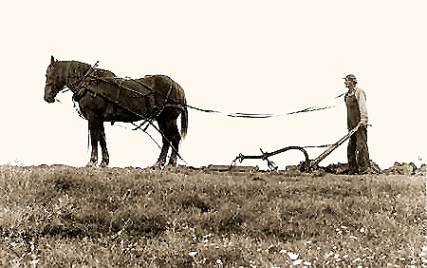
plow1930s

A farmer slowly walks behind his plow. The ground is hard and unyielding, but the steel cuts the heavy sod like a knife. He is preparing the soil for receiving the seed. He knows that what he is doing is imperative and he shouts out to encourage the horse. Its getting late and he wants to cut another furrow before night.

Plodding behind the plow he thinks many things. He can break up the ground, till and fertilize it, sow the seed— and then wait. He is powerless it get the seed to germinate and grow. He is limited to cultivating the soil and waiting. That is all he can really do, and he accepts this powerlessness. He can do everything right, and still not have a crop. All he can do is his part.

The farmer works in partnership with God. He is dependent on Him to grow the seed. The farmer must rely on the weather to meet and engage the planted seed. There are no shortcuts here. He does all he can, and then hopes that it is enough.

Farming is a joint endeavor between man and God. The man does what he has to do. God takes what the man has done and then finishes it. The crop will grow because He wills it. The farmer plays a part for sure, but ultimately God must become involved. Afterall, He makes the seed to sprout and grow.

We can say decisively that the pursuit of holiness in a Christian’s life is a joint endeavor between a believer and God.

Each have made the effort. The Christian does what is necessary, and then the seed is finally sown. It is then up to God to make the seed become the seedling. But each must work to finish the growth.

No one can attain holiness in their life apart from the work of preparation (it’s indeed work). The man must prepare the ground through plowing and cultivating. The farmer works the ground in order to make the ground ready. On the other hand, God provides both the environment and the growth needed to grow the seedling. Both the farmer and God must do their work.

A life of holiness is not automatic. It will never come at measured pace, trickling into our souls at a mechanized rate. (It would be nice if it would). Rather it wheat-field-landscape-picture_1920x1200_79595seems to come, in fits and spurts, sputtering rather than simply flowing.

Holiness is like a steamy Amazon jungle, vibrant and full of life. It is saturated with things living and green. It is not like an arid and sterile desert. Holiness is pulsating and powerful, full of lush growing things.

Becoming a person of holiness is the grandest adventure for the human soul. It defies our tendency to be rigid and legalistic. It is quite the opposite. It is tapping into life itself, and who is up to the task? Our morbid ideas of what holiness are not worthy of what really is.

Yes, to be holy is to work. Just as the farmer must prepare the soil for the seed, we too must guide our plows. God is ready to sow, and we should be ready to be ready. That is if we want to be fruitful and productive.

“Oh, the fullness, pleasure, sheer excitement of knowing God on earth!”

 Jim Elliot

bry-signat (1)

cropped-christiangraffiti1.jpg

A Towel, Not a Title

There are no shortcuts in discipleship
“Jesus knew that the Father had given him authority over everything and that he had come from God and would return to God. 4 So he got up from the table, took off his robe, wrapped a towel around his waist.”  

John 13:3-4, NLT

Jesus was always constant.  Nothing could erode His place or position.  The authority had been His Fathers, and it had been given to Him.  He carried it as a special burden, treasured and separating Him.  Jesus had the freedom to act like the servant.  It didn’t bother or confuse Him, He understood perfectly who He was.

With the supreme authority given to him, he got down on His knees, and began to wash dirty feet.  I can offer no magic or flair to adjust this scene.  He washed off dirt, cleaned between toes, making filthy feet clean.  And all of this ‘as God in human flesh’.  This staggered the disciples, perhaps a baseball bat on the side of the head, would’ve been more compassionate.

This was revolutionary, it completely devastated the disciples.  They just couldn’t grasp what was happening.  Jesus, who was ‘God in flesh’, had decided, in a moment of time, to clean their feet.  Outrageous!  Not really happening!  No way! Never!

The reality.

This spun them around.  They tried as fast as possible to process what had just happened, and ‘who’ it had happened from.

Essentially, it buried them.  Jesus Christ, as Servant pounded them into the ground.  Servanthood was to take the supremacy from this point forward.  Becoming an indentured slave was now the way of Christlikeness.  This servanthood was to now guide us to a point of slavery.

Gone are the days of Zebedee, when one can ask for a position, on the right or the left.  We can ask, most certainly, but we haven’t been the first.  We can ask but the sheer weight is against us.  So very many have gone before us.  We must become a people who accept, and then presses into His grace, His specialness, His presence.

Today, more towels are what we need.

We have got to turn over our ‘need’ for recognition and pick up from the pile the rag of servanthood, we must ‘ask’ our brother/sister if we can scrub their feet.  We must get on our knees and do the unspeakable.  We must find a way to clean off their feet. This dear one, is what you’ve been told to do.

“There are many of us that are willing to do great things for the Lord, but few of us are willing to do little things.”   D.L. Moody

bry-signat

flourish91

Discernment and Your Ministry

zebras

“He begs God on behalf of a human
as a person begs for his friend.”

Job 16:21, NCV

I’ve been thinking about a class I had in Bible School.  The instructor made a comment that has stuck in my thinking for over 30 years now.  I have relied on it countless times in ministry since. It has helped me piece together certain issues of the heart.

When we “preach” to a person, we are actively accelerating the judgement of God in their life. When we pray for that same person, we delay this judgement and allow more room for the Holy Spirit to work.


Preaching

Now I know this is a generalization, and yet the basic premise of preaching and praying has a specific action.  When you preach, you are calling that person to make a decision.  They meet up with the truth and must decide for themselves.  This is a very sensitive moment.  If they consider your message at all– you must understand, one way or the other, that it will require a decision.  Either they act on it, or they’ll decide to reject it.

Within the Bible we often see judgement coming to someone, and very often it comes right after a “declaration of the truth” by a witness or a sermon.  Those who hear the word must choose to believe it, or spurn it.  Even a neutral position is a position. A decision must be made on all light that comes their way.

Prayer

Perhaps this may be easier to see.  The Word is full of men and women who interceded for others.  If preaching accelerates God’s judgement on a person (or group,) than prayer decelerates it.  In a sense, authentic intercession can give them more time.  It delays things, without approving them.

A classic case is Abraham.  He intercedes, and by doing so desires to save and deliver God’s own.  He “stands in the gap” for the unaware.  We see him “negotiating” with the Lord, trying to make a deal of sorts. He is bold and somewhat presumptuous. And actually, this is a regular occurrence with different circumstances.  Many in scripture do seem to get intensely involved in the lives of the people they represent.

“I will surely not stop praying for you, because that would be sinning against the Lord. I will teach you what is good and right.” 

1 Samuel 12:23

 Conclusion

Should we preach or pray?  We must consider, I think, the certain obligations of both.  I believe at the end of a person’s life, they have had both dynamics working.  Its like the tide– it ebbs and then advances, and perhaps that will help us to do the right thing at the right time.  We understand the necessity of preaching, and just as important the work of prayer.  We must do both, but grasp the issues behind each work.  Both are necessary for one to come to faith in Jesus.

Seeing the effects of our actions brings us into a deeper understanding of the life in the Spirit.  It motivates and will guide us.  We start to understand the Lord’s ways and become aware of what is happening in the world that is around us. This new discernment can only sharpen our work.

bry-signat

flourish9


Suffering: Finding Some Reasons

suffering1“Since he himself has gone through suffering and testing, he is able to help us when we are being tested.”

Hebrews 2:18, (NLT)

“Whenever you meet someone who has really suffered; been limited, gone through things for the Lord, willing to be imprisoned by the Lord, just being satisfied with Him and nothing else, immediately you scent the fragrance. There is a savor of the Lord. Something has been crushed, something has been broken, and there is a resulting odor of sweetness.”

  Watchman Nee

I remember a time many years ago when I felt like I had a ‘charmed’ life. I had no issues, few problems– life was smooth, there was no ‘roughness.’ I felt like I was God’s favorite, His ‘golden boy.’ I should have known it wouldn’t last :-).

Suffering in the scriptures is often linked with the concept of endurance. Often within the selected verse the writer weaves into it this idea. I believe that to endure something transforms it to good. Believers will suffer, but the issues get transformed into something quite beautiful, if, we add the ingredient of patient endurance.

“We give great honor to those who endure under suffering. For instance, you know about Job, a man of great endurance. You can see how the Lord was kind to him at the end, for the Lord is full of tenderness and mercy.”

James 5:11

In many ways, suffering is a tutor teaching us the foreign dialect of the Kingdom. If done under the kind direction of the Holy Spirit, it can give us a working knowledge of patience, endurance and joy. We must learn to speak in another language. A suffering believer will find a new vocabulary in pain that allows him to speak with understanding to those who are also in pain.

I spent several years studying Spanish. Even though I wasn’t really fluent, I discovered it opened a whole new world; being bilingual created new opportunities that I’d never even knew existed. I believe that suffering works under this same principle.

light-end-tunnelDo you speak the language? Can you communicate with love to those who hurt? Learning it can transform you to a person that can speak authoritatively to a wide swath of people. Having had to handle your own pain gives you the privilege of interpreting God’s love into pain and hurt.

From our own hurt (through endurance and joy) we can help others. I can always tell a fellow-sufferer. They are typically gentle and loving people, devoid of pride and control. These are the ones who have learned to speak the idiom of the Kingdom of God.

“He comforts us in all our troubles so that we can comfort others. When they are troubled, we will be able to give them the same comfort God has given us… We were crushed and overwhelmed beyond our ability to endure, and we thought we would never live through it. In fact, we expected to die. But as a result, we stopped relying on ourselves and learned to rely only on God, who raises the dead.

2 Corinthians 1:4, 8-9

bry-signat

flourish8