
Together, for Each Other

“The Bible knows nothing of solitary religion.” 

–John Wesley

There isn’t really a place for the individual in our walk of discipleship.  This is a most exceptional truth.  You might say that our society here in the U.S. is expressed in the ‘Marlboro Man’ who rides alone.  “High Noon,” (my favorite Western) is based on a solitary man who stands when other won’t.  The message of individualism saturates this movie. Like Gary Cooper, I think I have to face the bad guys alone.

But I think we need to understand that we are connected to other believers.  In fact, I believe that the Holy Spirit works quite distinctly in ‘generations.’  Whether we like it or not, each of us is connected to our generation.  We are responsible for our own time and place. I’m a child of the Sixties, it’s what makes me tick.

Stellar individuals like Charles Spurgeon and D.L. Moody spoke directly to their generation.  They were voices in the late 1800s.  They connected to their particular milieu, but were surrounded by many praying believers.  Their ministries and sermons, were founded upon the prayers of many saints.  Their ministries were an extension of many people. They were surrounded by other believers.

We are connected with others who are also connected. We are organically related and that needs to be understood.  It’s funny about that, we are called a “body.”  This is a difficult concept for us to understand.  But we need to know that you are not so much solitary, but woven into the life of others. The Church is plural and it happens when believers join together.

We need to understand that the Christian life is not solitary.

If this makes you curious, check out the word “together” in New Testament.  We can reflect on this, and think out what that really means. Just a few scriptures:

“From whom the whole body, joined and held together by every joint with which it is equipped, when each part is working properly, makes the body grow so that it builds itself up in love.”  

Ephesians 4:16, ESV

“For, in the first place, when you come together as a church, I hear that there are divisions among you. And I believe it in part.”

1 Corinthians 11:17-19

“Not neglecting to meet together, as is the habit of some, but encouraging one another, and all the more as you see the Day drawing near.”

Hebrews 10:24-26,

And there is at least a dozen or so more.  The idea– ‘together,’ is only a start, and we need to understand that the Christian life is not solitary. The Father melts our independence, and then molds us with each other to make us into something new. 

Whether we like it or not, we are “together.”

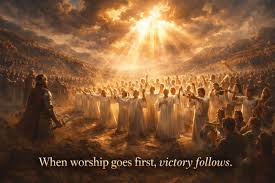
Our Worship Comes First

In 2 Chronicles 20, King Jehoshaphat received terrifying news: a vast army was coming against Judah.

They were outnumbered. They were afraid. And they didn’t know what to do.

So Jehoshaphat called the people together and sought the Lord.

And God gave them a powerful reminder:

“The battle is not yours, but God’s.”
— 2 Chronicles 20:15

Then came the most unusual battle strategy.

When Judah marched toward the enemy, Jehoshaphat sent singers ahead of the army.

Not the warriors.
Not the strongest men.
The worshipers.

They went before the soldiers, praising God and declaring His goodness before they ever saw the victory.

And as they began to praise, the Lord set ambushes against their enemies, and the enemy armies turned against one another.

By the time Judah arrived, the battle had already been won.

What a picture of faith.

They praised before the breakthrough.
They worshiped before the victory.
They trusted God before they could see what He was doing.

Maybe you’re facing a battle right now that feels bigger than you.

You may not know how God will make a way.
You may not know when the answer will come.
But you can still praise Him.

Because praise isn’t pretending the battle isn’t real.

Praise is remembering that the battle isn’t yours to carry alone.

Put praise on the front line.
Let worship speak louder than fear.
And trust the God who fights for His people.

“The battle is not yours, but God’s.” 🙏🏻🤍

📖 2 Chronicles 20:15–22

Battle Belongs  · Phil Wickham ·Salt and Light, https://www.facebook.com/saltandlight.words

A Used Heroin Needle

Clarion Alley, 1987

I lived in the inner city of San Francisco from 1986-1989. I was a full-time missionary and lived in community called SOS. There were about 10 believers, and we were committed to doing high visibility evangelism, “taking the Church on the street.” We all lived in an old Victorian in the Mission district. 

I will not minimize the difficulty and danger of the streets combined with our ministry’s approach. Not only was it hard, but we also lived in a hard place. Our neighbors were heroin addicts, and we lived just a couple of doors down from the “largest lesbian rock-roll bar west of the Mississippi.”  

Directly behind our house was an alley that was as bad as you can imagine; addicts and winos had basically taken over. It was full of trash, feces, and urine. And in the hot summer it would make your eyes water. It really was awful. 

Please keep reading. 

One hot summer day I decided to clean up part of our alley. Armed with an old broom, laundry detergent, a hose (and courage) I headed out to scrub away. It took some doing; it was somewhat nauseating. 

I noticed a small hole in the corner of the wall. I reached in to discover a well-used heroin needle hidden inside. I ran that needle into my hand. 

I really didn’t think much about it at the time. 

About six months later I was in San Francisco General outpatient for AIDS testing. I had been terribly tired and had lost some weight. Perhaps I had been infected? It was funny but a part of all of this was having to sit in a circle with a dozen gay men being instructed about safe sex practices. (I remember bananas and condoms were used.) 

It was 1987, and AIDS testing was still primitive; it took 6 weeks for the results. 

That wait was a bit of a challenge. I cried out to the Lord many times. Since the symptoms got even worse, I started to think the worse. I was thinking, “was this considered martyrdom?” or “I can’t ask Lynn to marry me now.” (I had been thinking about this up to then.) 

I was positive that I had AIDS. 

About 20 years later I discovered I had contracted HCV, Hepatitis C. I had a good doctor who knew his stuff. Although my liver had been damaged by that point, he guided me through a maze of testing and found a new med that was supposed to have good results. It did, thank God. I had finally been cured. 

Lynnie and I were married on January 7, 1989. 

What can I say really? I know the Lord directly intervened. We returned to Alaska where I was asked to teach at the Alaska Bible Institute. I was able to draw on my many experiences with SOS in San Francisco to touch the hearts of young men and women going into ministry. 

Lynnie and I went on to pastor a Church in 2000. 

Only God can bring good out of something bad. 

“O Lord my God, I cried to You for help, and You have healed me.” 

Psalm 30:2 

 James H. Aughey 

I Know He Loves Me (But is that Enough?)

Gods-love

“Yet Jerusalem says, “The Lord has deserted us;  the Lord has forgotten us.”
Never! Can a mother forget her nursing child?  Can she feel no love for the child she has borne? But even if that were possible,    
 I would not forget you! 16 See, I have written your name on the palms of my hands. Always in my mind is a picture of Jerusalem’s walls in ruins.”

Isaiah 49:14-16, NLT

Some of us need to be persuaded of God’s love. We are unconvinced. But Isaiah understands. We grasp the theology, but not the meaning. Our own native ideas keep us in disbelief. Perhaps the greatest liability we have as believers is this doubt that God really feels this way about us. But, He does.

Isaiah claims the impossible, yet grounds himself in what is real. The Father loves us and we’re His very own. Even if we don’t seem as holy as we ought to be. In His out reached hands, we discover scars.  This is the price He has purchased us with. We once were blind, and very lost— but now we are His own children and can see.

God may love me. But does He like me?

We are given the impression that He more than ‘loves’ us; He ‘likes’ us. That dear ones, is not a point I’m prepared to support it with scripture, but that isn’t the truth, it doesn’t exist except in my own thinking. I know that He theologically loves me. But to be really honest I sometimes think that God is irritable with me, and He just gets tired of having me around.


But I also must believe God also likes me as well. Surely, there is such a fine line here, between ‘like’ and love. The more I walk with the Lord, and it’s been over 50 years now, the more I love/like Him. I have learned to like Him as much as I love Him. And if God doesn’t like me, I think it actually diminishes His love.

Isaiah speaks for the Lord using tender metaphors. Among the people some had the mindset that God had somehow forgotten them. They thought that they were ‘the lost ones.’

God then uses the analogy of a mother. A nurturing mother. This metaphor is strong and sure. No, God hasn’t forgotten His people. Look at His hands, your name is ‘tattooed’ on them. You’re His, forever. (I hope you like that truth.)

“In math, if you divide an infinite number by any number, no matter how large, you still have an infinite quotient. So Jesus’ love, being infinite, even though it is divided up for every person on earth, is still infinitely poured out on each one of us!” 

Charles Spurgeon

bry-signat (1)