The Joyful Necessity of Dying Daily

Eye+Fetch+Photography+Stormy+Wheat+Fields+by+Diane+Loft (1)
Photo by Diane Loft

“We know that our old sinful selves were crucified with Christ so that sin might lose its power in our lives. We are no longer slaves to sin.”

Romans 6:6, NLT

“There are two things which the Church needs: more death and more life— more death in order to live; more life in order to die.”

C.A. Fox

The need of this moment is critical. Many believers have never came to this point of ‘knowing.’ Maturity comes when one realizes that crucifixion has dealt with the old man. We died when He died, we were there when He died, we were part of that event. Romans 6 is all about a believers ‘co-crucifixion’ with Jesus Christ. Calvary was far more than a religious event— it was where our sin was terminated. It was more than just a penalty carried— it was where our old nature put to death.

“My old self has been crucified with Christ. It is no longer I who live, but Christ lives in me. So I live in this earthly body by trusting in the Son of God, who loved me and gave himself for me.”

Galatians 2:20

Sin has no power to sway a dead man. A man who is dead doesn’t respond to a girl in a leopard skin bikini. (It doesn’t matter if she is insanely gorgeous). He no longer can be tempted to sin. Why?  Because he is dead. This is not an issue of semantics, it is not poetic interpretation of a metaphor. It rings true in heaven and it is quite real here on earth.

Sin should no longer remain in power of a believer’s life. We believe that our sins have been dealt with on the cross, that Jesus took our sins from us, bearing them as a ‘sacrificial lamb.’ But the same is true to say, “My sinful nature was also crucified with him.”

“I tell you the truth, unless a kernel of wheat is planted in the soil and dies, it remains alone. But its death will produce many new kernels—a plentiful harvest of new lives.”

John 12:24

The principle is from farming. A kernel of wheat will bring an abundance. But it must be buried first. The dead seed miraculously sprouts. At the moment of death it suddenly receives a new life. The dead seed grows into a bountiful harvest. This is the New Testament principle of dying to self. A few things:

  • we are not sinless— we must deal daily with the sinful part of us,
  • this must be taken by faith, much like anything else from God, Heb. 11
  • discipline aids our quest for holiness, 1 Tim. 4:8
  • it accentuates the role of water baptism, it’s a daily reckoning, Rom. 6:4,
  • temptations can be really strong, but He enables us, 1 Cor. 10:13
  • this is a God honoring way to live.

Crucifixion should always be taken by faith in God’s Word and it will lead to resurrection. Crucifixion weakness is necessary for resurrection power. Jesus shares his life with us— his power is given to his people. He shares all that He is so we might become like him.

“Do not let sin control the way you live; do not give in to sinful desires. 13 Do not let any part of your body become an instrument of evil to serve sin. Instead, give yourselves completely to God, for you were dead, but now you have new life. So use your whole body as an instrument to do what is right for the glory of God.”

Romans 6:12-13

We’ve been given a gracious teacher in the person of the Holy Spirit. He will never condemn our feeble efforts to be holy. Be encouraged: God delights to make the weakest of us strong. He has done all He can to work holiness into our hearts.

bry-signat-1-1


cropped-christiangraffiti1.jpg


Jesus is Our Centerpiece

The Gospel of John describes a wonderful image of the vineyard— branches and vine. This illustrates our relationship with Jesus.  We must abide and remain in him to be fruitful.  He is the vine, and we, we are merely the branches. He is the sole source of everything.

Notice the clear implications of John 15. (Come to Me, remain in Me, stay connected to Me.)  He didn’t advise or suggest we attend a seminar, go to Bible school, or attend a prayer meeting.

He said, “Come to ME.”  He, and He alone is the one we are to center on. He insists that He is to be our total focus. There is no other (Matthew 11:28.)

This is either an egotistical religious fanatic intoxicated with His power and self-importance, or He really is reality.  C.S. Lewis comments,

“I am trying here to prevent anyone saying the really foolish thing that people often say about Him: I’m ready to accept Jesus as a great moral teacher, but I don’t accept his claim to be God. That is the one thing we must not say. A man who was merely a man and said the sort of things Jesus said would not be a great moral teacher.
He would either be a lunatic — on the level with the man who says he is a poached egg — or else he would be the Devil of Hell. You must make your choice. Either this man was, and is, the Son of God, or else a madman or something worse. You can shut him up for a fool, you can spit at him and kill him as a demon or you can fall at his feet and call him Lord and God, but let us not come with any patronizing nonsense about his being a great human teacher. He has not left that open to us. He did not intend to.”


Jesus insists that we worship Him.  That much is clear.  “I am the way, I am the truth, I am the life.  I am the only way to the Father.”  And of course, “He who believes in Me has eternal life, and he who doesn’t is condemned” (John 14:6.) We just breeze through these verses and never truly grasp the ramifications. A mere man could not say these things (at least not with straight face) and be considered sane.

He either was what He said He was, or a liar or lunatic.  And we must decide who He really is. 

As believers we need to realize Jesus’ His rightful position.  The One who sits on the throne is the center.  All things derive their life, meaning and essence from Him.  We must not forget that He is the Risen Lord.  We need to realize that He has asked us to worship Him.  Point blank.

Many of our struggles come when we try to reduce Jesus to something less than what is real. If He really is the only way to the Father, we had better pay attention.

“A rule I have had for years is: to treat the Lord Jesus Christ as a personal friend. His is not a creed, a mere doctrine, but it is He Himself we have.”

–D.L. Moody

bry-signat (1)

cropped-christiangraffiti1.jpg

Caregivers: Improving Your Serve

serving-hands

One of the weightiest issues of caring for a mentally ill spouse, child, or friend, is that it is so phenomenally relentless.  The disease is so unpredictable, in its intensity and its spontaneity.  You think you have the situation in hand, and it breaks out somewhere else, and often in public and causing major problems.  This is wearing on anyone, including the Christian believer. And sometimes that can even make it more challenging.

You will need a support network, if you’re going to be a caregiver.  This support is received in three different ways.

First, emotional support.  Without someone who can listen and give words that encourage you, you’ll grow in resentment and frustration with your particular “lot”.

Second, I would suggest physical support.  You will need someone to help you make sure the practical issues are met.  (washing the car, fixing the shower, etc.) My wife as a caregiver has had to do things that she would normally wouldn’t be called on to do (fix the stove, do the taxes, etc.) because of my illness.

Third, spiritual support.  It has three concentrations. Worship, prayer, and fellowship.  These three have obvious effects on the caregiver.  Just a word to the wise–when you pray you are going into it as two people (as well as for yourself).  You must maintain and strengthen yourself and for the person you are serving.  I think this is critical to your relationship.  Try to see challenges, not obstacles. Don’t forget the power of a worshipping heart or the warmness of good Christian fellowship.

God gives special grace to the caretaker.  My advice is to take it, and then use it.  Draw upon Jesus who is your caregiver.  Present your afflicted one to Him.  Be supernatural in the mundane.  The story of the paralyzed man on his cot being brought into Jesus’ presence by his friends fascinates me.  It has many parallels for you to be a good caregiver.

“And behold, some men were bringing on a bed a man who was paralyzed, and they were seeking to bring him in and lay him before Jesus,”

Luke 5:18, ESV

My last word of advice is that you don’t be self-critical or feel guilty.  Remember, it is your friend or family member who is the sick one.  Don’t get consumed by your responsibilities.  Don’t fall in the trap of judging yourself by how well you do or don’t do as a caregiver.  Remember, you are not performing for others, but for an audience of One, who sees all.

Educate yourself, use the internet to track down information.  If I can help you further, please feel free to contact me.  I’m not a rocket scientist but if I can encourage you I will.   May the Holy Spirit touch your heart. You are going to need it.


cropped-christiangraffiti1-2


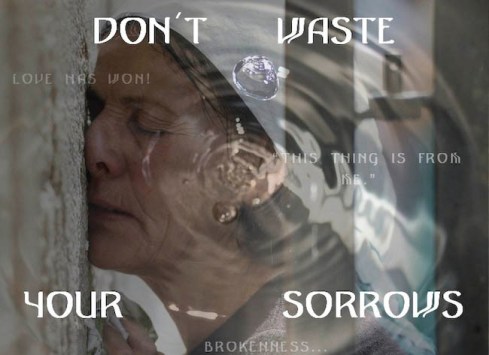
Don’t Waste Your Sorrows


062_dont_waste_your_sorrows

“These little troubles are getting us ready for an eternal glory that will make all our troubles seem like nothing.”

2 Cor. 4:17, CEV

“Before God could bring me to this place He has broken me a thousand times.”                                   

Smith Wigglesworth


As we move toward maturity, over time and through circumstance, we will start to develop exciting new ways of thinking.  We engage the Word and combined with our relationships with people we start the work of God.  We soon learn that the Kingdom of God flows through relationships, almost exclusively.

Pain and sorrow are some of the more intense ways the Lord reaches down and into our lives.

Rick Warren has written, “God intentionally allows you to go through painful experiences to equip you for ministry to others.” 


I think that as we dwell on this we will start to see the hand of God, moving things around in our complicated lives.  As we attend class in this school of the Spirit, we learn things that will change our life and ministry.

But we must consider that we can waste our pain and sorrows by not engaging the issues properly.  Will I submit, or will I grow sullen and cynical? Will I worship through my tears?  Surrendering to Christ is not a once-in-a-lifetime event.  It is a daily, and even hourly process.  I regard any kind of cynicism though, as a hungry predator who is hunting me.  Very dangerous, and I am highly suspectable.

Pain is the way the Father reaches me, he isn’t too concerned about our comfort (it isn’t the real issue, after all.)  When I hurt, I invaribly look for Jesus.  And that cannot be all bad.  Through the trials and pain I begin to reconnect with my Father.  Without the trials, I doubt we would ever call out for His help.

“Don’t waste your sorrows.”  It is easily said but seldom done.  We start to stagger by the weight of our personal issues.  Overwhelmed by the pain we start to panic and grab things, and throw them overboard, to lighten the load.  We can be confused, and will do whatever we must do to stay afloat.  But unless we take these sorrows well, we are just short-circuiting God’s intentions.

C.S. Lewis once commented on our issues,

“Experience: that most brutal of teachers. But you learn—my God do you learn.”

The darkness intends to absorb us.  Satan uses our own bitterness and frustration to do this.  Our discipleship is no longer valid if we commence doing our own will and desires.  Even though we get “flaky” the Father will always love us. But we dare not waste our pain, it comes at too big of a price.

bry-signat (1)

cropped-christiangraffiti1.jpg