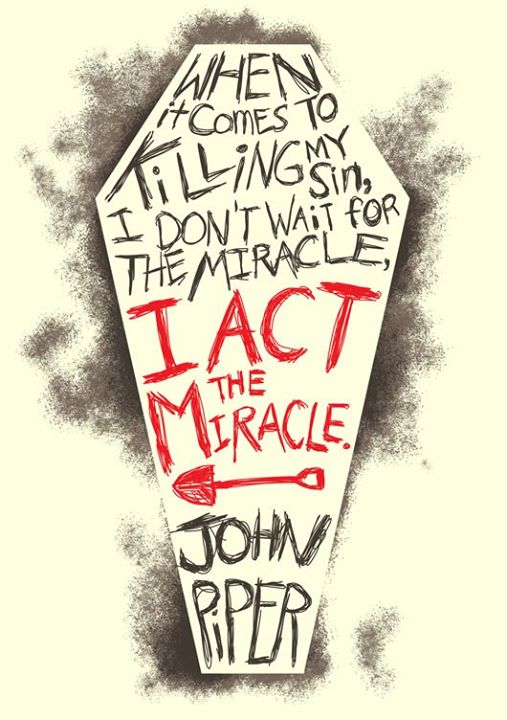
Killing My Sin, Before It Kills Me

killing-sin-act

We are for the most part anyway, eager to please God. We are Jesus’ people with the occasional brush with sin. But hey, who doesn’t? But that attitude must be questioned.

“My little children, these things I write to you, so that you may not sin.”

1 John 2:1

John hopes that his readers would make a choice— not to commit sin. After all, what soldier goes into battle with the intent of getting just a little wounded? Often we will sin just because it seems so inevitable, and we feel we can’t help ourselves. (But the reality is that we can.)

But the Holy Spirit now lives inside. Cooperation with Him is needed. Often we will work ourselves into a ‘no win scenario’ where we believe that sin rules. We can’t beat it, so we stop trying. That is common, and sad.

‘Passivity’ is defined as not participating readily or actively; inactive. When we are passive spiritually, we disengage ourselves from any effort of living holy and pure lives. Not being ‘hot’, but content to be lukewarm. At this point sin becomes, reluctantly, tolerated. “After all, I’m a sinner, what else can I do?”

Mentally ill people are often passive. We are told that we have an uncontrolled illness which dictates that we act ‘irresponsible.’ Our depression often escalates and we feel victimized by it. My experience has taught me that there are three kinds of depression:

  • organic depression, or the ‘biochemistry’ of the disease,
  • guilty depression, the kind that feels bad because of what we’ve done (or didn’t do),
  • reactionary depression, the type we feel when experiencing a loss, a loved one, or a job

Depression will almost always fall in these three categories. And passivity plays a part in all three. We  frequently feel victimized and ‘acted upon.’ When it comes to our discipleship we don’t act, we react. We are utterly convinced of the Bible— God’s truth, but we are so sporadic we can’t seem to get it to work for any length of time.

Yes, we are believers. And yes, we have issues. We’re waiting for a miracle, and hope we get a breakthrough soon.

At the base point of our lives, quite often, there is a passive attitude. Passivity aggravates our depression or mental illness. It deepens, spreading through our lives like a contagious illness. Our discipleship sputters and stalls. We no longer act on God’s Word, but we find ourselves fabricating a faith that makes allowances for our situation.

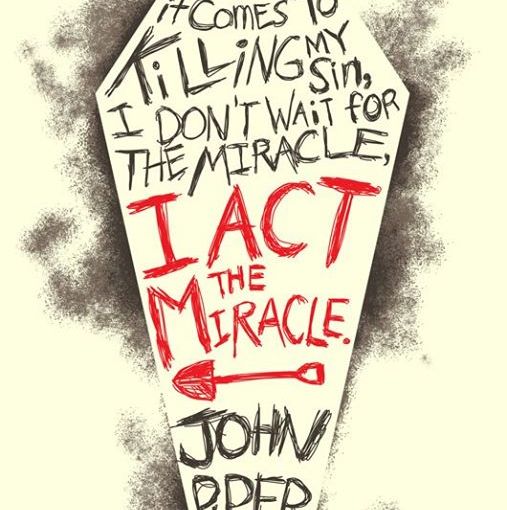
But we must ‘act the miracle.’ Everything God gives… everything… must be received by a convinced faith. We must be persuaded to give up our flawed ideas, and believe God for the real thing. I opened up this with 1 John 2:1. But there’s much more to this verse:

“My little children, these things I write to you, so that you may not sin.  And if anyone sins, we have an Advocate with the Father, Jesus Christ the righteous.”

I don’t want you to sin. Avoid sin. But even if you do— we have someone who will plead our case before God. He stands and argues our plight. He loves us that much.


bry-signat (2)

cropped-christiangraffiti1.jpg


How Things Grow, [Work]

plow1930s

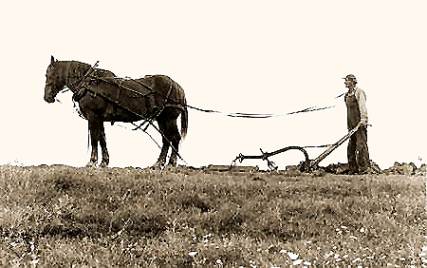
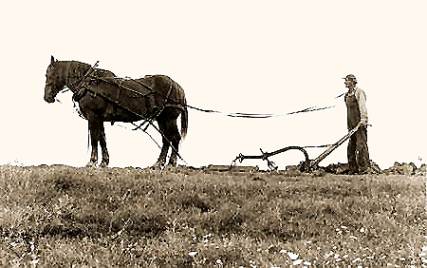
A farmer slowly walks behind his plow. The ground is hard and unyielding, but the steel cuts the heavy sod like a knife. He is preparing the soil for receiving the seed. He knows that what he is doing is imperative and he shouts out to encourage the horse. Its getting late and he wants to cut another furrow before night.

Plodding behind the plow he thinks many things. He can break up the ground, till and fertilize it, sow the seed— and then wait. He is powerless it get the seed to germinate and grow. He is limited to cultivating the soil and waiting. That is all he can really do, and he accepts this powerlessness. He can do everything right, and still not have a crop. All he can do is his part.

The farmer works in partnership with God. He is dependent on Him to grow the seed. The farmer must rely on the weather to meet and engage the planted seed. There are no shortcuts here. He does all he can, and then hopes that it is enough.

Farming is a joint endeavor between man and God. The man does what he has to do. God takes what the man has done and then finishes it. The crop will grow because He wills it. The farmer plays a part for sure, but ultimately God must become involved. Afterall, He makes the seed to sprout and grow.

We can say decisively that the pursuit of holiness in a Christian’s life is a joint endeavor between a believer and God.

Each have made the effort. The Christian does what is necessary, and then the seed is finally sown. It is then up to God to make the seed become the seedling. But each must work to finish the growth.

No one can attain holiness in their life apart from the work of preparation (it’s indeed work). The man must prepare the ground through plowing and cultivating. The farmer works the ground in order to make the ground ready. On the other hand, God provides both the environment and the growth needed to grow the seedling. Both the farmer and God must do their work.

A life of holiness is not automatic. It will never come at measured pace, trickling into our souls at a mechanized rate. (It would be nice if it would). Rather it wheat-field-landscape-picture_1920x1200_79595seems to come, in fits and spurts, sputtering rather than simply flowing.

Holiness is like a steamy Amazon jungle, vibrant and full of life. It is saturated with things living and green. It is not like an arid and sterile desert. Holiness is pulsating and powerful, full of lush growing things.

Becoming a person of holiness is the grandest adventure for the human soul. It defies our tendency to be rigid and legalistic. It is quite the opposite. It is tapping into life itself, and who is up to the task? Our morbid ideas of what holiness are not worthy of what really is.

Yes, to be holy is to work. Just as the farmer must prepare the soil for the seed, we too must guide our plows. God is ready to sow, and we should be ready to be ready. That is if we want to be fruitful and productive.

“Oh, the fullness, pleasure, sheer excitement of knowing God on earth!”

 Jim Elliot

bry-signat (1)

cropped-christiangraffiti1.jpg

Humility and the Broken Believer

humility-universe-stars

“…they should be gentle and show true humility to everyone.”

Titus 3:2

“Humility is perfect quietness of heart. It is for me to have no trouble; never to be fretted or vexed or irritated or sore or disappointed. It is to expect nothing, to wonder at nothing that is done to me, to feel nothing done against me. It is to be at rest when nobody praises me and when I am blamed or despised.

It is to have a blessed home in the Lord where I can go in and shut the door and kneel to my Father in secret and be at peace as in a deep sea of calmness when all around is trouble. It is the fruit of the Lord Jesus Christ’s redemptive work on Calvary’s cross, manifested in those of His own who are definitely subject to the Holy Spirit.”

—Andrew Murray

As believers who have been broken on the wheel of life, we will sometimes struggle with “the what-ifs”.  What if I could have stayed stable, we ask ourselves.  We are so busy thinking about what-could-of-been and we miss the opportunities we now have as a broken person.  Murray apparently reached a place where he could find peace with whatever happened.

We who struggle with depression, or with mania or delusions have much to deal with.  We are not really accepted by our pastors and church and it seems we fight a very private battle.  It seems that we will never reach our potential. Humility becomes a way to escape many of these issues.

But no matter what happens, through whatever misunderstanding I must endure, peace is found in humbling myself. Without humility there will not be any peace.

Someone once told me, “always try to do someone else’s will rather than your own.”

“How great victory was that which Jonathon must have gained over himself, when he rejoiced to see David raised above him! He discerned the mind of God in David, and had so learned to delight in God, that he did not see in David one who was to outshine him, but another faithful man raised up for God and Israel.”

–Robert C. Chapman

Someone once told me, “always try to do someone else’s will rather than your own.”  I think that is excellent advice.

V
bry-signat (1)
cropped-christiangraffiti1.jpg

Harmless Doves, [Opting Out of Cynicism]

cynicism_graffiti

cynical, (a definition)

sinikəl/adjective

1.  believing that people are motivated by self-interest; distrustful of human sincerity or integrity. Contemptuous; mocking.
        “her cynical attitude”
        “he gave a cynical laugh”

2. concerned only with one’s own interests and typically disregarding accepted or appropriate standards in order to achieve them.

Dictionary.com

I want to speak from my heart. I woke up this morning intensely cynical about the world. I hate to think I’m becoming critical or judgmental, but whatever it is I must take it in prayer to Jesus. I feel like I’ve been bit by a snake– a venomous one at that.

When I think of our Lord’s example, it helps a great deal. He who knows every man’s heart and motives and that didn’t discourage him. He knew when he came what each of us had done, and was capable of doing.

There was this incident at the Temple:

23 Now while he was in Jerusalem at the Passover Festival, many people saw the signs he was performing and believed in his name. 24 But Jesus would not entrust himself to them, for he knew all people. 25 He did not need any testimony about mankind, for he knew what was in each person.

John 2:23-25, NIV

People can’t be trusted. Our motives and our desires, although hidden from men, are clear to God. And yet He loves us deeply. And love, “keeps no record of wrongs” (1 Cor. 13:5.) In his humanity, Jesus was tempted in every way. Discouragement and despair over the sin of men was resisted.

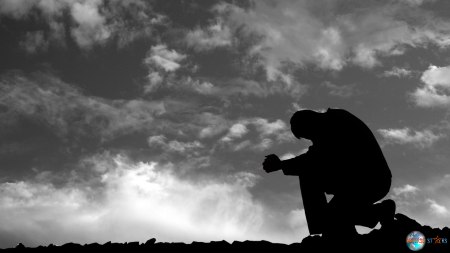
We can become cynical and jaded over the wrongs of others– it’s easy to do. There can become a ‘coarsening’ and a hardness of heart. That is dangerous. It requires a touch from Jesus. It means its time we get on our knees.

dove_peace_black_white_line_art_christmas_xmas_peace_on_earth-1979pxWhen Jesus sent out his disciples he encouraged them, ““Behold, I send you out as sheep in the midst of wolves. Therefore be wise as serpents and harmless as doves.” (Matt. 10:16.) He knew the hostile human heart had its own agendas– people would be like wolves. But though they would see first-hand the deceitfulness of many, they were to be wise, and be completely harmless.

The Holy Spirit will keep us close as we seek his victory in this matter. We will be transformed into the likeness of Christ. Exchange your attitude with His. He will strengthen you. We can renounce the spirit of judgmentalism that is so pervasive. We will love the way he loves.

I know there is much more to say about this. But now the Spirit is prompting me to pray through this issue myself.

bry-signat

cropped-christiangraffiti1 (3)