Led Aside by Jesus, [Consideration]

“He took the blind man by the hand and led him outside the village. When he had spit on the man’s eyes and put his hands on him, Jesus asked, “Do you see anything?”

–Mark 8:23, NIV

Here I can imagine the gentleness and the kindness of Jesus–we see Him leading this man out of town to a quieter place. Showmanship?  Not on your life.  Jesus has made the decision to avoid the theatrics of a blind man given sight, and ducked the paparazzi for a moment to touch this man.

In a way, we are all like this blind man.  We stumble around and try to make our way.  But it is raucous confusion– the fields of philosophy, religion, psychology, politics and art are not much more than a blind men tapping with his cane, trying to find their way into the light.  This may be rather simplistic, but I believe it’s more true then we care to admit.  The entire social history of humans is based on confusion and conflict.

We grope in the gloom, and there is none to take our hand and lead us out of the darkness.  We stumble and fall, and come no closer to understanding then when we first started.  It is hopeless.  Our striving borders on madness and insanity.

The blind man in Mark 8 entrusted himself to Jesus’ care.  He willingly went with Jesus, following down the path and out of the village.  Jesus carefully leads him by the hand, which is quite remarkable.  (I guess I’m envious.)  Jesus would have led this man past every obstacle.

Each of us have to encounter Jesus for ourselves.

We are born blind, having no awareness (zero, zilch, nada) of spiritual truth.  We must be taught to see.  At the airport in Salt Lake City recently, I saw a young blind man being led through large crowd.  I was fascinated by his trust in his guide as people jostled to try to make their connections.  There was a quiet composure in him.  (In his place, I would be terrified.)

We must trust Jesus, with that same composure and grace.  When we cannot see, we must trust.

“I do not try to see my way,
Before, behind, or left, or right;
I cannot tell what dangers gray
Do haunt my steps, nor at what height
Above the sea my path doth wind:
For I am blind. 

“Yet not without a guide I wend
My unseen way, by day, by night;
Close by my side there walks a Friend,——
Strong, tender, true: I trust His sight;
He sees my way before, behind,
Though I am blind.”

by an Unknown Author

bry-signat

cropped-christiangraffiti1-3


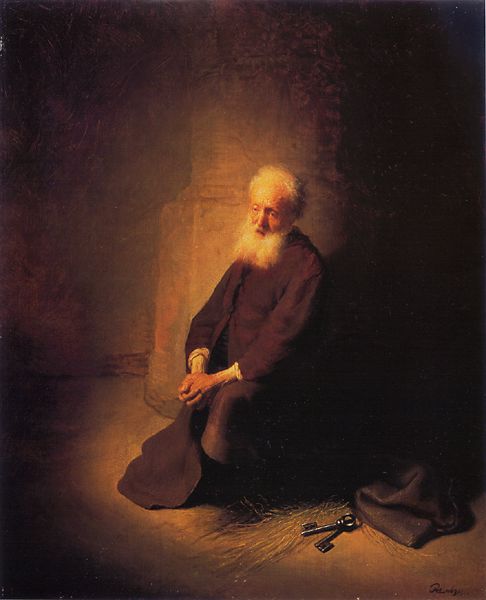
Impulsive Peter

Peter was the magnificent failure.  But I’m grateful for his story.  As we examine his life and his actions and decisions, we see a man who was so much like us.  I relate and understand Peter more then any other disciple in the New Testament.  He was so real. He was so impulsive. He spoke before he thought, jumped in without looking and acted without thinking it through. Let’s take a look at Peter’s life after he met Jesus.

1) Peter, the fisherman-– When Jesus came to where  the boat was kept, Peter latched on immediately to become a disciple.  Jesus said, “Follow Me” and that is all Peter needed to hear.  (Matt 4:18-20; Matt. 14:25-31).

2) Peter, the bold-– There was a situation on a boat in a terrible storm.  It was between 3:00 am and 6:00 am.  These men are desperately exhausted, and they were still three miles from safety.  They suddenly see what appears to be a ghost, walking through the vicious storm to the boat.  It is Jesus!  He is walking on water, as if it were a sidewalk!

Peter shouts out– “Lord, if it is really you, allow me to leave this boat and let me come to you!”  Peter steps out of the boat, and begins to walk– on water!  But the wind whipping frightened him, and he began to sink.  We see Jesus, reaching out to grab Peter, to save him from drowning.  Before we judge him too harshly, how many of us would do what Peter did?

3) Peter, the confessor— Jesus asked His disciples who they thought He was. Peter was the first to acknowledge Jesus’ deity as the Son of the living God. (Matt. 16:15-16)

4) Peter, the witness— Peter, along with James and John, have been chosen to accompany Jesus to go up to a mountain top to pray.  When they arrive, something happens to Jesus.  He is ‘transfigured’, His clothes shimmer and turn white.    Then Moses and Elijah appeared, talking with Jesus. Being a man of action and not knowing what else to do, Peter offered to build shelters for the three holy men. An authoritative voice from heaven let him know that this was a time to worship, and to learn (Matt 17:1-4, Luke 9:28-36).

5) Peter, the reluctant one— Just before their last Passover, Jesus starts acting strange.  He strips off His outer garments, until He is down to His underwear.  He fills a basin with water, grabs a towel, and then begins to wash everyone’s feet.  He has become the servant to His disciples.  And Jesus will declare that this specific path is for every disciple that will follow.  Peter is incensed, and declares himself to be immune from this claim.

6) Peter, the boaster— Jesus explains that the disciples cannot follow Him.   Peter boasted that he would lay down his life for Jesus. This brought Jesus’ prediction that Peter would deny Him three times that very night. I wonder what Peter thought about this. He may have found it hard to believe, but we know that Jesus never lies.

When Jesus is arrested, Peter follows the cohort into the Temple.  It is at this point, Peter begins to outright deny Jesus.  It seems Peter can’t vocalize any support for His teacher and master.  In his craven fear, Peter denies Him who spoke and taught him.  How very sad,  (John 13 and 18).

7) Peter the repentant— Jesus appeared to them again by the Sea of Gaililee.  It is Peter, who from his fishing boat, identifies Jesus as Jesus.  Once again, he jumps out of the boat, but this time to swim to the shore.  The others follow in the boat.  Jesus has started a fire, and fish are frying. On the shore, when they had finished eating, Jesus restores Peter. Peter reaffirmed his love for Jesus three times – the same number of times he had denied Him. Jesus said to Peter, “Follow me.”

From that point, Peter followed Jesus closely. He went on to be a great preacher of the gospel and a leader of the church. He wrote 1st and 2nd Peter in the New Testament.  In the Book of Acts, we see Peter cooperating closely with the Holy Spirit.  His compulsiveness has been majorly modified and adapted to fit into the Kingdom.  Peter is now a man restrained and directed into God’s Kingdom.

1brobry-sig4 (2)


cropped-christiangraffiti1-3-1


Gold Fears No Fire, [Comfort]

Things fall apart

“He comforts us every time we have trouble, so when others have trouble, we can comfort them with the same comfort God gives us.”

-2 Cor. 1:4, NCV

“The sinners in Zion are afraid;
    trembling has seized the godless:
“Who among us can dwell with the consuming fire?
    Who among us can dwell with everlasting burnings?”

Isaiah 33:14, ESV

There has to be some sort of confusion here. Some discrepancy, some incongruity, something overlooked. But things are never what they seem, and that is accentuated when we are in real pain. We think that whatever trouble we get enmeshed in, can’t have any real redeeming value. Or does it?

After a period of time walking with God, whose presence is true fire, we should process this prominent thought. Suffering is part of God’s idea. He has plans that hinge on our pain. It has been deliberately placed into our lives.

A competent pharmacist will be extremely aware of the drug he is filling for a patient. Never too much, nor too little. God is even more meticulous and acutely alert when it comes to suffering and pain. He has an intense love for you through it all. He drops in the proper amount needed for that moment.  It is confined and designed to heal, grow, and strengthen. Never to harm or destroy. He is not punishing you.

“Character cannot be developed in ease and quiet. Only through experiences of trial and suffering can the soul be strengthened, ambition inspired, and success achieved.”

Helen Keller

Keller understood. She was both deaf and blind, since infancy. From this dark and complete isolation, she broke through. Helen Keller became a potent and significant woman. She would graduate from college and became a famed public speaker of international renown.

“God never allows pain without a purpose in the lives of His children. He never allows Satan, nor circumstances, nor any ill-intending person to afflict us unless He uses that affliction for our good. God never wastes pain. He always causes it to work together for our ultimate good, the good of conforming us more to the likeness of His Son” (see Romans 8:28-29).

Jerry Bridges

Gold fears no fire.

We must believe pain has purposes. Life teaches us how to love. Some seem to go through life “charmed”, they are really not hurt in any substantial way. If that is the case, reach out and help someone else, for there’s certainly enough pain and evil to go around. (We should find ourselves actively sharing in the trials of others.)

I think that when a believer finally arrives in heaven, they will be ushered in limping, wounded, leaning on an angel for support. They will bring it all to Jesus, their scars remembered, and their sins forgiven. And we will be transformed, fit for heaven.

aabryscript

cropped-cropped-christiangraffiti1.jpg

The Real Treasures, [Weaknesses]

treasure

As Christians often our theology tells us that mental illness, depression, and bipolar disorder have no place in the believer’s life.  So we hide, sneaking into our sessions with our therapists, and change the subject to minimize our exposure to direct questions. We have had to hide our issues really well. 

But I would submit to you that it is we who are closest to the Kingdom of God. It is far easier for us to approach the Father, in our brokenness, humility, and general lostness. We have needs; a sound mind, a healthy body and we know it. We have no illusions of wellness, nothing can convince us that we are well. We are not.

We are broken and only our loving creator can mend us.

You might say that the Church needs us. An Archbishop was given an ultimatum by the Huns who surrounded his cathedral. “You have 24 hours to bring your wealth to these steps”, the war-leader demanded. The next morning the Archbishop came out leading the poor, the blind, the lame, and the lunatics. “Where is your treasure? Why have you brought out these… people?” The Archbishop simply and quietly replied, “These are the treasures of the Church, these who are weak are our valuables. They make us rich.”

We often can value giftedness more than weakness.

I am afraid the the Western Church no longer sees its “treasures” like it should. In our pride and self-centeredness we have operated our churches like successful businesses. We value giftedness more than weakness. We definitely have no room for the desperately weak. I suppose it’s time for the Church to begin to act like Jesus.

Church isn’t where you meet. Church isn’t a building. Church is what you do. Church should be a verb.  Church is who you are. Church is the human outworking of the person of Jesus Christ. Let’s not go to Church, let’s be the Church.

bry-signat

flourish88