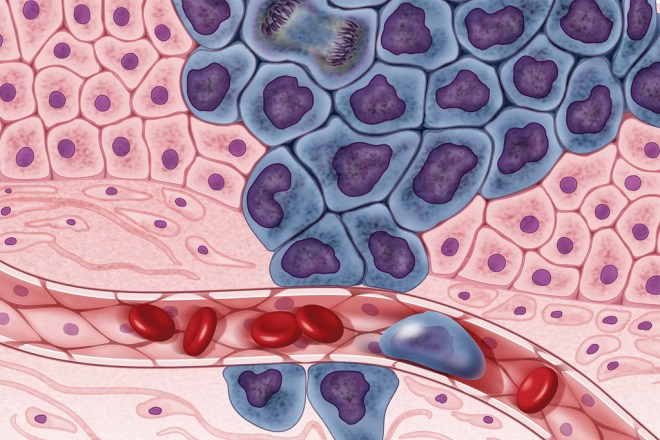
Christ and Cancer

NIH illustration
illustration by NIH
by John Piper

Before I entered college I hardly gave a thought to cancer and terminal illness. But ever since those college days death by disease has walked beside me all the way. Two of my college acquaintances died of leukemia and cancer of the lymph glands before they were 22. At seminary I watched Jim Morgan, my teacher of systematic theology, shrivel up and die in less than a year of intestinal cancer. He was 36. In my graduate program in Germany my own “doctor-father,” Professor Goppelt, died suddenly just before I was finished. He was 62—a massive coronary. Then I came to Bethel, the house of God! And I taught for six years and watched students, teachers, and administrators die of cancer: Sue Port, Paul Greely, Bob Bergerud, Ruth Ludeman, Graydon Held, Chet Lindsay, Mary Ellen Carlson—all Christians, all dead before their three score and ten were up. And now I’ve come to Bethlehem and Harvey Ring is gone. And you could multiply the list ten-fold.

What shall we say to these things? Something must be said because sickness and death are threats to faith in the love and power of God. And I regard it as my primary responsibility as a pastor to nourish and strengthen faith in the love and power of God. There is no weapon like the Word of God for warding off threats to faith. And so I want us to listen carefully today to the teaching of Scripture regarding Christ and cancer, the power and love of God over against the sickness of our bodies.

I regard this message today as a crucial pastoral message.

You need to know where your pastor stands on the issues of sickness, healing, and death. If you thought it was my conception that every sickness is a divine judgment on some particular sin, or that the failure to be healed after a few days of prayer was a clear sign of inauthentic faith, or that Satan is really the ruler in this world and God can only stand helplessly by while his enemy wreaks havoc with his children—if you thought any of those were my notions, you would relate to me very differently in sickness than you would if you knew what I really think. Therefore, I want to tell you what I really think and try to show you from Scripture that these thoughts are not just mine but also, I trust, God’s thoughts.

Six Affirmations Toward a Theology of Suffering

So I would like everyone who has a Bible to turn with me to Romans 8:18–28. There are six affirmations which sum up my theology of sickness, and at least the seed for each of these affirmations is here. Let’s read the text:

I consider that the sufferings of this present time are not worth comparing with the glory that is to be revealed to us. For the creation waits with eager longing for the revealing of the sons of God; for the creation was subjected to futility, not of its own will but by the will of him who subjected it in hope; because the creation itself will be set free from its bondage to decay and obtain the glorious liberty of the children of God. We know that the whole creation has been groaning in travail together until now; and not only the creation, but we ourselves, who have the first fruits of the Spirit, groan inwardly as we wait for adoption as sons, the redemption of our bodies. For in this hope we were saved. Now hope that is seen is not hope. For who hopes for what he sees? But if we hope for what we do not see, we wait for it with patience.

Likewise the Spirit helps us in our weakness; for we do not know how to pray as we ought, but the Spirit himself intercedes for us with sighs too deep for words. And he who searches the hearts of men knows what is the mind of the Spirit, because the Spirit intercedes for the saints according to the will of God.

We know that in everything God works for good with those who love him, who are called according to his purpose. (RSV)

1. All Creation Has Been Subjected to Futility

My first affirmation is this: the age in which we live, which extends from the fall of man into sin until the second coming of Christ, is an age in which the creation, including our bodies, has been “subjected to futility” and “enslaved to corruption.” Verse 20: “The creation was subjected to futility.” Verse 21: “The creation will be freed from slavery to corruption.” And the reason we know this includes our bodies is given in verse 23: not only the wider creation but “we ourselves (i.e., Christians) groan in ourselves awaiting sonship, the redemption of our bodies.” Our bodies are part of creation and participate in all the futility and corruption to which creation has been subjected.

Who is this in verse 20 that subjected creation to futility and enslaved it to corruption? It is God. The only other possible candidates to consider would be Satan or man himself. Perhaps Paul meant that Satan, in bringing man into sin, or man, in choosing to disobey God—perhaps one of them is referred to as the one who subjected creation to futility. But neither Satan nor man can be meant because of the words “in hope” at the end of verse 20. This little phrase, subjected “in hope,” gives the design or purpose of the one who subjected creation to futility. But it was neither man’s nor Satan’s intention to bring corruption upon the world in order that the hope of redemption might be kindled in men’s hearts and that someday the “freedom of the glory of the children of God” might shine more brightly. Only one person could subject the creation to futility with that design and purpose, namely, the just and loving creator.

Therefore, I conclude that this world stands under the judicial sentence of God upon a rebellious and sinful mankind—a sentence of universal futility and corruption. And no one is excluded, not even the precious children of God.

Probably the futility and corruption Paul speaks of refers to both spiritual and physical ruination. On the one hand man in his fallen state is enslaved to flawed perception, misconceived goals, foolish blunders, and spiritual numbness. On the other hand, there are floods, famines, volcanoes, earthquakes, tidal waves, plagues, snake bites, car accidents, plane crashes, asthma, allergies, and the common cold, and cancer, all rending and wracking the human body with pain and bringing men—all men—to the dust.

As long as we are in the body we are slaves to corruption.

Paul said this same thing in another place. In 2 Corinthians 4:16 he said, “We do not lose heart, but though our outer man (i.e., the body) is decaying (i.e., being corrupted) yet our inner man is being renewed day by day.” The word Paul uses for decay or corrupt here is the same one used in Luke 12:33 where Jesus said, Make sure your treasure is in heaven “where thief does not come near and moth does not corrupt.” Just like a coat in a warm, dark closet will get moth eaten and ruined, so our bodies in this fallen world are going to be ruined one way or the other. For all creation has been subjected to futility and enslaved to corruption while this age lasts. That is my first affirmation.

2. An Age of Deliverance and Redemption Is Coming

My second affirmation is this: there is an age coming when all the children of God, who have endured to the end in faith, will be delivered from all futility and corruption, spiritually and physically. According to verse 21, the hope in which God subjected creation was that some day “The creation itself also will be set free from its slavery to corruption into the freedom of the glory of the children of God.” And verse 23 says that “We ourselves groan within ourselves waiting eagerly for our adoption as sons, the redemption of our bodies.” It has not happened yet. We wait. But it will happen. “Our citizenship is in heaven from which we await a Savior, the Lord, Jesus Christ, who will transform the body of our lowliness to be like the body of his glory” (Philippians 3:20, 21). “In a moment, in the twinkling of an eye, at the last trumpet, for the trumpet will sound and the dead will be raised incorruptible and we shall be changed” (1 Corinthians 15:52). “He will wipe away every tear from our eyes, and there shall be no longer any death; and there shall be no longer any mourning or crying or pain; the first things have passed away” (Revelation 21:4).

There is coming a day when every crutch will be carved up, and every wheelchair melted down into medallions of redemption. And Merlin and Reuben and Jim and Hazel and Ruth and all the others among us will do cartwheels through the Kingdom of Heaven. But not yet. Not yet. We groan, waiting for the redemption of our bodies. But the day is coming and that is my second affirmation.

3. Christ Purchased, Demonstrated, and Gave a Foretaste of It

Third, Jesus Christ came and died to purchase our redemption, to demonstrate the character of that redemption as both spiritual and physical, and to give us a foretaste of it. He purchased our redemption, demonstrated its character, and gave us a foretaste of it. Please listen carefully, for this is a truth badly distorted by many healers of our day.

The prophet Isaiah foretold the work of Christ like this in 53:5–6 (a text which Peter applied to Christians in 1 Peter 2:24):

But he was wounded for our transgressions, he was bruised for our iniquities; upon him was the chastisement that made us whole, and with his stripes we are healed. All we like sheep have gone astray; we have turned every one to his own way; and the Lord has laid on him the iniquity of us all. (RSV)

The blessing of forgiveness and the blessing of physical healing were purchased by Christ when he died for us on the cross. And all those who give their lives to him shall have both of these benefits. But when? That is the question of today. When will we be healed? When will our bodies no longer be enslaved to corruption?

Continue reading Christ and Cancer

What Could Have Been

What do you regret? As a believer it is already forgiven.

“Many of us crucify ourselves between two thieves – regret for the past and fear of the future.”  

~Fulton Oursler

Regret is something that can really damage our lives. My dictionary defines regret as, “to feel remorse for, or to feel sorrow over something.” It’s often a difficult emotion for us, resulting in a paralysis of sorts. It is the personal sorrow about one’s behavior in a certain situation, that can be overwhelming.

There will always be a deep sense of loss for “what could have been.”

I regret many things, it seems my mind works as an active recorder. Future life continues its relentless advance, and there is from the past a constant awareness of darkness, failure and sin. Because the future comes at me so fast, I never really have time to reflect on the past.

There are some who have no idea what I’m talking about.

I might as well be speaking Chinese. But there are others who will “spark” on what I have just stated. Regret for many of us, is savage and bitter.

Not a day goes by when the voice of darkness doesn’t speak to us. My thinking is that it may be more reasonable to take a baseball bat across your femurs, and dealing with broken legs, than handling regret that has gone vicious and viral.

We think “about what could have been.” We imagine life without regret, of things we might have done not having this dark burden. However, these possible choices are things we can never be sure of.

In my younger days I dreamed of attending college, and then going to seminary. I really thought that I wanted to be a pastor, in some small Lutheran church in the Midwest. But this would never happen. It was just an aspiration, a dream. And it wasn’t reality (even though I wish it had been).

I assure you there are far more nastier and blacker regrets, there are things of which I am profoundly ashamed. But my point is this, they exist, they do unsettle us, and the present moment is corrupted by my past behavior.

I once read an interview with a prominent psychiatrist. He said something that connected with me. “Over 80% of mentally ill patients could be released from treatment if they only understand that they were forgiven.”

Regrets can be so strong, and so crippling that we will sometimes try to destroy ourselves.

You are not unique or alone. There are millions of sincere Christian believers who face what you are facing.

“The temptations in your life are no different from what others experience. And God is faithful. He will not allow the temptation to be more than you can stand. When you are tempted, he will show you a way out so that you can endure.”

1 Cor. 10:13, NLT

I must tell you that there is a spiritual war. Satan is the enemy of our souls. He will bring to your mind fear and confusion. In scripture, he is called “the accuser of the brethren.” He has a diabolical ministry to bring you down. He operates out of pure hatred.

He will never show you any mercy.

We must develop a more scriptural method of wrapping up our minds in God’s Word. It stops and deadens the spiritual radiation from the enemy. The Word has tremendous power to halt the enemies attack. The only way to survive all of this is to dress up yourself in spiritual armor.

“Therefore take up the whole armor of God, that you may be able to withstand in the evil day, and having done all, to stand firm.”

Ephesian 6:13

cropped-christiangraffiti1-2

Self-Destruction

“For whoever finds me finds life
and receives favor from the Lord.
But those who miss me injure themselves.
All who hate me love death.”  

Proverbs 8:35-36

“There are seeds of self-destruction in all of us that will bear only unhappiness if allowed to grow.”  Dorothea Brande 

*

“If one looks with a cold eye at the mess man has made of history, it is difficult to avoid the conclusion that he has been afflicted by some built-in mental disorder which drives him towards self-destruction.”   Arthur Koestler 

*******

 Among people with a mental illness, there is a sort of impulsivity, and in advanced cases we can see a ‘self-destructive behavior‘.  We do things, superficially we recognize and even assert that it is detrimental, but we will continue to do it regardless.  Those ‘in the know around us’ can’t believe what we are doing. It is totally irrational.

Bipolar, schizophrenia, and many other mental illnesses have impulsivity as a common aspect of their disease processes.

  • We drink,
  • do drugs,
  • do pornography, strippers
  • steal from our friends,
  • cut ourselves,
  • misuse our credit cards (and go deeply in debt)
  • get crazy at rock concerts,
  • and much more.

We are impulsive and we do things that a healthy person would never do.  We consistently choose the worst things and we can’t seem to stop ourselves.

We are the ‘wild children,’ we just seem to thrive on the edge of destruction, repeatedly.  This is in spite of the consequences.  We just don’t worry about the side-effects of our choices.  We don’t think ahead, all we think is of the moment.  We consistently choose what is really bad for us, and then throw ourselves headlong into the darkness.  The more we do these terrible things, the wilder it seems to get.

We can’t seem to stop. 

I can say this because I had a personal issue with ‘self-destruction’.  You might say I have a ‘Masters degree’ in it.  I have gotten very proficient at it, and have utilized deception to cover my tracks.  So much of my life is hidden and I seem to float my darkness out in such a way as to diffuse questions and to excuse awful nasty behavior.

Being impulsive/self-destructive is a hard life in many ways. 

We cultivate an image to others that we have really never attained.  We are very good at deception, we have discovered how to do and say what we want without others “getting in our faces.” Being impulsive, ready to step into the most pleasurable darkness, becomes something we must cover up, at all costs.

“Can a man scoop a flame into his lap
    and not have his clothes catch on fire?”

Proverbs 6:27

Am I secretly drinking, doing drugs or using sex (esp. in pornography)?  The impulses that drive us to do this stuff will become the way we experience destruction, but somehow we don’t seem to get it.  The mentally ill have a horrendous rate of alcoholism and addiction.  I’ve seen figures that put us at 80% that have significant issues.  We seem to be ‘self-medicating’ ourselves to escape, or trying to get some stability.

When we come to Jesus, we discover that He loves us completely, including our ‘hidden side’.  His love comes to us without any conditions.  We are free to do whatever we want.  However, we will find that ‘sin accepted’ is very brutal to us.  Smashing out heads against a brick wall, over and over, doesn’t make the wall any softer.  And yet we continue to do the most foolish thing we can do, and then we–  REPEAT.

There is a way out of this.  But few will really do it. 

It’s called ‘public confession.’ We get it out into the open, where the sun shines, and it will be seen exactly for what it is.  We choose not to live out our lives in secretiveness. We must learn the skills of transparency, as we lay out our evil, our deception for the church to see.

When we deceive others, we will end up deceiving ourselves.  We absolutely cannot continue a life in darkness, or in long-term sin. wPeop cover their faults and excuse themselves do not have a repeneir faults and excuse themselves do not have a repentant spirit.

***

cropped-christiangraffiti1-3-1

Bethesda, 31 A.D.

healing-the-lame

“Afterward Jesus returned to Jerusalem for one of the Jewish holy days. 2 Inside the city, near the Sheep Gate, was the pool of Bethesda, with five covered porches. 3 Crowds of sick people—blind, lame, or paralyzed—lay on the porches.5 One of the men lying there had been sick for thirty-eight years. 6 When Jesus saw him and knew he had been ill for a long time, he asked him,“Would you like to get well?”

7 “I can’t, sir,” the sick man said, “for I have no one to put me into the pool when the water bubbles up. Someone else always gets there ahead of me.”

8 Jesus told him, “Stand up, pick up your mat, and walk!”

9 Instantly, the man was healed! He rolled up his sleeping mat and began walking! But this miracle happened on the Sabbath,

John 5:1-9, NLT

We were following Jesus and He led us to the pool of Bethesda. A crowd gathered quickly, but I jostled myself right up front. We stood waiting, we pretty much knew something big was going to happen. And it did. I can never be the same, after what I saw. This is my simple story.

So much was happening, and as I watched I realized that so much escapes me. I can’t take it all in. But when I decide to watch Jesus, I quickly become aware of what is important, what is real. It starts to make sense. The chaos of the moment becomes calm. At least it does when He takes charge.

There were hundreds of sick people camped out. They are laying under the roofs, with their thin mats. The smell alone was really bad, all were unwashed and some with putrid and festering sores. Dirty bandages are used over and over, and shared with all.

Finally, all are watching Jesus, they become quiet wondering what He will say. We’re all pretty curious. We see Jesus as He walks directly into this ugly field of suffering people. He doesn’t hesitate or flinch.

It is almost like He is at home in this dreadful place.

Just to have a religious teacher visit Bethesda is rare. They never come. And today is the Sabbath (and a special feast day at that) and that alone makes it impossible. And yet Jesus is here, and that somehow is wonderful.

Jesus stops to talk with a man who is an ‘old-timer’ here in this horrible place of pain. This man had been sitting here for almost 40 years, and that is a long, long time. Jesus speaks. “Do you want to get well?” Jesus waits quietly.

“Sir, when the water is stirred, I don’t have anybody to put me in the pool. By the time I get there, somebody else is already in.” The man explains. He has an excuse that seems like a reason. Nothing has ever gone right– ‘I always miss out, and I can’t find anyone to help me.’ And I suppose that this is the world of the blind, the crippled, the paralyzed in Israel. They are confined to Bethesda, with the weak hope of finally being healed. I don’t think that this is how it was meant to work.

This man was horribly discouraged.  It was then Jesus said, “Get up, take your bedroll, start walking.” And this very crippled man was healed on the spot. No ‘hocus-pocus’, no incantations, no magic dust or rubbing of sacred bones. Nothing.

He was healed by a few spoken words.

I cannot emphasize my own astonishment enough. It shook all of us to the core. We were all stunned, and undone. The crowds, and all the sick and the paralyzed just stopped and stared. There are so few moments in life, just like this. We just looked at each other sort of stunned.

The ramifications of what we all had witnessed were staggering. Shocked, we turned to each other, and a great fear fell on us like a heavy blanket. The crowd did not disperse, we were completely shocked, and pretty much speechless.

For years that sense of awe has never left me.

I don’t really listen to the scorners anymore– they simply have no idea. It completely changed my life. I was never the same after that.

“For the Son of Man came to seek and save those who are lost.”

Luke 19:10

Kyrie elesion,  (Lord, have mercy on us.)

Bryan
 cropped-christiangraffiti1 (1)