Two O’ Clock in the Morning Poetry, #3

Collector_Trench

Middle Parts of Fortune, by Frederic Manning

“The air was alive with the rush and flutter of wings; it was ripped by screaming shells, hissing like tons of molten metal plunging suddenly into water, there was the blast and concussion of their explosion, men smashed, obliterated in sudden eruptions of earth, rent and strewn in bloody fragments, shells that were like hell-cats humped and spitting, little sounds, unpleasantly close, lie the plucking of tense strings, and something tangling his feet, tearing at his trousers and puttees as he stumbled over it, and then a face suddenly, an inconceivably distorted face, which raved and sobbed at him as he fell with it into a shell-hole.”
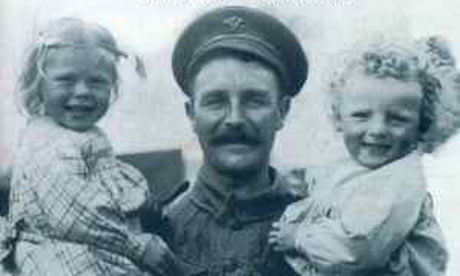
(Accounts of The Great War) 
R
FredricmanningManning was an Australian aspiring intellectual, already in his mid-30s when he enlisted as a private soldier in 1915. His prewar existence in England was dogged by unfulfilled literary hopes and emotional confusions. He served for only a few months in France, and his military career ended in alcoholism and disgrace. But in 1929 he composed a novel, obviously autobiographical, about three soldiers’ experience of the trench nightmare, which is outstanding. Almost certainly the finest work of its kind to emerge from the war. (Penguin)
&

Manning continued to write. In 1917 he published a collection of poems under the title Ediola. This was a mixture of verse predominantly in his former style alongside war poems heavily influenced by the imagism of Pound, which deal introspectively with personal aims and ideals tempered in the crucible of battle. He contributed to anthologies, for example, The Monthly Chapbook which appeared in July 1919 edited by Harold Monro, containing twenty-three poems by writers including John Alford, Herbert Read, Walter De La Mare, Osbert Sitwell, Siegfried Sassoon, D. H. Lawrence, Edith Sitwell, Robert Nichols, Rose Macaulay and W. H. Davies alongside Manning and Aldington. He wrote for periodicals, including The Criterion, which was produced by T. S. Eliot.

&&&

Poetry did not pay, and so in 1923 Manning took a commission from his publisher John Murray to write The Life of Sir William White, a biography of the man who, as Director of Naval Construction, led the build-up of the Royal Navy in the last years of the nineteenth century. Galton had died in 1921, which not only left Manning effectively homeless, but also lacking a forceful directing influence in his life. He lived for much of the time at the Bull Hotel in Bourne, apart from a short spell when he owned a farmhouse in Surrey. At this time he was friendly with T. E. Lawrence, then serving in the Royal Air Force at RAF Cranwell, some twenty miles (a motorcycle ride) from where Manning was living. In 1926 he contributed the introduction to an edition of Epicurus’s Morals: Collected and faithfully Englished by Walter Charleton, originally published in 1656, published in a limited edition by Peter Davies. — from Wikipedia and Penguin

&

Bonus–
wwi13
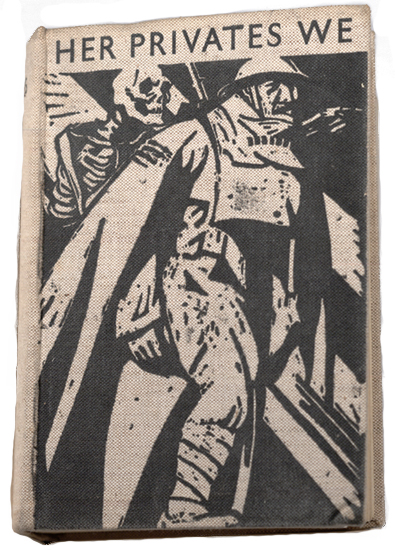
“Her Privates We” 1930, Cover art

Hell and Hope

inferno

Sometimes, I feel like a tour guide for believers that are walking through hell. I point out the different strugglers, and urge each one not to linger too long but to keep moving. We look on those trapped (they have no hope within them) but we hope that they are yet to reach out for the Savior. It is distressing, and yet somehow we understand them just a little bit.

Our journey out and down each sad corridor can be painfully disturbing for us. There are so many different types of prisons and chains used to confine and control. Dante wrote his “Inferno” (Italian, for hell), and somehow he in some curious way walks through the different levels (varieties) of hell with us. Virgil (Dante’s own tour guide) takes Dante through some pretty hairy stuff, and they pass through the very gate, which bears an inscription, of the infamous phrase “Lasciate ogne speranza, voi ch’intrate“, or “Abandon all hope, ye who enter here.”

Our own rescue from this dreadful place is based on that singular word, “hope”. Somehow, hope has distilled inside us, and that alone can enable us to walk out as the freed. We have chosen not to abandon hope, but to use it as our passport out of the bottom of hell itself. We show it to each guardian, and then pass through without any hinderance.

  • And so at last the poor have hope. (Job 5:16)
  • Having hope will give you courage. You will be protected and will rest in safety. (Job 11:18)
  • Lord, you know the hopes of the helpless. Surely you will hear their cries and comfort them. (Ps. 10:17)
  • All day long I put my hope in you. (Ps. 25:5)
  • Let your unfailing love surround us, Lord, for our hope is in you alone. (Ps. 33:22)
  • O Lord, you alone are my hope. (Ps. 71:5)
  • Your word is my source of hope. (Ps. 119:114)
  • “Listen to me, all who hope for deliverance— all who seek the Lord!” (Isa. 51:1)
  • And his name will be the hope of all the world.” (Matt. 12:21)
  • Even when there was no reason for hope, “Abraham kept hoping.” (Rom. 4:18)
  • We, too, wait with eager hope. (Rom. 8:23)
  • Rejoice in our confident hope. (Rom. 12:12)
  • The Scriptures give us hope and encouragement as we wait. (Rom. 15:4)
  • Three things will last forever—faith, hope, and love. (1 Cor. 13:13)
  • That you can understand the confident hope he has given us. (Eph. 1:18)
  • Our hope is in the living God, who is the Savior of all. (1 Tim. 4:10)
  • In order to make certain that what you hope for will come true. (Heb. 6:11)
  • This hope is a strong and trustworthy anchor for our souls. (Heb. 6:19)
  • Let us hold tightly without wavering to the hope we affirm. (Heb. 10:23)
  • They placed their hope in a better life after the resurrection. (Heb. 11:35)
  • You have placed your faith and hope in God. (1 Pet. 1:21)
  • If someone asks about your Christian hope. (1 Pet. 3:15)

I suppose we must say (it’s clear) that hope is what sets us free from the difficulty that rests in our minds. Whatever DSM-IV has branded us, whatever a psychiatrist has declared us to be, and whatever our therapist has told us– our hope, that’s in Christ, will open all doors that are closed and locked.

Hope really is the Christian’s freedom from hell. Those of us who have been freed from our incarceration from our mental illness are amazingly liberated. I know the lostness of being very much lost. But hope is everything. When our hope somehow connects with Jesus, our souls are set free. We walk out of hell, with our souls soaring clean.

kyrie elesion, Bryan

*

A Full Quiver, to Press the Enemy

Shoot-an-Arrow

In an old book of prayers, I discovered this list. As I read it, and pondered them, I felt like I had been given a giant pile of treasure. And I want to share the wealth with my friends.

The idea of “arrow prayers” maybe novel to you. I, myself, am a pure novice on these things. I often see the tremendous value, without the real commitment to live it out. I often aspire, but do not attain. (Lord, have mercy on me.)

Arrow praying is identified by a short, piercing exclamation. It has little flourish, and zero frills. Religious people will often not see their value. I’m convinced that believers with a broken life will understand. Broken people will often pray things that the Father hears. We do pray, but short and to the point. That is good.

“And Mary said, Behold the handmaid of the Lord; be it unto me according to thy word. And the angel departed from her.” Luke 1:38

“Glory to God in the highest, and on earth peace, good will toward men.” Luke 2:14

“Lord, now lettest thou thy servant depart in peace, according to thy word:” Luke 2:29

“And straightway the father of the child cried out, and said with tears, Lord, I believe; help thou mine unbelief.” Mark 9:24

““Save me, Lord!” he shouted.”  Matthew 14:30

‘ ‘O God, be merciful to me, for I am a sinner.’” Luke 18;13

“Jesus, remember me when you come into your Kingdom.”  Luke 23:42

“Abide with us: for it is toward evening, and the day is far spent. And he went in to tarry with them.” Luke 24:29

““Give me this water! Then I’ll never be thirsty again, and I won’t have to come here to get water.” John 4:15

“Sir,” they said, “give us that bread every day.” John 6:34

“Lord, to whom would we go? You have the words that give eternal life.” John 6:68

“Lord, your dear friend is very sick.” John 11:3

“Lord, show us the Father, and we will be satisfied.” John 14:8

“Yea, Lord; thou knowest that I love thee.”  John 21:16

“My Lord and my God!”  John 20:28

“Yes, I am coming soon!” Amen! Come, Lord Jesus!” Revelation 22:20

These are all prayers, hidden in something direct and cool. These words which are sudden and aware, and press us into a special sensitivity of godliness. Our own cries, will ride need to ride piggyback on these certain cries, and right into the heart of God.

Let us turn, as much as we are able, to the One who heals the flawed, and all those who are crooked. He loves us constantly, even when we are confused by our twistedness. I tell you, He keeps reaching out for the ungodly, for His glory and by His grace.

%

kyrie elesion, Bryan

(Lord, have Mercy on us, the sinners.)


A Mighty Fortress, Understood

martin_luther2 (1)Martin’s Depression

The hymn A Mighty Fortress Is Our God gloriously celebrates God’s power. It was penned by the great 16th-century reformer Martin Luther, who believed God’s power could help believers overcome great difficulties — even depression. Given his pastoral heart, he sought to bring spiritual counsel to struggling souls. His compassion for those souls shines in numerous places, including his sermons, lectures, Bible commentaries and ‘table talks’. In addition, he devoted many letters to counseling troubled folk.

Luther’s writings reveal his knowledge of various emotional difficulties. For example, in August 1536 he interceded for a woman named Mrs. Kreuzbinder, whom he deemed insane. He described her as being “accustomed to rage” and sometimes angrily chasing her neighbor with a spear.

In addition, Luther’s wife, Kate, struggled with pervasive and persistent worry indicative of generalized anxiety disorder. Prince Joachim of Anhalt, to whom Luther often wrote, exhibited signs of obsessive-compulsive disorder, and he believed he had betrayed and crucified Christ. Conrad Cordatus, a pastor and frequent guest at Luther’s table, exhibited signs of hypochondriasis, a disorder involving preoccupation with fears of having a serious disease.

Besides observing mental difficulties in others, Luther had a compelling reason to affirm their reality. Luther himself endured many instances of depression. He described the experience in varied terms: melancholy, heaviness, depression, dejection of spirit; downcast, sad, downhearted. He suffered in this area for much of his life and often revealed these struggles in his works. Evidently he did not think it a shameful problem to be hidden.

Satan as the “accuser of the brethren,” causes Christians to dwell on past sins. Such thoughts induce melancholy and despair. Concerning a friend’s depressive thoughts, Luther wrote, “Know that the devil is tormenting you with them, and that they are not your thoughts but the cursed devil’s, who cannot bear to see us have joyful thoughts.”   Luther recognized a spiritual truth about depression. One can expect Satan’s persistence until faith is destroyed, but in the midst of depression God is with us. He never leaves us alone. In the midst of trouble He draws near to us.

Sometimes the invisible God draws near through visible people, and they become the bearers of God’s comforting and strengthening words to troubled souls.  What’s more, God seeks to assure us of His love and esteem. And through His Word, He counters Satan’s lies with His truth.

Some Martin Luther Quotes

Luther's Seal
Luther’s Seal

“All who call on God in true faith, earnestly from the heart, will certainly be heard, and will receive what they have asked and desired.”

“Faith is a living and unshakable confidence, a belief in the grace of God so assured that a man would die a thousand deaths for its sake.”

“Christ took our sins and the sins of the whole world as well as the Father’s wrath on his shoulders, and he has drowned them both in himself so that we are thereby reconciled to God and become completely righteous.”

*

“A Mighty Fortress is Our God,” by Luther

1. A mighty fortress is our God,
a bulwark never failing;
our helper he amid the flood
of mortal ills prevailing. 
For still our ancient foe
doth seek to work us woe;
his craft and power are great,
and armed with cruel hate, on earth is not his equal.  

2. Did we in our own strength confide,
our striving would be losing,
were not the right man on our side,
the man of God’s own choosing.
Dost ask who that may be? 
Christ Jesus, it is he;
Lord Sabaoth, his name,
from age to age the same,
and he must win the battle.  

3. And though this world, with devils filled,
should threaten to undo us,
we will not fear, for God hath willed
his truth to triumph through us. 
The Prince of Darkness grim,
we tremble not for him;
his rage we can endure,
for lo, his doom is sure;
one little word shall fell him. 

*

ybic, Bryan

Quotes from, http://christian-quotes.ochristian.com/