Discernment and Your Ministry

zebras

“He begs God on behalf of a human
as a person begs for his friend.”

Job 16:21, NCV

I’ve been thinking about a class I had in Bible School.  The instructor made a comment that has stuck in my thinking for over 30 years now.  I have relied on it countless times in ministry since. It has helped me piece together certain issues of the heart.

When we “preach” to a person, we are actively accelerating the judgement of God in their life. When we pray for that same person, we delay this judgement and allow more room for the Holy Spirit to work.


Preaching

Now I know this is a generalization, and yet the basic premise of preaching and praying has a specific action.  When you preach, you are calling that person to make a decision.  They meet up with the truth and must decide for themselves.  This is a very sensitive moment.  If they consider your message at all– you must understand, one way or the other, that it will require a decision.  Either they act on it, or they’ll decide to reject it.

Within the Bible we often see judgement coming to someone, and very often it comes right after a “declaration of the truth” by a witness or a sermon.  Those who hear the word must choose to believe it, or spurn it.  Even a neutral position is a position. A decision must be made on all light that comes their way.

Prayer

Perhaps this may be easier to see.  The Word is full of men and women who interceded for others.  If preaching accelerates God’s judgement on a person (or group,) than prayer decelerates it.  In a sense, authentic intercession can give them more time.  It delays things, without approving them.

A classic case is Abraham.  He intercedes, and by doing so desires to save and deliver God’s own.  He “stands in the gap” for the unaware.  We see him “negotiating” with the Lord, trying to make a deal of sorts. He is bold and somewhat presumptuous. And actually, this is a regular occurrence with different circumstances.  Many in scripture do seem to get intensely involved in the lives of the people they represent.

“I will surely not stop praying for you, because that would be sinning against the Lord. I will teach you what is good and right.” 

1 Samuel 12:23

 Conclusion

Should we preach or pray?  We must consider, I think, the certain obligations of both.  I believe at the end of a person’s life, they have had both dynamics working.  Its like the tide– it ebbs and then advances, and perhaps that will help us to do the right thing at the right time.  We understand the necessity of preaching, and just as important the work of prayer.  We must do both, but grasp the issues behind each work.  Both are necessary for one to come to faith in Jesus.

Seeing the effects of our actions brings us into a deeper understanding of the life in the Spirit.  It motivates and will guide us.  We start to understand the Lord’s ways and become aware of what is happening in the world that is around us. This new discernment can only sharpen our work.

bry-signat

flourish9


Led Aside by Jesus, [Consideration]

“He took the blind man by the hand and led him outside the village. When he had spit on the man’s eyes and put his hands on him, Jesus asked, “Do you see anything?”

–Mark 8:23, NIV

Here I can imagine the gentleness and the kindness of Jesus–we see Him leading this man out of town to a quieter place. Showmanship?  Not on your life.  Jesus has made the decision to avoid the theatrics of a blind man given sight, and ducked the paparazzi for a moment to touch this man.

In a way, we are all like this blind man.  We stumble around and try to make our way.  But it is raucous confusion– the fields of philosophy, religion, psychology, politics and art are not much more than a blind men tapping with his cane, trying to find their way into the light.  This may be rather simplistic, but I believe it’s more true then we care to admit.  The entire social history of humans is based on confusion and conflict.

We grope in the gloom, and there is none to take our hand and lead us out of the darkness.  We stumble and fall, and come no closer to understanding then when we first started.  It is hopeless.  Our striving borders on madness and insanity.

The blind man in Mark 8 entrusted himself to Jesus’ care.  He willingly went with Jesus, following down the path and out of the village.  Jesus carefully leads him by the hand, which is quite remarkable.  (I guess I’m envious.)  Jesus would have led this man past every obstacle.

Each of us have to encounter Jesus for ourselves.

We are born blind, having no awareness (zero, zilch, nada) of spiritual truth.  We must be taught to see.  At the airport in Salt Lake City recently, I saw a young blind man being led through large crowd.  I was fascinated by his trust in his guide as people jostled to try to make their connections.  There was a quiet composure in him.  (In his place, I would be terrified.)

We must trust Jesus, with that same composure and grace.  When we cannot see, we must trust.

“I do not try to see my way,
Before, behind, or left, or right;
I cannot tell what dangers gray
Do haunt my steps, nor at what height
Above the sea my path doth wind:
For I am blind. 

“Yet not without a guide I wend
My unseen way, by day, by night;
Close by my side there walks a Friend,——
Strong, tender, true: I trust His sight;
He sees my way before, behind,
Though I am blind.”

by an Unknown Author

bry-signat

cropped-christiangraffiti1-3


So You Wanna Go Back to Egypt?


1867_edward_poynter_-_israel_in_egypt

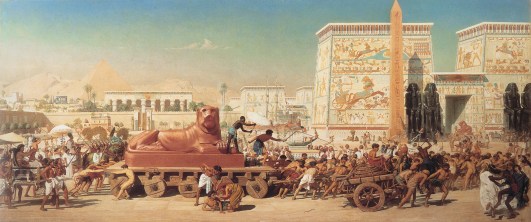
God has always wanted to lead His people. I think that He is almost catatonic with joy when we allow Him to do this. Throughout the ages, and all through Israel’s history, we see Him reaching out to people,  who are stubborn and selfish in their choices. But He reaches out to them anyway.

Israel had been sovereignly led out of Egypt. Miracle after miracle had made this happen. A dramatic exodus from slavery would make the front page that day. People from every generation would know that God was setting His people free.

God didn’t tell them the way, but rather showed them the path Himself. He led them with “a cloud by day and a pillar of fire by night” (Exodus 13:20-22). The people, however, repeatedly refused to trust their Deliverer-Shepherd. They hardened their hearts and rebelled against Him.

“Our fathers were unwilling to be obedient to him, but repudiated him and in their hearts turned back to Egypt, 40 saying to Aaron, ‘Make for us gods who will go before us; for this Moses who led us out of the land of Egypt—we do not know what happened to him.’”

Acts 7:39-40, NASB

They made the choice themselves, they would turn around. They would go back in slavery to Egypt. (Actually in their hearts, they had already done so!) They were rejecting and renouncing God, and turning their backs on Him.

But we are given what we want. Even if it takes us into bondage again.

When we begin to follow, God starts to lead. He takes an active role to guide and direct us, and to bring us into victory. When we try to go back to Egypt, we will experience His discipline.

“So Christ has truly set us free. Now make sure that you stay free, and don’t get tied up again in slavery…” 

Galatians 5:1, NLT

“Because of their unbelief they were not able to enter His rest” (Hebrews 3:19). Then the author draws a clear distinction: “They didn’t share the faith of those who listened to God. For only we who believe can enter His rest” (Hebrews 4:2-3).

There is a wonderful and real rest. But I am tempted to turn back. Will I decide to let God lead me?

1brobry-sig4 (2)

k

k

cropped-christiangraffiti1-3-1

The Art of Kneeling

6a00e551f9630d883301a3fd04a70e970b

“Come, let’s worship him and bow down. Let’s kneel before the Lord who made us.”  

Ps. 95:6, NCV

We come directly to Him, with so many deep and ugly flaws.  We step toward Him, having lost every confidence, but yet there is an assurance that we have arrived at something far beyond ourselves.

Mental illness destroys confidence.  In our most lucid and aware moments, we discover that we are completely disarranged.  We stumble and fumble through many things which are easy for others.  But they are intensely difficult for us.  My distinct paranoia has ruined many possible relationships.  I end up fouling many possible friendships to my loss.

We gravitate toward this place where we can only bow.  There are so many, far too many loose ends.  So much is unsure and I’m totally unready for this.  And yet, we have a nagging thought that we just might shatter these issues that hold us.  And maybe even break into a profound awareness of Light. Sometimes we can only bow without saying a word.

We must readily admit that we can only bow.

Nothing can be brought in, or considered as a provision or an enhancement to our credit. All of us are beggars and losers in His sight.  We simply can’t generate anything that just might make us acceptable in His eyes. The only thing acceptable is the blood of Jesus on the cross.

Everyone who truly kneels is brought to this place.  We are undone, completely.  In the light of His deep grace, we have been dismantled and rendered inoperative.  We must step out of our ruins, and leave them in a pile.  Sweet grace will save us, in fact, it is the only thing that can.

“We believe that we are all saved the same way, by the undeserved grace of the Lord Jesus.” Acts 15:11

bry-signat


cropped-christiangraffiti1-3-1