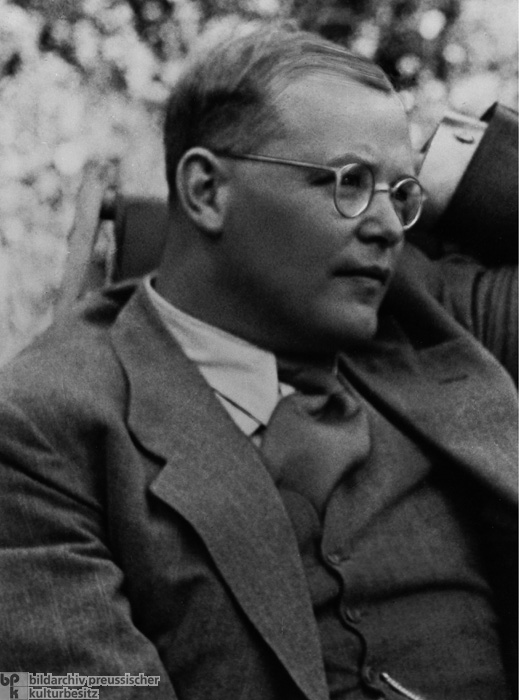
Dietrich Bonhoeffer, A Saint for Today

Dietrich Bonhoeffer (1906-1945) is known for his leadership role in the Confessing Church, efforts on behalf of peace and justice, opposition to antisemitism, and writings on theology and ethics that have been influential far beyond his German Lutheran context. He was was hanged by the Nazis on April 6, 1945 in the Flossenburg concentration camp.

Dietrich Bonhoeffer quotes:

In normal life we hardly realize how much more we receive than we give; life can be rich only with such realization. source: Letters and Papers from Prison

To be silent does not mean to be inactive; rather it means to breathe in the will of God, to listen attentively and be ready to obey. Meditating on the Word

It is not necessary that we should discover new ideas in our meditation. It is sufficient, and far more important, if the Word, as we read and understand it, penetrates and dwells within us. Life Together

When we come to a clearer and more sober estimate of our own limitations and responsibilities, that makes it possible more genuinely to love our neighbor. Letters and Papers…

There is not a place to which the Christian can withdraw from the world, whether it be outwardly or in the sphere of the inner life. Any attempt to escape from the world must sooner or later be paid for with a sinful surrender to the world. Ethics

You have granted me many blessings; let me also accept what is hard from your hand. Prayers from Prison

The first call which every Christian experiences is the call to abandon the attachments of this world. The Cost of Discipleship

Earthly possessions dazzle our eyes and delude us into thinking that they can provide security and freedom from anxiety. Yet all the time they are the very source of anxiety. The Cost of Discipleship

The first service that one owes to others in the fellowship consists of listening to them. Just as love of God begins with listening to his word, so the beginning of love for our brothers and sisters is learning to listen to them. Life Together

From God we hear the word: “If you want my goodness to stay with you then serve your neighbor, for that is where God comes to you.” In the anthology, No Rusty Swords

Judging others makes us blind, whereas love is illuminating. By judging others, we blind ourselves to our own evil and to the grace which others are just as entitled to as ourselves. The Cost of Discipleship

I can no longer condemn or hate a brother [or sister] for whom I pray, no matter how much trouble he causes me. His face that hitherto may have been strange and intolerable to me is transformed through intercession into the countenance of a brother for whom Christ died. Life Together

We have learned a bit too late in the day that action springs not from thought but from a readiness for responsibility. Letters and Papers from Prison

Which of us has really admitted that God’s goodness can also lead us into conflict. In the Anthology, No Rusty Swords

Our enemies are those who harbor hostility against us, not those against whom we cherish hostility… As a Christian I am called to treat my enemy as a brother and to meet hostility with love. My behavior is thus determined not by the way others treat me, but by the treatment I receive from Jesus. The Cost of Discipleship

So long as we eat our bread together, we shall have sufficient even for the least. Not until one person desires to keep his own bread for himself does hunger ensue. Life Together

In a world where success is the measure and justification of all things, the figure of him who was sentenced and crucified remains a stranger. Ethics

 A Prayer written by Bonhoeffer

In me there is darkness,

but with you there is light;

I am lonely, but you do not leave me;

I am feeble in heart; but with you there is help;

I am restless, but with you is peace.

In me there is bitterness, but with you there is patience;

I do not understand your ways, but you know the way for me.

Amen.

The Blessings of a Long Struggle

falteringfaith

It’s a familiar story. A person has become a Christian in recent years and is engaged in spiritual practices–prayer, Bible study, meditation, church attendance, fellowship, tithing, and/or the sacraments. They’ve listened closely to their priest or pastor and have developed some formulas that are supposed to help them overcome the problems, sins, and weaknesses in their lives.

They’ve heard sermons and/or read books that have titles that start with “Three Steps,” “Five Keys,” and “Four Ways,” that are supposed to lead them to the abundant Christian life. They see progress in their lives but are discouraged because they still struggle with certain sins, problems, and/or weaknesses. Some feel like they can’t overcome the very deep negative legacy from the unhealthy family they grew up in.

Church leadership would do many believers a service by teaching them about how God can bring good out of their protracted struggle. No , it’s not God’s will for us to habitually sin , but God, in his tender mercies can work redemptively in this long and frustrating battle.

One of the first good things that can come out of a long battle with a character flaw or problem is deliverance from a formulaic Christian faith. “Do these three things and your problem will go away” you learn from a best–seller, but your problem doesn’t go away. The fallen human heart is a complex and formidable thing, and these canned approaches are a little like taking a squirt gun to a forest fire.

When people experience sustained adversity, their lives feel out of control, and they will often grab on to formulas to give them a sense of righting a ship that’s taking on water. Unfortunately, they end up trusting in the formulas more than God himself. Faith in formulas will always eclipse faith in God. The Christian life is more about a restful trust in a Person than embracing a set of principles no matter how spiritual those principles may sound.

The New Testament is clear on the centrality of faith (not self–effort or formulas) in the overcoming life:

When asked by his disciples what they must do to do the works God requires, Jesus answered, “The work of God is this: to believe on the one he has sent” (John 6:28, 29). When describing the person who overcomes the world, the Apostle John said, “He who believes that Jesus is the Son of God” (I John 5:4, 5).

The failure of formulas is a good experience because it drives the believer to faith in the living God. In this faith, there is a wonderful exchange: I give Christ my pitiful attempts to live the victorious Christian life and he gives me his transforming power to overcome sin. However, this exchange may not happen overnight; it may be a process that takes years.

For those of you in a long struggle, please be comforted by the mercies of God that endure forever. If he can forgive a murderer and adulterer like David, he can forgive you and me. Please take the advice that Winston Churchill gave the British people during World War II: “Never, never, never, never give up ” or listen to the lyrics from a U2 song called “Miracle Drug” : ” There is no failure here, sweetheart/ Just when you quit.” Even better is C.S. Lewis from The Business of Heaven:

“I know all about the despair of overcoming chronic temptations. It is not serious, provided self–offended petulance, annoyance at breaking records, impatience, etc. don’t get the upper hand. No amount of falls will really undo us if we keep on picking ourselves up each time. We shall of course be very muddy and tattered children by the time we reach home, but the bathrooms are already, the towels put out, and the clean clothes in the airing cupboard. The only fatal thing is to lose one’s temper and to give it up. It is when we notice the dirt that God is most present in us: it is the very sign of his presence.”

Amen.

ybic, Jonathan

Jonathan is a old friend of mine. He writes like I wish I could. You would do well to visit his site. http://www.openheavensblog.com/ –Bryan

The Art of Offending God

SinfulInside1

“Oh, how often they rebelled against him in the wilderness
    and grieved his heart in that dry wasteland.”

Psalm 78:40, NLT

“For forty years I was angry with them, and I said,
‘They are a people whose hearts turn away from me.
    They refuse to do what I tell them.’”

Psalm 95:10, NLT

“And do not grieve the Holy Spirit of God [do not offend or vex or sadden Him], by Whom you were sealed (marked, branded as God’s own, secured) for the day of redemption (of final deliverance through Christ from evil and the consequences of sin).”

Ephesians 4:30, AMP

I must say, we instinctively know how to offend God.  No one has to teach us how it’s done, we just know how to do it. We have the amazing ability to sadden God. Our sins, and our rebellion causes God to tremble and weep. Disobedience, in any form affects the very essence of God’s well-being.

As a believer in Jesus, I know that sin is never permanent. It is not like getting a spiritual tattoo on our hearts. Our faith prevents sin from completely attaching itself to our hearts. But my sorrow or grief over my sin, must drill itself directly into my heart. I should come to the point where I can not sin against Him who loves me hysterically.

To turn back to Him involves “contrition.” To be contrite is to imply a very simple acknowledgment of our sin– and the rebellion that is often seen within. Somehow this is possible. I do not understand the mechanics of it all. But I am very glad it is there. God loves a heart that is contrite.

God is very offended by our sin. But somehow we do not grasp this. More or less this is a bit intangible. In our mind, we go don’t ever stop sinning against Him. We feel that we are getting away of something, which isn’t true at all.

As a closet-Lutheran, I propose the Lutheran Church which also has its own act  of contrition, which is said during Holy Absolution. The following version, taken from the Lutheran Service Book (2006), says:

    O Almighty God, merciful Father, I a poor, miserable sinner, confess to you all my sins and iniquities, with which I have ever offended you and justly deserved your punishment now and forever. But I am heartily sorry for them and sincerely repent of them, and I pray you of your boundless mercy, and for the sake of the holy, innocent through many bitter sufferings and death of your beloved son, Jesus Christ, to be gracious and merciful to me, a poor sinful being.

I can say nothing more than this. I will simply rest in this kindness that isn’t me at all. He loves each of us, as if we were the only ones. Thank you Father.

Y

ybic, Bryan

*

Long Furrows

The Plowers

“Many a time they have afflicted me
from my youth;
Yet they have not prevailed against
me.
The plowers plowed on my back;
They made their furrows long.”

Psalm 129:2-3

The farmers here have begun making long furrows.

Lord, help us trust our deep afflicted places to you, that You may plant good in them.  And here’s a simple poem . . .

^

He Prevails

potato-hot.com
potato-hot.com

From our youth
they have afflicted

yet somehow
they have failed

though pushed down
and plowed long

His will for us
prevails.

flourishx

With Love,

Debbie

Deb’s blog can be found and read at: http://iftodaywehear.wordpress.com/