When Rags Became Grace

ebedmelech

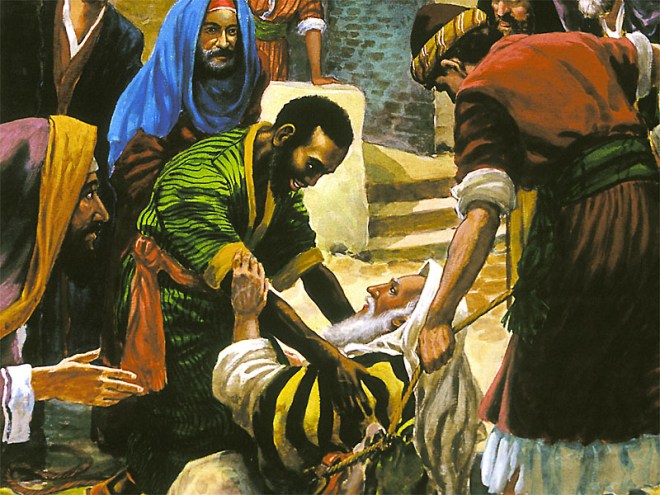
“Ebedmelech from Ethiopia was an official at the palace, and he heard what they had done to me. So he went to speak with King Zedekiah, who was holding court at Benjamin Gate. Ebedmelech said, “Your Majesty, Jeremiah is a prophet, and those men were wrong to throw him into a well. And when Jerusalem runs out of food, Jeremiah will starve to death down there.” 10 Zedekiah answered, “Take thirty of my soldiers and pull Jeremiah out before he dies.”

11 Ebedmelech and the soldiers went to the palace and got some rags from the room under the treasury. He used ropes to lower them into the well. 1Then he said, “Put these rags under your arms so the ropes won’t hurt you.” After I did, 13the men pulled me out. And from then on, I was kept in the courtyard of the palace guard.

Jeremiah 38:8-13, CEV

At the very last, there was just one remaining.  A single man, Ebedmelech.  He was a Ethiopian; made a eunuch by the will of the king.  The situation in Jerusalem has gotten very difficult.  In an action of revenge and reprisal, certain men intend to kill the prophet Jeremiah.  They take a certain satisfaction in this, and Jeremiah is thrown into a very deep cistern.  They intend for him to starve to death, which is a terrible way to die.

The king in these last pathetic days is being manipulated by the surviving leadership of the city.  Zedekiah gives tacit approval for the destruction of Jeremiah.  He just lets it happen without a good reason.  The prophet is lowered in the muddy cistern.  Without food, he will soon starve.  In the minds of this evil mob, they have taken care of the any last vestiges of a godly ‘righteousness.’

But there is one, he is a wild card.  And no man would have guessed it.  Ebedmelech, the Ethiopian eunuch steps forward and decides to change history.  Not only his ethnicity, but his state as a castrated man are definite issues.  This mob never recognized him as someone who would intervene.  He was a non-entity, a non-factor. He was black, and a eunuch, and a nobody.

But Ebedmelech is intervening, in the face of terrible risk, he steps out boldly to make an intercession.  He doesn’t appear to be intimidated, and makes a cry for the truth.  He becomes an intense and strong advocate for the release of Jeremiah from the deep mud.

Ebedmelech is given the ‘green-light’ by king Zedekiah. Ebedmelech rounds up thirty men to assist him as he delivers the prophet.  Ropes are brought out, and out comes Ebedmelech with a big armload of rags.  They shout down to Jeremiah.  The instructions are called down to him of what needs to take place for the extraction.

It’s interesting, but the rags are the most interesting. 

They are really an extra touch, not a necessity.  The rags become essentially, a form of grace.  They would pad the ropes, providing a degree of comfort as the prophet is pulled up out of the mud.  Ebedmelech showed the heart of God in what he did.  There was his desire to somehow make the prophet comfortable.  In doing so he communicated a kindness and concern that was saturated with God’s own enveloping presence.

Our illnesses– physical or mental, have moved us to a lonely place on the edge. 

We are those on the so-called ‘margins.’ Ebedmelech has now become a carrier of God’s grace.  Jeremiah could have been lifted up by just the ropes.  It would’ve been more difficult, granted.  But the rags sent down by Ebedmelech provided the prophet an extra gentleness.  And I am certain it did not pass by without notice.  Their mention in this Book of Jeremiah is significant, and shows Jeremiah’s deep appreciation of kindness.

We can gather up much from what has been written.  We will sometimes find ourselves in parallel situations.  But our kindness and concern can make the difference.  Admittedly, they are quite insignificant–quite minor. Call it ‘icing on the cake.’ But when you show the kindness of our Father, you will infuse the situation with love, and grace.  

So be an  Ebedmelech,—  an outcast perhaps– but in a position of kindness.


bry-signat (1)

cropped-christiangraffiti1.jpg


“Fine, I’ll Do It Broken” Link

Fine, I’ll Do It Broken

“Fine, I’ll Do It Broken

If you want a woman torn apart inside, weeping at the drop of a pin, confused in her own identity, disqualified in every sense of a leader…you got it!

A great link to a special teaching by Cheryl Meakins. This will bless you.

Fine, I’ll Do It Broken

Food Bank Epiphanies

NA-AU104_FOODBA_G_20081119182634

The last two months I’ve been the recipient of some reasonably heavy lessons of understanding. I was just standing in line at the food pantry. I’m learning more here than in my Biblical Doctrine class my first year at Bible college. Amazing! But again, maybe not.

My 10 Commandments of the Food Pantry

  1. Jesus has a special connection to the poor among us.
  2. The needs are tremendous as many lack food. (This may be a new concept for some.)
  3. The Church has the mandate and potential to meet these needs.
  4. What the government does is often just confusing the real issues.
  5. The stigma in receiving food seems to be temporary.
  6. Understanding and wisdom are more important than the box of food.
  7. People will stand in line for a long time to help their families.
  8. Most people are nicer than they used to be by going to the food bank.
  9. Some people’s abundance should be given away.
  10. You can never have too many boxes to use to carry stuff (and avoid the milk.)

What is worked inside is far more than what we get standing in line. Many things can happen once humility and need does its work inside. There is a powerful comradeship that can develop. Strangers become friendly when they are in line. There is a kind of a mutual understanding that proceeds out of poverty, and takes root, and spreads.

I honestly believe the distribution of food is only the secondary benefit. I really think the spiritual work is the new found work done in people’s hearts. There should be a dignity that saturates this work.

The Church Leader’s Ten Quotes on Giving

  1. You can give without loving, but you cannot love without giving.   Amy Carmichael
  2. I do not believe one can settle how much we ought to give. I am afraid the only safe rule is to give more than we can spare.  C.S. Lewis
  3. The measure of a life, after all, is not its duration, but its donation.   Corrie Ten Boom
  4. Get all you can, save all you can and give all you can.   John Wesley
  5. Christian giving is to be marked by self-sacrifice and self-forgetfulness, not by self-congratulation.   John Stott
  6. God doesn’t look at just what we give. He also looks at what we keep.   Randy Alcorn
  7. Our giving is but a reflex of God’s giving.  Sam Storms
  8. God made all of His creation to give. He made the sun, the moon, the stars, the clouds, the earth, the plants to give. He also designed His supreme creation, man, to give. But fallen man is the most reluctant giver in all of God’s creation.   John MacArthur
  9. Nothing that you have not given away will ever be really yours.   C.S. Lewis
  10. I will place no value on anything I have or may possess except in relation to the kingdom of Christ.   David Livingstone

recite-25825-95458975-1jznxku

The Blessings of a Long Battle, part 2

brutal-boxing

 “Do not fear the conflict, and do not flee from it; where there is no struggle, there is no virtue.”   John of Kronstadt

Part 1 of this post highlighted how God can bring good out of a long struggle with a sin, weakness, and/or problem by helping the Christian make the transition from putting their faith in formulas (e.g., “Do these three things and your problem will go away”) to a restful trust in Christ. Again, no sane Christian advocates habitual sin but the benefits of a protracted battle are numerous:

(1)  After a long battle, in making the transition from formulas to faith in God, a new brokenness develops in the believer. They’ve come to the end of themselves, run out of “self–effort fuel”, and are beginning to learn what Christ meant when he said, “…apart from me you can do nothing” (John 15:5).

(2) During a long battle with sin or weakness, there is a pattern of falling down and getting up. Proverbs 24:16 says that a righteous man falls seven times but keeps rising again. In this process many Christians report that a new intimacy has emerged in their relationship to God. They’ve come to know the God of mercy and compassion as never before because they’ve been repeatedly forgiven after their many stumbles.

(3) “He who is forgiven much loves much.” Along with a new intimacy, a greater love for God can also develop, after a long battle, because we’ve been forgiven over and over.

(4) And since God has extended his tender mercies to us over and over, we then can extend his mercy and compassion to others who have a protracted struggle with some issue. If our heart is right, a long battle can inoculate us from self–righteousness and judgmentalism in relation to others who fall over and over. How can we not extend to them the same grace that God extended to us?

In extending this grace to others, we may become a wounded healer to them. The healing we received from Christ during our struggle is graciously passed on those often struggling with similar issues. Healing emerges from your wounds just as resurrection emerges from death.

(5) After a war, the soldier of Christ often emerges battle–tested and wise to the schemes of the enemy. If a person has been pulled down into the dust 27 different ways by the devil, then, if he or she is paying attention, they’ve learned 27 strategies the enemy of our soul uses to try to destroy us.

In Twelve Step programs, one often hears the acronym H.A.L.T. mentioned in discussing relapse back into addiction. These four letters stand for hungry, angry, lonely, and tired and emphasize how these conditions create fertile soil for relapse.

If you frame the issue a different way, these are four strategies the devil uses to bring us back into bondage. How was this acronym learned? By people relapsing over and over when these conditions were present. Recovering people became wise through their failures in their long battle with addiction.

*

Jonathan

posted from http://www.openheavensblog.com/