Velcrocity, My New Amazing Word

velcro-magnified
Velcro magnified

I like inventing new words, especially for words that have far too much mileage on them. A car runs great, but even the best autos start to have issues after the odometer goes over 200,000 miles.

So I’m purposing a new word even though I’m not quite ready to completely toss the old one yet. The new word is “Velcrocity”. I will define velcrocity as a mix of love, faithfulness and endurance. (Possible forms of this word– Walk in velcrocity, be velcroized more and more. Wasn’t that velcroful worship? And on and on.)

Just in case you’re wondering, Velcro is a fastener mostly used for clothing. It consists of two strips, one is covered in tiny loops and the other in tiny flexible hooks. The two strips ‘adhere’ when they are pressed together and separate when pulled apart.

“Velcro is strong enough that a two inch square piece is enough to support a 175-pound (79 kg) person. The strength of the bond depends on how well the hooks are embedded in the loops, how much surface area is in contact with the hooks, and the nature of the force pulling it apart.” –Wiki

Why velcrocity? Thinking about the Father God’s love for me (and others) made me start thinking about Velcro– and being “laid up” with my health sucking so poorly has helped me pray and think. And being way too curious I did a frontal assault on the internet of the sticky subject of Velcro.

The best info came from Wikipedia, of course. http://en.wikipedia.org/wiki/Velcro

The more contact between the strips of Velcro will strengthen the bond. The tighter the hook part pushes into mesh part more effort required to pull them apart.  The negatives of this wonder are they have to stay clean. Lint, dirt of hair get between and can keep the strips from bonding.

As I write this, the imagery parallels what I’ve already learned from my Bible, prayer, fellowship and worship. Spiritual lessons quite often will come from what I see physically. But I need to be teachable and a whole lot more perceptive.

Focus on Jesus, and stick to the things of God. There is an adhesion needed in the Church today, and it truly starts with your heart. The covenant heart of God is that you would more and more cling to Him. He is truly tenacious, in the best use of the word.

“I will never leave you, or forsake you.”

“The Love of God endures forever.”

&

Kyrie eleison.

ybic, Bryan

(How about Velcrophobic? Velcroful? Velcrology? Velcrophobic? —and then maybe not,)

Five Rings to Make Us

Oh, how He loves you and me.

“For the Lord your God is living among you.
He is a mighty savior.
He will take delight in you with gladness.
With his love, he will calm all your fears.
He will rejoice over you with joyful songs.”

Zephaniah 3:17, NLT

Five rings– they are listed from the very inside, outward in concentric circles– and each one is a profound truth.  We throw a rock in the lake, and we see the rings grow wider and wider.  We watch and listen to the rhythm of the water, and it does us much good. I love lakes, and a picnic at the beach is like a “dream come true.”

The first ring, the starting point is the phrase, “among you.”  The center point is the “the Lord your God.”  When the Lord is your center we just expect that there is something else just teetering, ready to happen.  His presence, active and decisive as it is, has boldly put things into motion. Salvation always starts at the top, and works its way down.

The second ring is “He is a mighty Savior.”  This is agape love sweating.  Really, the work of salvation can only come from him.  He initiates, and then goes on to complete this saving work.

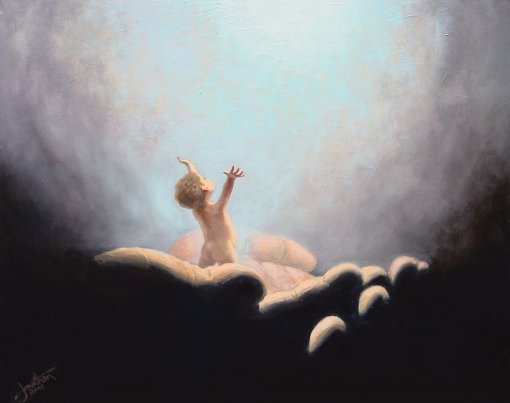
The third ring is being rejoiced over with gladness . This seems outrageous to us who have been diminished and wrecked by sin.  It doesn’t seem possible, but the Father gets a real boost when he thinks of us.  He is very glad when he gazes on you.

The fourth ring is this–  “He calm us with his love.”  A toddler begins to unravel, and his mother meets him, and holds him closely.  The child sobs start to diminish, and mom begins to restore his broken heart.  He has been quieted. The presence of mom has turned everything around.

The fifth and final work is the Father’s singing.  It is done with a flair and deeply enthusiastic; He sings with a loud voice, He doesn’t seem to hum, and the angels do not do background vocals.  Singing at the top of his voice, it is said he “exults” in you.  He has a way about Him as He sings easily, reveling and boasting in your faith in Him.

“Your God is present among you,
    a strong Warrior there to save you.
Happy to have you back, he’ll calm you with his love
    and delight you with his songs.”

Zephaniah 3:17, MSG

*

ybic, Bryan

Guest List

Our Daily Bread

January 25, 2013 — by Dennis Fisher

Read: Luke 14:7-14
“When you give a feast, invite the poor, the maimed, the lame, the blind. And you will be blessed.”  

—Luke 14:13-14

Bible in a Year:
Exodus 12-13; Matthew 16

____________

Qumran was a first-century Jewish community that had isolated itself from outside influences to prepare for the arrival of the Messiah. They took great care in devotional life, ceremonial washings, and strict adherence to rules of conduct. Surviving documents show that they would not allow the lame, the blind, or the crippled into their communities. This was based on their conviction that anyone with a physical “blemish” was ceremonially unclean. During their table fellowship, disabled people were never on their guest lists.

Ironically, at that same time the Messiah of Israel was at work in the cities and villages of Judea and Galilee. Jesus proclaimed His Father’s kingdom, brought teaching and comfort, and worked mighty miracles. Strikingly, He proclaimed: “When you give a feast, invite the poor, the maimed, the lame, the blind. And you will be blessed” (Luke 14:13-14).

The contrast between Jesus’ words and the guest list of the Qumran “spiritual elite” is instructive to us. Often we like to fellowship with people who look, think, and act like us. But our Lord exhorts us to be like Him and open our doors to everyone.

The gospel must be shared with all,
Not just with those like you and me;
For God embraces everyone
Who turns to Him to set them free. —Sper
*

The inclusive gospel cannot be shared by an exclusive people.

—George Sweeting

© 2013 RBC Ministries

http://odb.org/

Significant Worship

A Psalm Study, 108:1-6

A Song. A Psalm of David.

 1 My heart is confident in you, O God;
      no wonder I can sing your praises with all my heart!
 2 Wake up, lyre and harp!
      I will wake the dawn with my song.
 3 I will thank you, Lord, among all the people.
      I will sing your praises among the nations.
 4 For your unfailing love is higher than the heavens.
      Your faithfulness reaches to the clouds.
 5 Be exalted, O God, above the highest heavens.
      May your glory shine over all the earth.

6 Now rescue your beloved people.
      Answer and save us by your power.

–Psalm 108:1-6, NLT

David has tapped into strength and significance.  The astounding part of it is–it’s a Person, not a method.  He has a relationship that alters the reality around him.  David is outrageously enthusiastic about this.  He exudes a confidence that can’t be contained.  Our strength is in a person!  (Not religion, a moral code, ethics or even discipleship.)  It’s Jesus, it is a relationship, that is personal–a intimate friendship.

David refers to a ‘harp and lyre.’  These are obsolete for the most part.  But I think any musical instrument can be used.  A piano or a guitar, (even a cherry red Stratocaster) is quite acceptable.  But there is an interesting shift.  David’s heart and soul is his musical instrument!  Worship starts right there, not in a set of drums.  His heart is the primary place of worship.  That is where worship must happen.  And we can easily confuse this.

King David understands innately the significance of worshipping God.  He visualizes going out to all the peoples of the world–not as a diplomat, but as a worshipper.  That is his central thought and theme.  No trade treaties, or ambassadors or even peace envoys.  But Jehovah God is his ingrained purpose.

And worshipping Him is a reasonable thing.  David proclaims two attributes that are ‘sparkplugs’ for his spiritual life, (v.4).

  1. Love
  2. Faithfulness

These ignite his love and worship.  When King David thinks about them, he can’t help but sing and worship.  And they are extremely significant for us as well.  When you think of God’s love and His unceasing faithfulness–and if they are properly seen, and understood, you too will worship.  As a matter of fact the existence of heart worship is evidence of a healthy spiritual heart.

David wants to God to show Himself to the whole earth–everyone!  Far jungle tribesman and Eskimos, all need to see God!  Everybody gets to see Him. That is the wonderful purpose of Christian missions.  David wants desperately to share this with all.  He has a true zeal (and sometimes that scares us).

Verse 6 hints of the existence of sin and evil.  These are things so engrained and prevalent in our society, and in our hearts–we need a deliverer and a savior.  Jesus has to step in.  We have no other options, and our creator has got to be our Savior.  When we begin to realize our desperate predicament, all the vanity (an old fashioned word) and emptiness, we are halfway there. I encourage you to worship, everyday.

#

ybic, Bryan