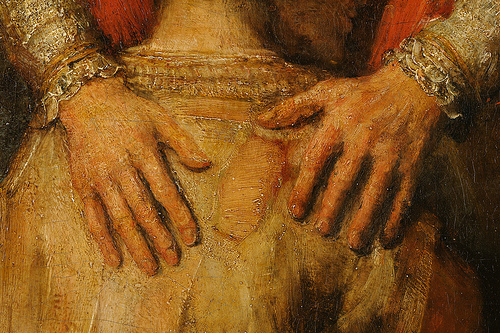
Admitting I Need Jesus

When I was in the sixth grade, a friend invited me to her church. My parents didn’t go to church, but said I could go with Clarissa if I wanted to. Before long, I was spending at least three days a week with my church friends. I learned who Jesus was and that if I believed in Him I would be saved.

I believed, though I didn’t fully understand my need for a Savior.

It would be many years and much wayward living later before I would realize the importance of the Apostle Paul’s words to the church in Rome. “For I am not ashamed of the gospel, for it is the power of God for salvation to everyone who believes, to the Jew first and also to the Greek. For in it the righteousness of God is revealed from faith to faith; as it is written, ‘But the righteous man shall live by faith.’” (Romans 1:16–17 NASB).

It’s easy to think “of course I’m not ashamed of the gospel.” Why would anyone be ashamed of the good news that Jesus died for our sins so that we might be reconciled to Him?

But at its core, faith in the gospel requires the believer to say “I can’t do this myself.”

Well, let me tell you a little secret that believers and nonbelievers often forget. We humans, with all our self-importance, like to think we’re the kings and queens of the universe. We strut around like peacocks, patting ourselves on the back for our so-called brilliance. And you know what? We even pass that audacity onto our poor children, encouraging them to be little independent dynamos. But hey, who needs divine intervention when we’ve got our fabulous human ego, right? wink

I remember a time when my son was in high school and because of a snow day his class schedule was changed. As a result, he took the wrong books. He called to ask me to bring the right books to the school office on my way to work, which I happily agreed to do. When I got to the office to drop them off, the school secretary chided me for bailing him out. “These kids need to learn to be responsible or suffer the consequences,” she said.

I’ve thought of that encounter often, being thankful that Jesus didn’t say the same to the Father when the plan of salvation was put into place. What if Jesus had said, “You know Dad, these humans need to be more responsible or suffer the consequences.” We’d all be doomed.

And so, although it requires me to admit I can’t do it alone, I choose to live by faith in the One who gives me His righteousness.

For the broken believer (which is all of us, if we’re honest), it is all the more important to be okay with something less than full independence. We were created to be dependent on God and on one another. We were created to live in community and relationship with others.

Note: A version of this article was originally published in the January 2020 issue of The Christian Journal, a publication I highly recommend, and not just because they publish some of my writing.

Little Sin, Little Love— Much Sin, Much Love


She was forgiven many, many sins, and so she is very, very grateful. If the forgiveness is minimal, the gratitude is minimal.”

Luke 7:47, Message

I have been a disciple of Jesus for over 40 years.  But it seems that I really haven’t been a desperate lover of Jesus until recently.

I have seen a lot of stuff, so I made a quick list–

  • the charismatic movement
  • the Imperials
  • New Wine Magazine
  • “I Found It”
  • Larry Lea‘s Prayer Program
  • the PTL Club
  • the Shack
  • preaching on the streets of San Francisco
  • Jesus’ festivals, Festival of the Son
  • Promise Keepers
  • Anita Bryant
  • the Living Bible, youth edition
  • YWAM teams, the Candle– SF
  • Four Spiritual Laws
  • ’88 Reasons Why
  • “Honk if You Love Jesus”
  • preaching on death row
  • Don Francisco
  • carrying the cross, Arthur Blessit
  • the Hiding Place
  • Watchman Nee
  • Outdoor baptisms in city parks

I’ve been exposed to a lot of winds blowing through, and moving on.  You learn to separate the chaff from the grain.  Much of my life has been spent winnowing out to get to the good stuff.  God, through his word describes a coming “trial by fire” over each person’s works.  Romans 14:12 says,

“Yes, each of us will give a personal account to God.” 

One time I walked as a backslidden Christian. I remember once waking up from a drunken stupor with my t-shirt soaked in blood. That blood was someone elses.  I sobered up really quick.  I had this shadowy awareness of beating someone almost to death.  I still catch myself wondering what exactly happened.  There is so much stuff that will be revealed, and I have done many despicable things.

The judgment seat of Christ, therefore, involves believers giving an account of their lives to Christ. The judgment seat of Christ does not determine salvation; that was determined by Christ’s sacrifice on our behalf and our faith in Him. All of our sins are forgiven, and we will never be condemned for them.

We should not look at the judgment seat of Christ not as condemnation but as love, but rather as the Lord speaking into our lives. Yes, as the Bible says, we will have to give an account of ourselves. Part of this is surely answering for the sins we committed.   

But the One who will judge me is also my Savior. That comforts me.

The Greek word for the judgement of Christians is “bema seat.” It was where the judge sat during athletic contests.  Think of the high chair on which a court official sits during a tennis match.  

The issue will not be our salvation, but our faithfulness.    

Loving Jesus must become your critical objective for the rest of your days, 1 Peter 4:8, “Love covers a multitude of sins.”  We also read of the sinful woman who washed Jesus feet, “therefore I tell you, her sins, which are many, are forgiven—for she loved much. But he who is forgiven little, loves little.” (Luke 7:47)

Dear one, practice loving him– starting today.  Many are the doers, few be the lovers.  The demanding weight of evangelism and world missions has quadrupled in the last 10 years.  Now is our time!  We love much!  Time is getting very short.


Do You Have an Anchor?

“Then fearing lest we should have fallen upon rocks, they cast four anchors out of the stern, and wished for the day.”

Paul’s voyage, Acts 27:29

“This hope is a strong and trustworthy anchor for our souls. It leads us through the curtain into God’s inner sanctuary.”

Hebrews 6:19

An anchor is used when a boat needs to connect to the sea floor. It’s typically used to moor the ship or used in a bad storm.

“A boat anchor helps keep a boat attached to one place on the ocean floor so that it does not go adrift in the sea. Likewise, a “spiritual anchor” is something that helps keep us grounded, connected to what matters most, and able to cope with the challenges that life brings.”

Hopefulness is necessary for walking through the present circumstances we must face.

It also is for our future. To live without hope can be spiritually destructive. If there is no hope for us our hearts will break into pieces.

Hopelessness comes from living without an anchor. You must have an anchor as a believer. You must.

Despair will destroy you.

 A Christian may for many days together see neither sun nor star, neither light in God’s countenance, nor light in his own heart, though even at that time God darts some beams through those clouds upon the soul; the soul again by a spirit of faith sees some light through those thickest clouds, enough to keep it from utter despair, though not to settle it in peace. In this dark condition, if they do as Paul and his company did, cast an anchor even in the dark night of temptation, and pray still for day, God will appear, and all shall clear up, we shall see light without and light within; the day-star will arise in their hearts.

     Richard Sibbes

A Sound Mind

2-Timothy_1-7

“A sound mind.” For some of us that doesn’t seem remotely possible. We’ve come to believe this is only true for others, maybe, but not me. As mentally ill people we seem to think that we shouldn’t be this way. Given enough time our illness becomes fused to our spirit and soul. We buy the lie and choose to live defeated. Only the Lord Jesus can break this chain.

Healthy thinking is a wonderful gift. That’s important to note. I can’t earn it; nor can I fabricate it. It must be simply acknowledged and received as a bonus. We must come humbly and broken. I suppose that is where we become the happiest and healthiest.

In 1 Timothy 1:7 we’re told that we have a salvation that includes:

  • incredible power,
  • love,
  • and a sound (healthy) mind.

These three are a gift from God. You don’t buy a gift, nor do you earn it. Rather it comes from Someone who loves you (!) and only wants to restore you. We may have issues, but the Spirit is sound and lucid. He speaks so we understand.

Afflicted people will find what they need from the Holy Spirit of God. Mental illness isn’t a death sentence. Rather it’s a grand opportunity for God to teach us about His power in the middle of our pain.

The healthy mind is one that is clear and life-giving. It is without any sick or crippling deficiencies. It’s a mind that is vigorous and robust. Those of us who struggle with a mental illness this is fantastically good news. And it maybe that you’re certainly impaired but even then you’re given a strength to use in service in the body. Everyone has a gift and calling.

There is nothing worse than fighting through muddled thinking when you’re having mental issues. Names, dates and memories disappear in the fog. It can be frightening. I know what it’s like to be afraid of one’s own mind. It seems like it’s trying its best to kill me. (Some of you can ‘read-between-the-lines’ and understand exactly what I am saying.)

My own experience is that the Holy Spirit is working, with my meds, to hold me in a good place. Just as a diabetic must take insulin, so I need to take my antidepressants. The brain is an organ that can get sick also. We live in a fallen and broken world. We are human and therefore vulnerable just like anyone else. (Somehow, we imagine better.)

Grace does heal many, but there are some who will find ‘weakness’ becoming their real strength.

The very presence of the Holy Spirit is what enables. Broken believers are coming to see that their illnesses are helping them to be weak enough for God to use. It’s not how strong you are, but it’s how weak. “It is not that we think we are qualified to do anything on our own. Our qualification comes from God,” 2 Cor. 3:5, NLT.

bizen-kintsukuroi-tea-cup-1 (1)

“When the Japanese mend broken objects, they aggrandize the damage by filling the cracks with gold [‘kintsukuroi’]. They believe that when something’s suffered damage and has a history it becomes more beautiful.”

–Barbara Bloom