Afflictions That Heal Us

Today I especially wanted to share a message the David Wilkerson shared on his blog a few years ago.  It is probably one of the better messages I’ve read in quite awhile on the issue of pain and affliction in a believer’s life.  I hope this helps!

“Curse the scalpel if you must; but kiss the Surgeon’s hand.”

flourish14

“Before I was afflicted I went astray: BUT NOW have I kept thy word”

Psalm 119:67

“I believe in healing. I believe in affliction. I believe in “healing afflictions.” Any affliction that keeps me from going astray—that drives me deeper into his Word—is healing. God’s most gracious healing force spiritually and physically can be afflictions.

To suggest that pain and affliction are of the devil is to suggest that David was driven by the devil to seek God’s Word. I have suffered great pain. I have called on God for deliverance and I believe him for complete healing. Yet, while I go on believing, I continue to thank God for the present condition and let it serve to remind me how dependent on him I really am. With David I can say, “It is good for me” (Psalm 119:71).

Pain and affliction are not to be despised as coming from the devil. Such burdens have produced great men of faith and insight.

“Casting ALL your care upon him…”

1 Peter 1:5

Paul spoke of the “cares” of the churches that were thrust upon him (see 2 Corinthians 11:28). Every newborn church was another “care” on his shoulders. Growth, expansion, lengthening of stakes always involve new cares. The man God uses must have broad shoulders. He dare not shrink under the challenge of numerous cares and responsibilities.

Every new step of faith God leads me to take has brought with it numerous new cares and problems. God knows just how many cares he can trust us with. It is not that he seeks to break us—in health or strength; it is only that willing laborers are few and the harvest is so great. Cares are taken from those who refuse them and given as gifts to those who are not afraid of them. Forget the load of cares you carry—can we not cast them all on him?

Every new blessing is related to a family of cares. They cannot be divorced. You cannot learn to live with the blessing until you learn to live with the cares.”

Source: http://davidwilkersontoday.blogspot.com/



More Current, Please!

angel1I have always had a crazy connection with electricity. As a young boy of six or seven I started to push nails into the wall outlets of our home. My mom would come in to find me in a heap, with the nail still in the outlet. It would blow me backwards, and I remember “smelling the ozone” from each experience. I did this fairly often. Mom grew very concerned about me.

Then I discovered the shocking world of electric fences. Most were “pulse” currents, which meant they were alternately energized– and then off. If you grabbed it at the right time, you could beat the fencer and not be shocked. Of course, complicating things would be standing on wet grass. But bringing your little brother meant you could grab his hand, touch the wire, and he would get the full voltage. This was always fun.

Coming into the presence of a holy and loving God should be a powerful jolt. But it needs to be real– never theatrical or showy. Whether it is prayer or worship, we reach into a real world. While electrical shock is detrimental, the Holy Spirit is always strengthening and affirming. My prayer the last few months has been this: “May it be the real me who connects with the real You.”

In a nuclear power plant the workers clearly understand the nature of fission. They can’t see it, or feel it. They must take precautions, because what they handle is really dangerous. In 1 Samuel 6, we read of the time when the Philistines controlled the Ark of the Covenant. But the power they received was not anything they could handle or manage. They finally sent it back. “But the Lord killed seventy men from Beth-shemesh because they looked into the Ark of the Lord. And the people mourned greatly because of what the Lord had done. “Who is able to stand in the presence of the Lord, this holy God?” they cried out. “Where can we send the Ark from here?”

God is dangerous, “my Bible tells me so.” My thinking often would regard Him as docile and tame, but I challenge you to understand differently. I submit to you that our faith should put us into a perilous place– one in which we are asked to do outrageous things. Like building an ark, or going from a slave to a prime minister, or getting out of our boat and walking on the sea. Furthermore, the Book of Revelation is John’s account of being in God’s power and majesty (Rev. 15).

“We worship a dangerous God and He is coming to threaten every area of your life.  God is a loving God, do not be mistaken about that.  His love, however, is unlike any human love; its chief concern is not to make you comfortable, but to make you free and to be free is dangerous and the act of making us free is dangerous.” Joe Spann (and below)

electric-shockPlease don’t try to domesticate God.

He is wild and pretty much unpredictable– and we will not ever tame or teach Him. You can’t manage Him, or train Him to use a box. (He will defy this.) If we are truly going to draw close it will be like stepping into a spiritual reactor, or sticking a figurative nail into a metaphorical wall outlet.

“He is about to become dangerous to your everyday trappings, dangerous to your comfort, dangerous to your retirement plan, dangerous to your schedule, dangerous to your social standing, dangerous to your secrets, and dangerous to your religion. The good news is, He is also dangerous to your limits, dangerous to your fear, dangerous to your addictions, dangerous to your sickness, dangerous to your unforgiveness, dangerous to the chains that bind you chains that you have become way too comfortable with.”

The end result of this is that He wants to make you dangerous again; dangerous to your neighbors bondage, dangerous to the pain in the people around you, dangerous to the generations of abuse and pain in your family and the families you know, dangerous to the culture you are in every single day. And He wants to make us dangerous again. Dangerous to our neighborhoods, dangerous to our friends, dangerous to our culture, dangerous to the kingdom of darkness.”

I would like to make a toast, “May you see God as He is truly, and may you stick your nail into direct contact with Him. May you never settle for less, or want for anything more.” Amen.

1brobry-sig4

cropped-christiangraffiti1 (1)


*

Sunshine and Mercy

sunshine2

The Lord passed in front of Moses, calling out, “Yahweh! The Lord! The God of compassion and mercy! I am slow to anger and filled with unfailing love and faithfulness.”

Exodus 34:6, NLT

“I’m in a desperate situation!” David replied to Gad. “But let us fall into the hands of the Lord, for his mercy is great. Do not let me fall into human hands.”

2 Samuel 24:14

Sitting on the deck, it’s a cold morning, but the sun is bright. It’s a typical winter day here in Alaska, which means the sun is pushing back the winter for all it’s worth. Up here we have a ‘the love affair’ with the sun; it hides herself in the gloominess of winter— only to show herself off big time during our summers.

Soaking up the sun got me thinking about the mercy of God. I find I am of two minds. For the most part I love His mercy. It is probably the attribute I love most about Him. Mercy defined by my dictionary:

  • compassionate or kindly forbearance shown toward an offender, an enemy, or other person in one’s power; compassion, pity, or benevolence: Have mercy on the poor sinner.”

Who could not like this in ones deity? Most of us would agree that we are thrilled that God is this compassionate— especially when we’re such rascals ourselves. We will ground ourselves in His mercy, even when our minds give up.

But this is the hard part. I must be as merciful as He is. Mercy comes with the caveat that I become a compassionate person, even to those who are undeserving.

“Shouldn’t you have mercy on your fellow servant, just as I had mercy on you?’

Matthew 18:33

If you want mercy, you must be prepared to give it. Perhaps this is how God changes the world?

See what the Alaskan winter sunshine can do?

1brobry-sig4


“When a Christian shows mercy, he experiences liberation.”   ~Warren Wiersbe


cropped-christiangraffiti1 (1)

How Things Grow, [Work]

plow1930s

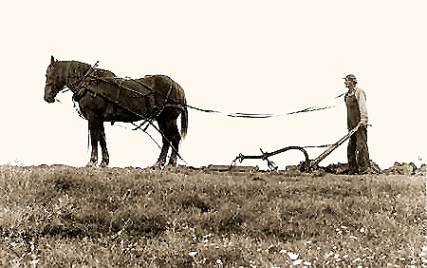
A farmer slowly walks behind his plow. The ground is hard and unyielding, but the steel cuts the heavy sod like a knife. He is preparing the soil for receiving the seed. He knows that what he is doing is imperative and he shouts out to encourage the horse. Its getting late and he wants to cut another furrow before night.

Plodding behind the plow he thinks many things. He can break up the ground, till and fertilize it, sow the seed— and then wait. He is powerless it get the seed to germinate and grow. He is limited to cultivating the soil and waiting. That is all he can really do, and he accepts this powerlessness. He can do everything right, and still not have a crop. All he can do is his part.

The farmer works in partnership with God. He is dependent on Him to grow the seed. The farmer must rely on the weather to meet and engage the planted seed. There are no shortcuts here. He does all he can, and then hopes that it is enough.

Farming is a joint endeavor between man and God. The man does what he has to do. God takes what the man has done and then finishes it. The crop will grow because He wills it. The farmer plays a part for sure, but ultimately God must become involved. Afterall, He makes the seed to sprout and grow.

We can say decisively that the pursuit of holiness in a Christian’s life is a joint endeavor between a believer and God.

Each have made the effort. The Christian does what is necessary, and then the seed is finally sown. It is then up to God to make the seed become the seedling. But each must work to finish the growth.

No one can attain holiness in their life apart from the work of preparation (it’s indeed work). The man must prepare the ground through plowing and cultivating. The farmer works the ground in order to make the ground ready. On the other hand, God provides both the environment and the growth needed to grow the seedling. Both the farmer and God must do their work.

A life of holiness is not automatic. It will never come at measured pace, trickling into our souls at a mechanized rate. (It would be nice if it would). Rather it wheat-field-landscape-picture_1920x1200_79595seems to come, in fits and spurts, sputtering rather than simply flowing.

Holiness is like a steamy Amazon jungle, vibrant and full of life. It is saturated with things living and green. It is not like an arid and sterile desert. Holiness is pulsating and powerful, full of lush growing things.

Becoming a person of holiness is the grandest adventure for the human soul. It defies our tendency to be rigid and legalistic. It is quite the opposite. It is tapping into life itself, and who is up to the task? Our morbid ideas of what holiness are not worthy of what really is.

Yes, to be holy is to work. Just as the farmer must prepare the soil for the seed, we too must guide our plows. God is ready to sow, and we should be ready to be ready. That is if we want to be fruitful and productive.

“Oh, the fullness, pleasure, sheer excitement of knowing God on earth!”

 Jim Elliot

bry-signat (1)

cropped-christiangraffiti1.jpg