“Without Your Wound, Where Would Your Power Be?”

The subject of “the pool at Bethesda” alludes to the following excerpt from the Thorton Wilder play “The Angel that Troubled the Waters”. The play is based on the biblical verses of John 5:1-4, but it changes the end of the parable.

I first encountered this excerpt within the book “Abba’s Child: The Cry of the Heart for Intimate Belonging“, by Brennan Manning.

The play tells of a physician who comes periodically to the pool of Bethesda, hoping to be the first in the water and healed of his melancholy when the angel appears and troubles the water. Everybody at the pool also hopes to be the first in the water and thereby healed of his malady. The angel appears but blocks the physician at the moment he is ready to step into the pool and be healed.

Angel: “Draw back, physician, this moment is not for you.”

Physician: “Angelic visitor, I pray thee, listen to my prayer.

Angel: “Healing is not for you.”

Physician: “Surely, surely, the angels are wise. Surely, O Prince, you are not deceived by my apparent wholeness. Your eyes can see the nets in which my wings are caught; the sin into which all my endeavors sink half-performed cannot be concealed from you.”

Angel: “I know.”

……………… A long pause

Physician: “Oh, in such an hour was I born, and doubly fearful to me is the flaw in my heart. Must I drag my shame, Prince and Singer, all my days more bowed than my neighbor?”

Angel: “Without your wound where would your power be? It is your very sadness that makes your low voice tremble into the hearts of men. The very angels themselves cannot persuade the wretched and blundering children on earth as can one human being broken on the wheels of living. In Love’s service only the wounded soldiers can serve. Draw back.”

Later, the person who enters the pool first and was healed rejoices in his good fortune then turns to the physician before leaving and said:

“But come with me first, an hour only, to my home. My son is lost in dark thoughts. I — I do not understand him, and only you have ever lifted his mood. Only an hour . . . my daughter, since her child has died, sits in the shadow. She will not listen to us but she will listen to you.”

………………………………………

For me, this story is quite exceptional, probably because the message of this excerpt—“Without your wound where would your power be?“—carries so much meaning for me, as this has taught me that through my weakness I can see others.  I believe that for us,  it should be our whole philosophy of ministry.

The depressed physician ministered out of his brokenness.  He parallels the way the Apostle Paul did his work “out of much suffering.”  Just something to think about.

This is a Broken Believers classic post.  It is shared again with the steady hope that it will encourage you and strengthen you in your walk with Him.

*******

ybic, Bryan

cropped-christiangraffiti1 (1)


Like Well-Watered Gardens: Isaiah 58

 988260_555532177842117_1231249567_n

Feed the hungry,
    and help those in trouble.
Then your light will shine out from the darkness,
    and the darkness around you will be as bright as noon.
11 The Lord will guide you continually,
    giving you water when you are dry
    and restoring your strength.
You will be like a well-watered garden,
    like an ever-flowing spring.”

Isaiah 58:10-11, NLT

This is the precise key many need for this moment. It just could be as vital as your next breath.

You see our faith was never intended to be a personal ‘spiritual make-over.’ Discipleship was not meant to be about becoming a ‘new-and-improved’ person. That simply is not the message. There can be an emphasis placed on a selfish preoccupation with becoming better (and nicer) and we miss out on God’s real intent for His redeemed people. The difference is subtle but significant. We cannot sanctify our selfishness— no matter how hard we might try. 

For years I travelled under a misconception that God wanted from me ‘a better Bryan.’ I felt like a juggler trying to keep the balls moving. But by making this my focus, and not on others, I only exacerbated my mental illness. For me, my depression is only intensified when I look inside. Often I can’t see the needs around me. All I can see are my own issues (which are formidable.)

Isaiah prophesies a spiritual ’cause-and-effect.” If a person will only reach out to others will there be a spiritual blessing. Often we struggle because we don’t realize the implications of being spent for others. We become ‘a well-watered garden’ if we will only reach out to others. If we would only learn that it is when we give out— we receive. The kingdom is reciprocal in the way blessings come.

“And I have been a constant example of how you can help those in need by working hard. You should remember the words of the Lord Jesus: ‘It is more blessed to give than to receive.’

Acts 20:35

The entire chapter of Isaiah 58 makes it a vital point to the people of God. Our own healing is contingent on becoming a blessing to others. If we will pour out we will be poured on. We become ‘a well-watered garden’ when we begin to serve others. Our own ‘healing’ will come when we reach out to the desperate needs around us. After all, isn’t that what we’re supposed to be about?

bry-signat (1)

cropped-christiangraffiti1.jpg

Killing My Sin, Before It Kills Me

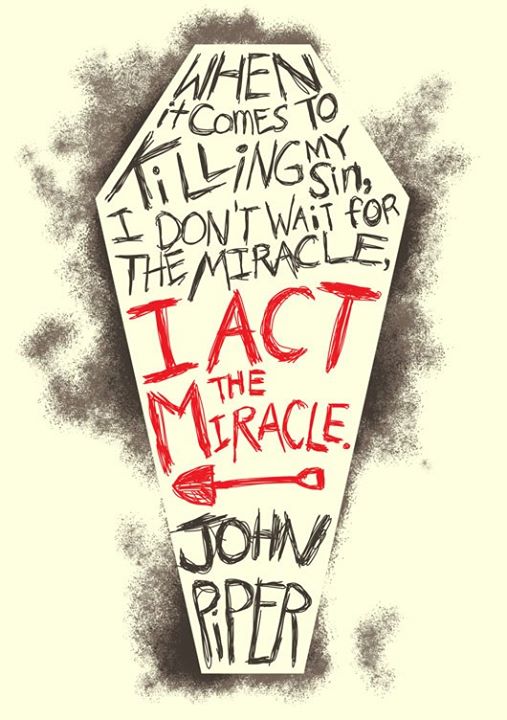
killing-sin-act

We are for the most part anyway, eager to please God. We are Jesus’ people with the occasional brush with sin. But hey, who doesn’t? But that attitude must be questioned.

“My little children, these things I write to you, so that you may not sin.”

1 John 2:1

John hopes that his readers would make a choice— not to commit sin. After all, what soldier goes into battle with the intent of getting just a little wounded? Often we will sin just because it seems so inevitable, and we feel we can’t help ourselves. (But the reality is that we can.)

But the Holy Spirit now lives inside. Cooperation with Him is needed. Often we will work ourselves into a ‘no win scenario’ where we believe that sin rules. We can’t beat it, so we stop trying. That is common, and sad.

‘Passivity’ is defined as not participating readily or actively; inactive. When we are passive spiritually, we disengage ourselves from any effort of living holy and pure lives. Not being ‘hot’, but content to be lukewarm. At this point sin becomes, reluctantly, tolerated. “After all, I’m a sinner, what else can I do?”

Mentally ill people are often passive. We are told that we have an uncontrolled illness which dictates that we act ‘irresponsible.’ Our depression often escalates and we feel victimized by it. My experience has taught me that there are three kinds of depression:

  • organic depression, or the ‘biochemistry’ of the disease,
  • guilty depression, the kind that feels bad because of what we’ve done (or didn’t do),
  • reactionary depression, the type we feel when experiencing a loss, a loved one, or a job

Depression will almost always fall in these three categories. And passivity plays a part in all three. We  frequently feel victimized and ‘acted upon.’ When it comes to our discipleship we don’t act, we react. We are utterly convinced of the Bible— God’s truth, but we are so sporadic we can’t seem to get it to work for any length of time.

Yes, we are believers. And yes, we have issues. We’re waiting for a miracle, and hope we get a breakthrough soon.

At the base point of our lives, quite often, there is a passive attitude. Passivity aggravates our depression or mental illness. It deepens, spreading through our lives like a contagious illness. Our discipleship sputters and stalls. We no longer act on God’s Word, but we find ourselves fabricating a faith that makes allowances for our situation.

But we must ‘act the miracle.’ Everything God gives… everything… must be received by a convinced faith. We must be persuaded to give up our flawed ideas, and believe God for the real thing. I opened up this with 1 John 2:1. But there’s much more to this verse:

“My little children, these things I write to you, so that you may not sin.  And if anyone sins, we have an Advocate with the Father, Jesus Christ the righteous.”

I don’t want you to sin. Avoid sin. But even if you do— we have someone who will plead our case before God. He stands and argues our plight. He loves us that much.


bry-signat (2)

cropped-christiangraffiti1.jpg


A Blessed Discomfort

Love One Another

What follows is NOT an ordinary, run-of-the-mill blessing.  Some would undoubtedly wish for one, and others anticipating what follows, will skip this blog.  It happens all the time.  But, at distinct times, the Holy Spirit surgically slices through our foggy-ness and illuminates us to ourselves.

May God bless you with discomfort at easy answers,
half truths, and superficial relationships,
so that you may live deep within your heart.


May God bless you with anger at injustice,
oppression, and exploitations of people,
so that you may work for justice, freedom, and peace.


May God bless you with tears to shed for those
who suffer from pain, rejection, starvation, and war,
so that you may reach out your hand to comfort them
and to turn their pain into joy.


And may God bless you with enough foolishness
to believe that you can make a difference in this world,
so that you can do what others claim cannot be done.

–From a Franciscan Benediction

Blessed with discomfort, anger, tears and foolishness.  Too often, we often think our discipleship as a massive undertaking for a personal renovation.  And when that does happen, thank God!   But we must drive this home, spiritual make-overs are not the point of holy living! 

We are directed to engage the world and to hammer away at the lies, in order to free people, under the direct supervision of the Holy Spirit.  When we serve, give, love, we will be surprised to find that our own lives will change, almost as an after-thought. Just maybe, that is what God intends? Maybe.

“And the King will say, ‘I tell you the truth, when you did it to one of the least of these my brothers and sisters, you were doing it to me!’

Matthew 25:40, NLT


bry-signat (1)

cropped-christiangraffiti1.jpg