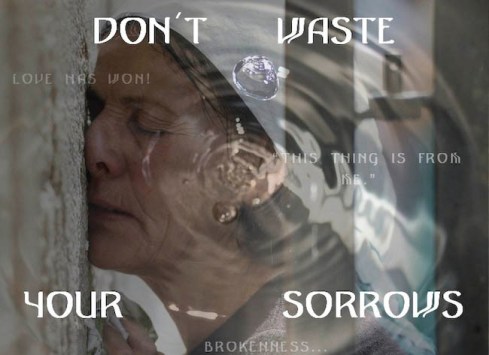
Don’t Waste Your Sorrows


062_dont_waste_your_sorrows

“These little troubles are getting us ready for an eternal glory that will make all our troubles seem like nothing.”

2 Cor. 4:17, CEV

“Before God could bring me to this place He has broken me a thousand times.”                                   

Smith Wigglesworth


As we move toward maturity, over time and through circumstance, we will start to develop exciting new ways of thinking.  We engage the Word and combined with our relationships with people we start the work of God.  We soon learn that the Kingdom of God flows through relationships, almost exclusively.

Pain and sorrow are some of the more intense ways the Lord reaches down and into our lives.

Rick Warren has written, “God intentionally allows you to go through painful experiences to equip you for ministry to others.” 


I think that as we dwell on this we will start to see the hand of God, moving things around in our complicated lives.  As we attend class in this school of the Spirit, we learn things that will change our life and ministry.

But we must consider that we can waste our pain and sorrows by not engaging the issues properly.  Will I submit, or will I grow sullen and cynical? Will I worship through my tears?  Surrendering to Christ is not a once-in-a-lifetime event.  It is a daily, and even hourly process.  I regard any kind of cynicism though, as a hungry predator who is hunting me.  Very dangerous, and I am highly suspectable.

Pain is the way the Father reaches me, he isn’t too concerned about our comfort (it isn’t the real issue, after all.)  When I hurt, I invaribly look for Jesus.  And that cannot be all bad.  Through the trials and pain I begin to reconnect with my Father.  Without the trials, I doubt we would ever call out for His help.

“Don’t waste your sorrows.”  It is easily said but seldom done.  We start to stagger by the weight of our personal issues.  Overwhelmed by the pain we start to panic and grab things, and throw them overboard, to lighten the load.  We can be confused, and will do whatever we must do to stay afloat.  But unless we take these sorrows well, we are just short-circuiting God’s intentions.

C.S. Lewis once commented on our issues,

“Experience: that most brutal of teachers. But you learn—my God do you learn.”

The darkness intends to absorb us.  Satan uses our own bitterness and frustration to do this.  Our discipleship is no longer valid if we commence doing our own will and desires.  Even though we get “flaky” the Father will always love us. But we dare not waste our pain, it comes at too big of a price.

bry-signat (1)

cropped-christiangraffiti1.jpg


Preaching to Yourself

PREACHING TO YOURSELF ABOUT HOPE

by Terry Powell

Have you ever “preached to yourself?” I’m referring to the act of fighting negative and unbiblical thought patterns with the Word of God. It’s also called “biblical self-talk,” reminding yourself of truth that counteracts Satan’s lies. In Future Grace, John Piper illustrates how the Psalmist battled despondency by preaching to himself:

In Psalm 73:26 the psalmist says, “My flesh andmy heart may fail.” Literally the verb is simply“My flesh and my heart fail!” I am despondent! I am discouraged! But then immediately he firesa broadside against his despondency: “’But God is the strength of my heart and my portion forever.” The psalmist does not yield.blunbelief with counterattack.

The poem that follws is a type of sermon delivered to myself. The stanzas are painfully realistic about the hopelessness that accompanies my depression. Yet the poem ends on a more positive note, citing another verse from the Psalms in which the author t back to despair and exalts God as the object of hope. What makes preaching to myself effective is reminding myself of God: Who He is, what He has done and what He had pledged Himself to do.

Hopeless?

Fleeting, it’s like a bird in flight,

Or like a shooting star at night,

Or lightning that spans the sky—

Gone in the blink of an eye.

Elusive, like the fog that lifts

When morning sun sends its gifts;

Or the zigzagging butterfly

That you can’t catch. No use to try.

That’s my relationship to hope:

It’s like a wet bar of soap

That keeps giving me the slip.

Can’t keep it within my grip.

Hope that a blinding beam of light

Will penetrate my soul’s dark night.

Hope that it won’t seem so strange

That habits of the heart can change.

Can God plant hope within a heart

For peace of mind and a fresh start?

Though right now I am without it,

God shouts “Yes!” Should I doubt it?


Why are you in despair, O my soul?

And why have you become disturbed within me?

Hope in God, for I shall yet praise Him,

The help of my countenance, and my God (Ps. 42:11).

When inward or outward trials come, what are some Bible truths or text that you “preach to yourself”?

ybic,

Terry

Terry teaches in the areas of Church Ministry and Ministry Leadership at Columbia International University in South Carolina. He has served as a Christian Education staff member for three  churches, and he’s a licensed preacher in the Presbyterian Church of America.  His current books in print are Serve Strong:  Biblical Encouragement to Sustain God’s Servants, and  Now That’s Good A Question!  How To Lead Quality Bible Discussions. Terry has been married for 46 years, and has two sons, a daughter-in-law, one grandson, and a dachshund.  His constant prayer is, “Lord, make me half the man my dog thinks I am!”

Check out his blog at https://penetratingthedarkness.com/. His ministry is focused on Christians experiencing clinical  depression and other mental issues.

The Blessings of a Long Battle, Part 3

boxing2

From Jonathan Coe’s website at http://www.openheavensblog.com/. Thank you gracious brother! (I’m so glad you are my friend.)

As I look over the last two posts on the blessings of a long battle, I’m reminded of what the Apostle Paul said to the Corinthians about the importance of not being ignorant concerning the schemes of Satan (II Corinthians 2:11). After reading those posts, I realized a word of balance was needed in discussing the relationship of formulaic Christianity to spiritual practices lest the devil distort the truth to his advantage.

Both posts encouraged the believer to move beyond canned formulas to a restful trust in and radical dependence on Christ. A common formula for someone who finds themselves in a protracted struggle with sin, weakness, or some thorn in the flesh is “Read the Bible, pray, and attend church and that will solve your problem.”

These are wonderful spiritual practices but the problem is that people begin to trust in the formula more than the Person who can heal their inner leper. The formula can become a religious idol.

The biblical view of spiritual practices (prayer, Scripture study, church attendance, fellowship, fasting, meditation, and the sacraments) is that they are both avenues of renewal and bridges to intimacy with the Living God. They are sacramental; they are a means of grace.

Christ is the Vine; we are the branches. One of the primary ways that the branches stay connected to the Vine is through spiritual practices. That is how we abide in him and apart from abiding in him, we can do nothing.

This next part is crucial, and, if you only get one thing out of this post, this is it: when the believer gets frustrated enough to forsake impotent formulas, the devil’s primary agenda then is to get that person to forsake authentic, life–giving spiritual practices too.

That’s why the Christian should ask for wisdom every day so that he or she can tell the difference between the two. Satan is more than happy to allow us to forsake the false as long as we don’t replace it with the real.

It’s part of the human condition that, in our anger and frustration, we often throw out the wheat with the chaff. And a person who is involved in a long, difficult battle is going to need all the grace–filled spiritual practices they have time for!

I’m convinced that when the devil sees a believer, who is involved in a long battle, leave anemic formulas and begin to become engaged in regular, soul–nourishing spiritual practices, it fills him with uncontrollable rage. He will come to that Christian with many false voices in an effort to separate the branch from the Vine. Here’s a small sampling:

  • “ You tried this religious stuff before and you still have the same addiction/weakness/problem. What makes you think it’s going to work this time?”
  • “If you have your quiet time with God in the morning when you don’t feel like it, you’re being a phony. You should only do it when you feel like it.”
  • “If your quiet time with God becomes a regular thing, it will become a dead religious ritual. You don’t want to become legalistic. Keep things spontaneous. Just do it when your heart moves you to do it.”
  • “Regular spiritual practices aren’t the real you. You can find God in every day life without them in a way that fits your personality.”
  • “You’re a person of action not of contemplation. You get things done without all this navel–gazing and spiritual stuff.”

These are just a few plays out of the devil’s playbook. May God give us the discernment to recognize his voice and the wisdom to reject his counsel.

Reposted from http://www.openheavensblog.com/. Thank you Jonathan for your great teaching.

The Blessings of a Long Battle, part 2

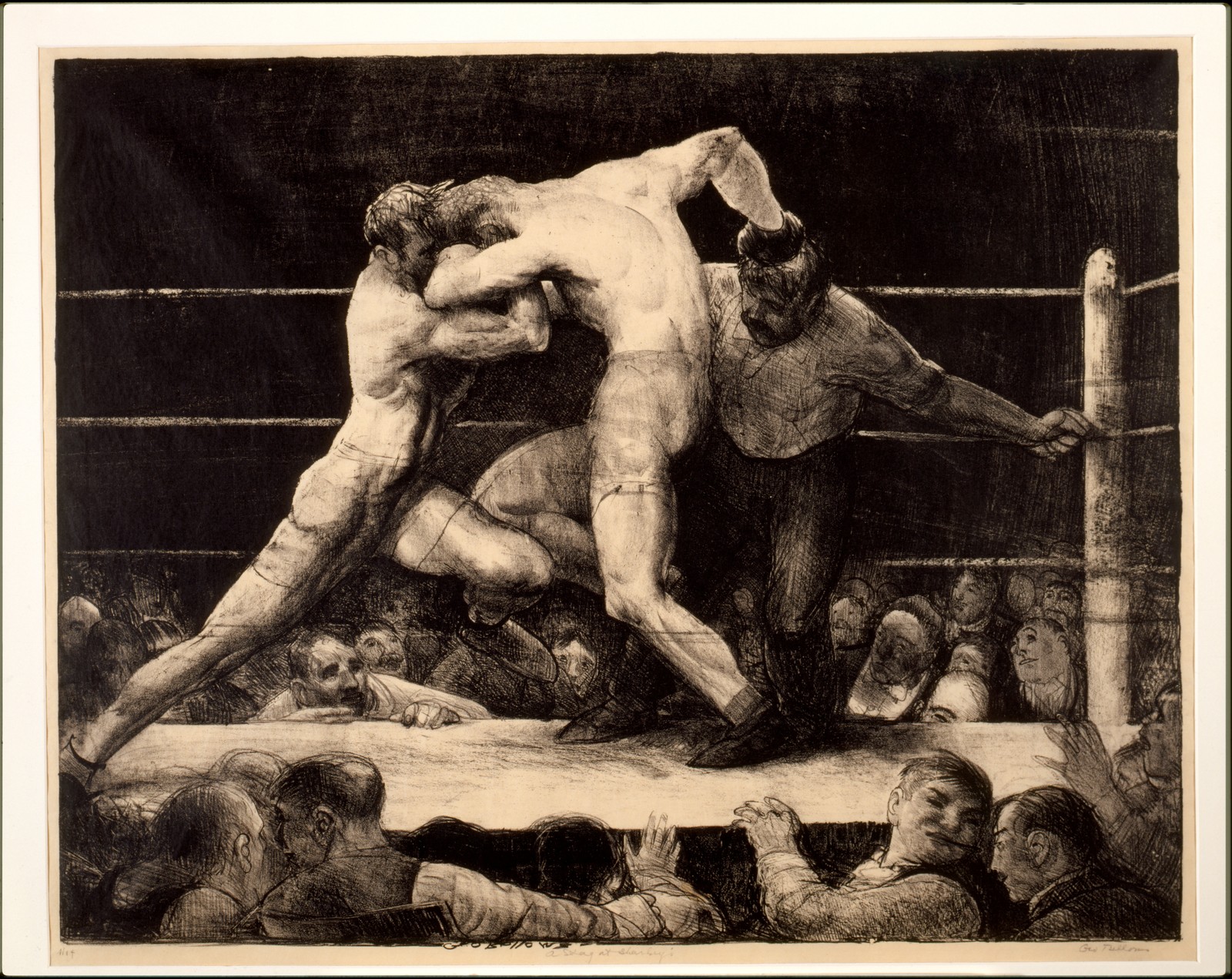
brutal-boxing

 “Do not fear the conflict, and do not flee from it; where there is no struggle, there is no virtue.”   John of Kronstadt

Part 1 of this post highlighted how God can bring good out of a long struggle with a sin, weakness, and/or problem by helping the Christian make the transition from putting their faith in formulas (e.g., “Do these three things and your problem will go away”) to a restful trust in Christ. Again, no sane Christian advocates habitual sin but the benefits of a protracted battle are numerous:

(1)  After a long battle, in making the transition from formulas to faith in God, a new brokenness develops in the believer. They’ve come to the end of themselves, run out of “self–effort fuel”, and are beginning to learn what Christ meant when he said, “…apart from me you can do nothing” (John 15:5).

(2) During a long battle with sin or weakness, there is a pattern of falling down and getting up. Proverbs 24:16 says that a righteous man falls seven times but keeps rising again. In this process many Christians report that a new intimacy has emerged in their relationship to God. They’ve come to know the God of mercy and compassion as never before because they’ve been repeatedly forgiven after their many stumbles.

(3) “He who is forgiven much loves much.” Along with a new intimacy, a greater love for God can also develop, after a long battle, because we’ve been forgiven over and over.

(4) And since God has extended his tender mercies to us over and over, we then can extend his mercy and compassion to others who have a protracted struggle with some issue. If our heart is right, a long battle can inoculate us from self–righteousness and judgmentalism in relation to others who fall over and over. How can we not extend to them the same grace that God extended to us?

In extending this grace to others, we may become a wounded healer to them. The healing we received from Christ during our struggle is graciously passed on those often struggling with similar issues. Healing emerges from your wounds just as resurrection emerges from death.

(5) After a war, the soldier of Christ often emerges battle–tested and wise to the schemes of the enemy. If a person has been pulled down into the dust 27 different ways by the devil, then, if he or she is paying attention, they’ve learned 27 strategies the enemy of our soul uses to try to destroy us.

In Twelve Step programs, one often hears the acronym H.A.L.T. mentioned in discussing relapse back into addiction. These four letters stand for hungry, angry, lonely, and tired and emphasize how these conditions create fertile soil for relapse.

If you frame the issue a different way, these are four strategies the devil uses to bring us back into bondage. How was this acronym learned? By people relapsing over and over when these conditions were present. Recovering people became wise through their failures in their long battle with addiction.

*

Jonathan

posted from http://www.openheavensblog.com/