Intimate Discipleship

worshipgod1
It’s all about Jesus

There is much good about the emphasis that the Church puts on discipleship.  We pray, fast, and study the Bible better than any other generation.  We have as our pastors and teachers men and women who have been equipped in seminaries and educated in counseling and church growth. And we are doing missions better than ever.

But I think there is something missing.  I seriously believe we have misplaced intimacy.  Our worship services seem mechanical.  We are no longer in a wild love affair with the One who really matters.  We no longer dwell on Him, crying out for His grace and mercy.

Could it be that the evangelical church in America has passed its expiration date?

Perhaps we have grown confused, and have struggled with an emptiness that is at the core of a legalistic and a works dominated life.  We do not cry out with a passionate love for Him who desperately wants to hold us close. We miss out on so much.

The Old Testament book of the Song of Solomon is the love story between a shepherdess and her beloved.  This love is a love that first envelops and then controls a person’s entire being.  Her love is intense, as well as thirsty.  She needs her shepherd.  There is an element of being ‘lovesick’ and never settling for a second best relationship with her beloved.

Biblical discipleship must always be intimacy with Jesus.

In 2 Corinthians 11, Paul writes about his deep concern for that particular Church,

2 “For I am jealous for you with the jealousy of God himself. I promised you as a pure bride to one husband—Christ. 3 But I fear that somehow your pure and undivided devotion to Christ will be corrupted, just as Eve was deceived by the cunning ways of the serpent.”

There is jealousy involved here (which is suspect by us) and foolishness (which is embarrassing) and is emotional (not at all what we think.)  This passage suggests a higher and purer following of Jesus that Satan wants to corrupt.  Paul was concerned that these Corinthians would not be a pure bride.  He got jealous over their vulnerability. He believed that they would miss the bridal love that they once knew.

I want to challenge you to keep the innocence of your relationship with Jesus. Guard it and refuse to be led away from its simple devotion.  Love Jesus with a white-hot love. Eternity is a long time to spend with someone who you feel ambivalent about.

Learn the language of romance again and remember that your discipleship is not an end in itself.  Biblical discipleship is nothing more than intimacy with Jesus. We must settle on this in our hearts. The true foundation of discipleship can only be a kind of ‘first love’.

“ Nevertheless I have this against you, that you have left your first love.”

Rev. 2:4


P.S. A fanatic is someone who loves Jesus more than you.

 

bry-signat (1)

cropped-christiangraffiti1.jpg

Five Barn Burners


“Barnburning for Dummies”

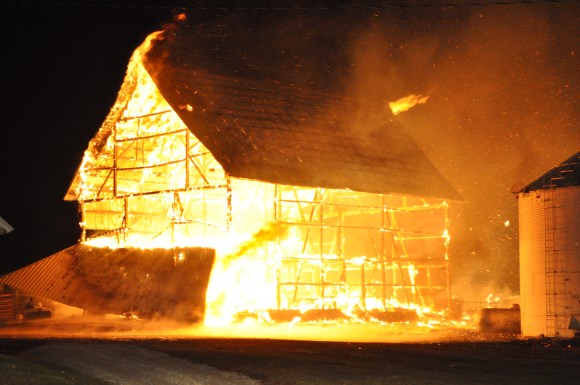
There are some who may not understand the term, but back on the farm in Wisconsin, “barnburning” meant one of two things:

1. A person who burns down a barn, (obviously literal.)
2. Something amazing or noteworthy. To be strong, impressive, or of interest, (metaphorical.)

The following verses have made a tremendous influence on me. Here are five “barn burners” — incendiary verses that have directed me and given me support in challenging times.  I hope at least one will fire up your heart.

It is a challenge to limit myself to just these five, so much has blessed me over 40 years–I should have at least 500.  Scraping up five was really not the problem, there could be so many more.

So here are five which have made a definite impact on my thinking. (I reserve the right to change my mind as necessary, LOL.) All verses are from the English Standard Version (ESV), such as it is. Get ready for some “spiritual napalm.”

*****

ONE: “Strengthening the souls of the disciples, encouraging them to continue in the faith, and saying that through many tribulations we must enter the kingdom of God.” Acts 14:22

This is a very precise chapter in my mind.  A great deal of attention is given to Paul and Barnabas’ relationship to the people.  At first, they are deified, but moments later the crowds pick up rocks to stone him.  However Paul’s message to the local church was impressive.  He strengthens, and he encourages.  The reality of difficulty and tribulation has become the very doorway for them to come into the kingdom.  This encourages me, and helps me in the conflicts I deal with.


TWO: “Fear not, little flock, for it is your Father’s good pleasure to give you the kingdom.” Luke 12:32

This verse tells me of God’s commitment to me.  First, I’m part of a little flock.  Nothing of any significance.  The world evaluates me, but I’m just a simple guy involved with a simple group of people, nothing more.  However in this verse, fear is the primary issue.  “Fear not, little flock.”  Our fear is supposed to be eradicated and extracted.

The word “pleasure” is an interesting choice of words.  We understand pleasure, or at least we think we do.  This verse implies that the Father has put into play His intensity. Pleasure is often a way of doing intensity.  God is “ultra-involved” and is exceptionally extravagant in His treatment of us.  We are brought into this place of grace, by His kindness and grace.  He can’t wait to pour out his love on us.


THREE:   “And I am sure of this, that he who began a good work in you will bring it to completion at the day of Jesus Christ.”  Phil. 1:6

What confidence!  That is a vital ingredient in our lives,  this confidence and boldness.  Our God is active in bringing us to a deeper place of  maturity.  Paul understands this, and uses God’s diligence as the basis for his growth.  This verse is a real confidence builder for me.  A promise that He will continue His work in me, no matter what.  This is a great promise for young Christians.  I often look at my own issues, and I give up after I accrue a certain frequency–a certain “sin-ratio.”

Shortly before I became a Christian, I spent a lot of time with Fred Tsholl who was the night-shift announcer at a nearby Christian radio station.  He was so patient and kind to me.  I would sit with him in the studio, all night long.  When it was time for me to leave he would quote this verse to me.  Looking back, this verse became quite significant.  I would take it as a promise from the Lord Himself.


FOUR:  “But we have this treasure in jars of clay, to show that the surpassing power belongs to God and not to us.” 2 Cor. 4:7

‘Jars of clay,’ really nothing more than this.  We are weak and vulnerable, we so easily can be broken.  But a treasure, I don’t think we grasp the value of treasure.  But, if it resides in us, we become a repository of great significance.  This magnificent work is not of our own effort.  It belongs to God.  It is nothing we can claim from any working on our part.


FIVE: “Who is that coming up from the wilderness,
   leaning on her beloved?” Song of Sol. 8:5

This world is a tangled place, it is a dense and difficult wilderness. There doesn’t seem to be a smooth road anywhere.  We make our way slowly, through much suffering and personal doubt.  This particular verse gives me an assurance of His presence, even in the middle of hardship and challenge.  He is present with me.

We come up out of this ugliness, precisely because of that close presence.  We lean on the Lord, as we traverse this hard place.  His dear presence will bring us through this darkness, He gives me the amazing strength to do this journey.

bry-signat-1

cropped-christiangraffiti1 (2)

The Blessings of a Long Battle, part 4

boxing3

In thinking about this final installment about how God can bring much good out of our protracted struggle with sin, weakness, or a problem, it dawned on me how important it is to see the Big Picture. In some ways this post reiterates truths in part 2 of this series, but also adds important new dimensions to those truths and explores new territory.

When a soldier goes through boot camp, it’s crucial for him or her to see the overall purpose of his training–the Big Picture. He or she is being pushed and tested in different ways to the extreme so that they will be prepared for any situation on the battlefield, won’t crack under pressure, and will be a team player.

In the conquest of Canaan under Joshua’s leadership, the nation of Israel experienced many victories over different hostile nations. However, Judges 3:1–4 says that God did not allow the Israelites to completely triumph but left certain enemies in the land (e.g., the Philistines) so that his chosen people would learn warfare.

When we became Christians, God could have put us in a cocoon of protective grace where we would be insulated from our three primary enemies–the world, the flesh, and the devil–but he didn’t so that we would also learn warfare.

If he would’ve sheltered us from the battle, we would end up like many “trust fund babies,” who, because of their vast inherited wealth, never have to work a day in their lives. They’re protected from the toil and struggle of life and never have to worry about paying the rent or the electric bill.

Often there is something profoundly missing in their lives: many are spoiled, shallow, and have not been battle–tested. Perhaps God designed an existence where we battled the world, the flesh, and the devil so that we would not end up becoming spiritual trust fund babies.

Macarius was a great monk who composed the Macarian Homilies in the 4th century. He was convinced that, if after becoming Christians, we were protected in a cocoon of grace from the temptations of the world, the flesh, and the devil, many of us would soon become conceited and fall as Satan fell. Instead of a three steps forward, two steps back grind that life often is, we would have a series of unbroken successes and become lifted up in pride and fall like Lucifer did.

In seeing the big picture, nothing is more important than understanding that God the Father through the Holy Spirit has been preparing a Bride for his Son in a Marriage that will span eternity. He wants you to be a part of that Bride. The Father wants the Bride to fervently love the Groom.

There is no love without free choice. If we would’ve been protected from the enemies of our soul, and choosing the Groom was exquisitely easy or even automatic, where’s the love that has been tested in the furnace of affliction? Like any spouse, Christ wants to be chosen. If we were automatons or even semi–automatons, where’s the love in that?

When we are in a long struggle with sin or weakness, it is because we have become over–attached to some created thing. Addiction is over–attachment in the extreme (e.g., overeating, alcohol, drugs, pornography, sex, power, work, shopping, etc.)

Christ the Uncreated One wants to be chosen over all the created things. Christ the Groom wants to stand in the midst of all his competitors–i.e. created things–and have the Bride choose him. One of the blessings then of a long battle is this: it’s the vehicle whereby we choose Christ as our Groom, as our only lover.

Does that love somehow go away if you’re a Christian who is up to your eyeballs in sin, addiction, and weakness? If anything God loves you more after you fall, because where sin abounds, grace abounds more. And as the old religious cliché tells us, he loves us in our sin and loves us too much to leave us there.

 *

Jonathan

Check out Jonathan’s own site at http://www.openheavensblog.com/.


The Blessings of a Long Battle, part 2

brutal-boxing

 “Do not fear the conflict, and do not flee from it; where there is no struggle, there is no virtue.”   John of Kronstadt

Part 1 of this post highlighted how God can bring good out of a long struggle with a sin, weakness, and/or problem by helping the Christian make the transition from putting their faith in formulas (e.g., “Do these three things and your problem will go away”) to a restful trust in Christ. Again, no sane Christian advocates habitual sin but the benefits of a protracted battle are numerous:

(1)  After a long battle, in making the transition from formulas to faith in God, a new brokenness develops in the believer. They’ve come to the end of themselves, run out of “self–effort fuel”, and are beginning to learn what Christ meant when he said, “…apart from me you can do nothing” (John 15:5).

(2) During a long battle with sin or weakness, there is a pattern of falling down and getting up. Proverbs 24:16 says that a righteous man falls seven times but keeps rising again. In this process many Christians report that a new intimacy has emerged in their relationship to God. They’ve come to know the God of mercy and compassion as never before because they’ve been repeatedly forgiven after their many stumbles.

(3) “He who is forgiven much loves much.” Along with a new intimacy, a greater love for God can also develop, after a long battle, because we’ve been forgiven over and over.

(4) And since God has extended his tender mercies to us over and over, we then can extend his mercy and compassion to others who have a protracted struggle with some issue. If our heart is right, a long battle can inoculate us from self–righteousness and judgmentalism in relation to others who fall over and over. How can we not extend to them the same grace that God extended to us?

In extending this grace to others, we may become a wounded healer to them. The healing we received from Christ during our struggle is graciously passed on those often struggling with similar issues. Healing emerges from your wounds just as resurrection emerges from death.

(5) After a war, the soldier of Christ often emerges battle–tested and wise to the schemes of the enemy. If a person has been pulled down into the dust 27 different ways by the devil, then, if he or she is paying attention, they’ve learned 27 strategies the enemy of our soul uses to try to destroy us.

In Twelve Step programs, one often hears the acronym H.A.L.T. mentioned in discussing relapse back into addiction. These four letters stand for hungry, angry, lonely, and tired and emphasize how these conditions create fertile soil for relapse.

If you frame the issue a different way, these are four strategies the devil uses to bring us back into bondage. How was this acronym learned? By people relapsing over and over when these conditions were present. Recovering people became wise through their failures in their long battle with addiction.

*

Jonathan

posted from http://www.openheavensblog.com/