The Desire For a Place of Power

“But they didn’t answer, because they had been arguing about which of them was the greatest.” 

Mark 9:34, New Living Translation

As the disciples walked they talked.  There was a casualness as they followed Jesus, it was a warm day and they walked, and sometimes even stopped–keeping up in a relaxed way. They finally meander their way slowly into Capernaum.  There was a safe-house there, and a place of peace.  It is here that Jesus confronts His followers.

He wants to know what they were talking about as they walked.  “What did you say to each other?”  The disciples looked at each other, and then down at the floor.  No one spoke. I think they were ashamed.  No one would reveal what they had thought about, and then had spoken out loud.

Did Jesus really need to ask this?  I honestly don’t know, but as I think about these verses, I say yes, and no.  Jesus was bringing His disciples to a place– an opportunity for them to be critically honest, perhaps even a bit reflective and thoughtful.  And yet He knew exactly what they had been discussing.

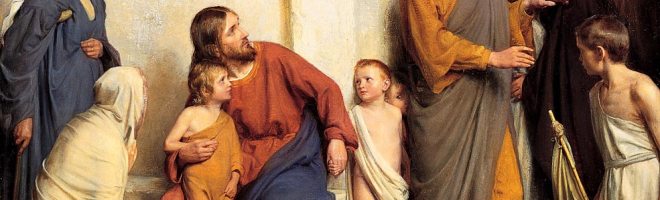
Even though the disciples knew what they had discussed on that dusty road; they don’t know that Jesus knows.  Awkward.  At this point Jesus doesn’t confront.  He shows.  As they sit down, Jesus begins to reveal their hearts.  A local street urchin, playing outside is brought into the house.  The disciples look, and think.  The child moves close to Jesus.  Jesus pulls him close.

At this point, Jesus begins to say things that elevate.  One of those crystalline moments that happen when His truth meets the human understanding.  That child is transformed into a lesson of influence.

Anyone who welcomes a little child like this on my behalf welcomes me, and anyone who welcomes me welcomes not only me but also my Father who sent me.”  v.37

This is a clear, and powerful statement of how things operate in the kingdom.  The child is brought into ultimate significance and worth.  The disciples are diminished into a lower status.  It’s funny, but our treatment of a child describes our real relationship with our Father God, and our Savior Jesus.  That little one has now become our “litmus test.”

I encourage you to seek out and develop relationships with the children in your life.  Although this is a literal interpretation, it will adjust us to a broader application of our Lord’s lesson.  When we are altered, we will be putting others first.  Our desire for place, and the power that goes with it, is nullified and zeroed out.
1brobry-sig4 (2)


cropped-christiangraffiti1-3-1


H

He Won’t Give Up, [Patience]


hourglass

But God had mercy on me so that Christ Jesus could use me as a prime example of his great patience with even the worst sinners.”

1 Timothy 1:16, NLT

I find that I often worry about the patience of God. Not that my worrying makes any difference. But I am quite aware of my sin and my failure. I am definitely not a “model citizen” of the Kingdom of God. I believe I’ve committed more sin as a Christian, than I ever did as a pagan.

But I must insist on God’s patience. I would easily slide through His fingers if I didn’t. But it is good to pay attention to the fact of patience. It is a good thing for us that He’s completely patient.

And remember, our Lord’s patience gives people time to be saved.”

2 Peter 3:15 , NLT

The very idea that God can be patient both chafes and comforts. We might see Him “tolerating” sinners. But yet we also see Him forgiving our sin. Patience gives Him the freedom to do both.

We could get critical, and maybe even frustrated with God’s love for lost people. He loves the world (John 3:16.)  However, our love doesn’t extend this far. We see the superficial, and believe that to be the whole story. But it isn’t. We give up on people, but He doesn’t.

Often, “sinners” will become disciples. (And mighty fine ones, at that.) The patience of God works effortlessly in the hearts of “sin-confused” people. At times it seems like it is “two steps forward and one back.” But that is ok. God will wait for sinners like us.

The patience of God draws us into a repentant life. He is “long- suffering,” which means that He will suffer long. But slowly, inexorably He brings us to His side. We offend Him, disregard Him, but He continues to love us. It makes no sense at all.

But He teaches us, by example to be long-suffering. We see in Him such kindness and mercy. His love for us is immeasurable. He takes it far, far beyond human reason. His patience is illogical. But I wouldn’t have it any other way.

“Have patience with all things, but chiefly have patience with yourself. Do not lose courage in considering your own imperfections, but instantly set about remedying them — every day begin the task anew.”

Francis de Sales

bry-signat (1)

cropped-christiangraffiti1.jpg

***

Feeding the Dogs, [Choosing Holiness]

A toy I grew up with, they were magnetized pushing against each other.

There is a story of a Native American elder who once described his own inner struggles to understand the Bible and Christianity.

Inside of me there are two dogs. One is black, and the other is white. The black dog is mean and tries to talk me into making the wrong choices. The white dog is good and encourages me to make the right choices. The black dog fights the white dog all day.” When asked by the friend which dog wins, the elder reflected for a moment and replied;

“The one I feed the most.”

White Dog: As a believing Christian, there is a part of us that is Christ-spirited, compassionate, trusting, open, abundant and focused on helping others. We pray and are being filled with the Holy Spirit.

Black Dog: The other part is our flesh. We can be proud, evil, self-centered, greedy, manipulative, sullen, promiscuous, drunken, and only wants to he served by others.

“An analogy is made between the good white dog, our new nature in Christ, and the bad black dog, our old fallen nature. While we cannot eliminate the old nature, we can choose to feed the white dog.”

(From “The Holy Spirit: Activating God’s Power in our Life,” by Billy Graham 1978.)
 

howlingwolf3-300x281The main key for us to remember is that these two parts are in constant struggle.

Two Scriptures to help: One– “If you use your lives to do the wrong things your sinful selves want, you will die spiritually. But if you use the Spirit’s help to stop doing the wrong things you do with your body, you will have true life.”   Rom. 8:13, NCV

Two– “Our sinful selves want what is against the Spirit, and the Spirit wants what is against our sinful selves. The two are against each other, so you cannot do just what you please.”   Gal. 5:17

In thinking this through this analogy might help.  I’m inclined to think that holiness is not so much like an “on and off” switch.  But I think it’s more like a “dimmer” switch is turned to brighten or darken a room.  I actually think there are times when we should make a deliberate decision for God.  And yet other times we just need to turn up the dimmer from 30% to 80%. Maybe all the way?

I’m just thinking out loud here.

 bry-signat

flourish31

The Real Treasures, [Weaknesses]

treasure

As Christians often our theology tells us that mental illness, depression, and bipolar disorder have no place in the believer’s life.  So we hide, sneaking into our sessions with our therapists, and change the subject to minimize our exposure to direct questions. We have had to hide our issues really well. 

But I would submit to you that it is we who are closest to the Kingdom of God. It is far easier for us to approach the Father, in our brokenness, humility, and general lostness. We have needs; a sound mind, a healthy body and we know it. We have no illusions of wellness, nothing can convince us that we are well. We are not.

We are broken and only our loving creator can mend us.

You might say that the Church needs us. An Archbishop was given an ultimatum by the Huns who surrounded his cathedral. “You have 24 hours to bring your wealth to these steps”, the war-leader demanded. The next morning the Archbishop came out leading the poor, the blind, the lame, and the lunatics. “Where is your treasure? Why have you brought out these… people?” The Archbishop simply and quietly replied, “These are the treasures of the Church, these who are weak are our valuables. They make us rich.”

We often can value giftedness more than weakness.

I am afraid the the Western Church no longer sees its “treasures” like it should. In our pride and self-centeredness we have operated our churches like successful businesses. We value giftedness more than weakness. We definitely have no room for the desperately weak. I suppose it’s time for the Church to begin to act like Jesus.

Church isn’t where you meet. Church isn’t a building. Church is what you do. Church should be a verb.  Church is who you are. Church is the human outworking of the person of Jesus Christ. Let’s not go to Church, let’s be the Church.

bry-signat

flourish88