Mechanisms of the Spirit

mechanical_Heart

Especially for the Leaders and Pastors who Guide the Ministry of the Church:


“Unless the Lord builds a house,
 the work of the builders is wasted.
Unless the Lord protects a city,
guarding it with sentries will do no good.”

Psalm 127:1

“O my son, give me your heart.
May your eyes take delight in following my ways.”

Proverbs 23:27

———————-

“The highest expression of the will of God in this age is the church which He purchased with His own blood.  To be scripturally valid any religious activity must be part of the church.  Let it be clearly stated that there can be no service acceptable to God in this age that does not center in and spring out of the church.  Bible schools, tract societies, Christian business men’s committees, seminaries and the many independent groups working at one or another phase of religion need to check themselves reverently and courageously, for they have no true spiritual significance outside of or apart from the church.”

–A.W. Tozer

As believers we sometimes lose the sight of what is going on around us. We get attached to a structure or a mechanism and view it as why we are here. Ministries, churches, retreats, conventions, even websites (!): every “structure” and every effort of man— however good and noble is not the Church of Jesus Christ.

The Church is a fluid and dynamic thing. It supersedes anything we can do or plan. Our efforts are always secondary, and even at there best are minuscule. We are gifted so that we might serve others, that is true. But wisdom always realizes the “big picture” even while serving in a “para-church” context.

The Church is the bride of Christ himself. It really is the only authorized work of God in the world today. It is what the Spirit is doing in our midst. Our personal efforts (like this website) are not really the full expression of truth in this world. That privilege belongs to the body.

I’m not trying to demean your ministry or work for the Lord. I won’t advocate that we shut-down our separate efforts. But I do suggest we restore our focus on the Church of Jesus above anything we can do. Paul cared deeply for the churches; he labored, toiled, travelled, was persecuted and despised all for the Church. Paul saw Jesus as its head, and he saw it as “the bride of Christ.” No sacrifice was too high or hard for the Bride.

“Apart from such external things, there is the daily pressure on me of concern for all the churches.”

2 Corinthians 11:28, NASB

We are to be servants of the Church first. We dare not be side-tracked or led in a subtly different direction. Perhaps a good way to think of this subject is that there are:

  • mechanisms, and
  • organisms.

Sometimes we’re somewhat mechanical and something living. I suggest that we restore to the living Church the honor and glory it deserves. Our individual ministries can be good— fruit may even be seen. But we dare not minimize the Church of the Lord Jesus Christ. She is his bride. She will rule and reign with him forever and ever.

“And I saw the holy city, new Jerusalem, coming down out of heaven from God, made ready as a bride adorned for her husband.”

Revelation 21:2

It will not be brokenbelievers.com that “descends” from heaven, but the Church. As important as I think I am, this website will not be in that place. This privilege belongs to Christ’s own bride– the Church. Perhaps it is this fact that we who are in ministry should consider from time-to-time: Let the church be the Church.

tbry-signat (1)

 

cropped-christiangraffiti1.jpg

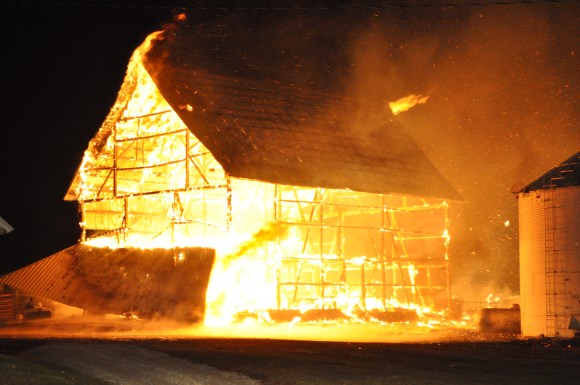
Five Barn Burners


“Barnburning for Dummies”

There are some who may not understand the term, but back on the farm in Wisconsin, “barnburning” meant one of two things:

1. A person who burns down a barn, (obviously literal.)
2. Something amazing or noteworthy. To be strong, impressive, or of interest, (metaphorical.)

The following verses have made a tremendous influence on me. Here are five “barn burners” — incendiary verses that have directed me and given me support in challenging times.  I hope at least one will fire up your heart.

It is a challenge to limit myself to just these five, so much has blessed me over 40 years–I should have at least 500.  Scraping up five was really not the problem, there could be so many more.

So here are five which have made a definite impact on my thinking. (I reserve the right to change my mind as necessary, LOL.) All verses are from the English Standard Version (ESV), such as it is. Get ready for some “spiritual napalm.”

*****

ONE: “Strengthening the souls of the disciples, encouraging them to continue in the faith, and saying that through many tribulations we must enter the kingdom of God.” Acts 14:22

This is a very precise chapter in my mind.  A great deal of attention is given to Paul and Barnabas’ relationship to the people.  At first, they are deified, but moments later the crowds pick up rocks to stone him.  However Paul’s message to the local church was impressive.  He strengthens, and he encourages.  The reality of difficulty and tribulation has become the very doorway for them to come into the kingdom.  This encourages me, and helps me in the conflicts I deal with.


TWO: “Fear not, little flock, for it is your Father’s good pleasure to give you the kingdom.” Luke 12:32

This verse tells me of God’s commitment to me.  First, I’m part of a little flock.  Nothing of any significance.  The world evaluates me, but I’m just a simple guy involved with a simple group of people, nothing more.  However in this verse, fear is the primary issue.  “Fear not, little flock.”  Our fear is supposed to be eradicated and extracted.

The word “pleasure” is an interesting choice of words.  We understand pleasure, or at least we think we do.  This verse implies that the Father has put into play His intensity. Pleasure is often a way of doing intensity.  God is “ultra-involved” and is exceptionally extravagant in His treatment of us.  We are brought into this place of grace, by His kindness and grace.  He can’t wait to pour out his love on us.


THREE:   “And I am sure of this, that he who began a good work in you will bring it to completion at the day of Jesus Christ.”  Phil. 1:6

What confidence!  That is a vital ingredient in our lives,  this confidence and boldness.  Our God is active in bringing us to a deeper place of  maturity.  Paul understands this, and uses God’s diligence as the basis for his growth.  This verse is a real confidence builder for me.  A promise that He will continue His work in me, no matter what.  This is a great promise for young Christians.  I often look at my own issues, and I give up after I accrue a certain frequency–a certain “sin-ratio.”

Shortly before I became a Christian, I spent a lot of time with Fred Tsholl who was the night-shift announcer at a nearby Christian radio station.  He was so patient and kind to me.  I would sit with him in the studio, all night long.  When it was time for me to leave he would quote this verse to me.  Looking back, this verse became quite significant.  I would take it as a promise from the Lord Himself.


FOUR:  “But we have this treasure in jars of clay, to show that the surpassing power belongs to God and not to us.” 2 Cor. 4:7

‘Jars of clay,’ really nothing more than this.  We are weak and vulnerable, we so easily can be broken.  But a treasure, I don’t think we grasp the value of treasure.  But, if it resides in us, we become a repository of great significance.  This magnificent work is not of our own effort.  It belongs to God.  It is nothing we can claim from any working on our part.


FIVE: “Who is that coming up from the wilderness,
   leaning on her beloved?” Song of Sol. 8:5

This world is a tangled place, it is a dense and difficult wilderness. There doesn’t seem to be a smooth road anywhere.  We make our way slowly, through much suffering and personal doubt.  This particular verse gives me an assurance of His presence, even in the middle of hardship and challenge.  He is present with me.

We come up out of this ugliness, precisely because of that close presence.  We lean on the Lord, as we traverse this hard place.  His dear presence will bring us through this darkness, He gives me the amazing strength to do this journey.

bry-signat-1

cropped-christiangraffiti1 (2)

The Blessings of a Long Battle, Part 3

boxing2

From Jonathan Coe’s website at http://www.openheavensblog.com/. Thank you gracious brother! (I’m so glad you are my friend.)

As I look over the last two posts on the blessings of a long battle, I’m reminded of what the Apostle Paul said to the Corinthians about the importance of not being ignorant concerning the schemes of Satan (II Corinthians 2:11). After reading those posts, I realized a word of balance was needed in discussing the relationship of formulaic Christianity to spiritual practices lest the devil distort the truth to his advantage.

Both posts encouraged the believer to move beyond canned formulas to a restful trust in and radical dependence on Christ. A common formula for someone who finds themselves in a protracted struggle with sin, weakness, or some thorn in the flesh is “Read the Bible, pray, and attend church and that will solve your problem.”

These are wonderful spiritual practices but the problem is that people begin to trust in the formula more than the Person who can heal their inner leper. The formula can become a religious idol.

The biblical view of spiritual practices (prayer, Scripture study, church attendance, fellowship, fasting, meditation, and the sacraments) is that they are both avenues of renewal and bridges to intimacy with the Living God. They are sacramental; they are a means of grace.

Christ is the Vine; we are the branches. One of the primary ways that the branches stay connected to the Vine is through spiritual practices. That is how we abide in him and apart from abiding in him, we can do nothing.

This next part is crucial, and, if you only get one thing out of this post, this is it: when the believer gets frustrated enough to forsake impotent formulas, the devil’s primary agenda then is to get that person to forsake authentic, life–giving spiritual practices too.

That’s why the Christian should ask for wisdom every day so that he or she can tell the difference between the two. Satan is more than happy to allow us to forsake the false as long as we don’t replace it with the real.

It’s part of the human condition that, in our anger and frustration, we often throw out the wheat with the chaff. And a person who is involved in a long, difficult battle is going to need all the grace–filled spiritual practices they have time for!

I’m convinced that when the devil sees a believer, who is involved in a long battle, leave anemic formulas and begin to become engaged in regular, soul–nourishing spiritual practices, it fills him with uncontrollable rage. He will come to that Christian with many false voices in an effort to separate the branch from the Vine. Here’s a small sampling:

  • “ You tried this religious stuff before and you still have the same addiction/weakness/problem. What makes you think it’s going to work this time?”
  • “If you have your quiet time with God in the morning when you don’t feel like it, you’re being a phony. You should only do it when you feel like it.”
  • “If your quiet time with God becomes a regular thing, it will become a dead religious ritual. You don’t want to become legalistic. Keep things spontaneous. Just do it when your heart moves you to do it.”
  • “Regular spiritual practices aren’t the real you. You can find God in every day life without them in a way that fits your personality.”
  • “You’re a person of action not of contemplation. You get things done without all this navel–gazing and spiritual stuff.”

These are just a few plays out of the devil’s playbook. May God give us the discernment to recognize his voice and the wisdom to reject his counsel.

Reposted from http://www.openheavensblog.com/. Thank you Jonathan for your great teaching.

The Blessings of a Long Battle, part 2

brutal-boxing

 “Do not fear the conflict, and do not flee from it; where there is no struggle, there is no virtue.”   John of Kronstadt

Part 1 of this post highlighted how God can bring good out of a long struggle with a sin, weakness, and/or problem by helping the Christian make the transition from putting their faith in formulas (e.g., “Do these three things and your problem will go away”) to a restful trust in Christ. Again, no sane Christian advocates habitual sin but the benefits of a protracted battle are numerous:

(1)  After a long battle, in making the transition from formulas to faith in God, a new brokenness develops in the believer. They’ve come to the end of themselves, run out of “self–effort fuel”, and are beginning to learn what Christ meant when he said, “…apart from me you can do nothing” (John 15:5).

(2) During a long battle with sin or weakness, there is a pattern of falling down and getting up. Proverbs 24:16 says that a righteous man falls seven times but keeps rising again. In this process many Christians report that a new intimacy has emerged in their relationship to God. They’ve come to know the God of mercy and compassion as never before because they’ve been repeatedly forgiven after their many stumbles.

(3) “He who is forgiven much loves much.” Along with a new intimacy, a greater love for God can also develop, after a long battle, because we’ve been forgiven over and over.

(4) And since God has extended his tender mercies to us over and over, we then can extend his mercy and compassion to others who have a protracted struggle with some issue. If our heart is right, a long battle can inoculate us from self–righteousness and judgmentalism in relation to others who fall over and over. How can we not extend to them the same grace that God extended to us?

In extending this grace to others, we may become a wounded healer to them. The healing we received from Christ during our struggle is graciously passed on those often struggling with similar issues. Healing emerges from your wounds just as resurrection emerges from death.

(5) After a war, the soldier of Christ often emerges battle–tested and wise to the schemes of the enemy. If a person has been pulled down into the dust 27 different ways by the devil, then, if he or she is paying attention, they’ve learned 27 strategies the enemy of our soul uses to try to destroy us.

In Twelve Step programs, one often hears the acronym H.A.L.T. mentioned in discussing relapse back into addiction. These four letters stand for hungry, angry, lonely, and tired and emphasize how these conditions create fertile soil for relapse.

If you frame the issue a different way, these are four strategies the devil uses to bring us back into bondage. How was this acronym learned? By people relapsing over and over when these conditions were present. Recovering people became wise through their failures in their long battle with addiction.

*

Jonathan

posted from http://www.openheavensblog.com/