When Rags Became Grace

ebedmelech

“Ebedmelech from Ethiopia was an official at the palace, and he heard what they had done to me. So he went to speak with King Zedekiah, who was holding court at Benjamin Gate. Ebedmelech said, “Your Majesty, Jeremiah is a prophet, and those men were wrong to throw him into a well. And when Jerusalem runs out of food, Jeremiah will starve to death down there.” 10 Zedekiah answered, “Take thirty of my soldiers and pull Jeremiah out before he dies.”

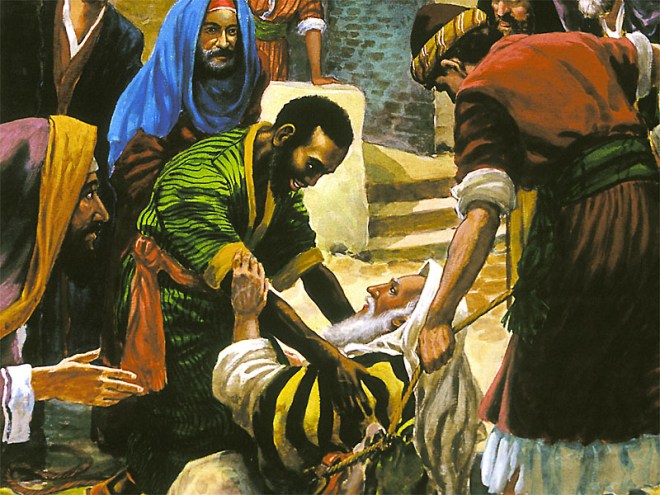
11 Ebedmelech and the soldiers went to the palace and got some rags from the room under the treasury. He used ropes to lower them into the well. 1Then he said, “Put these rags under your arms so the ropes won’t hurt you.” After I did, 13the men pulled me out. And from then on, I was kept in the courtyard of the palace guard.

Jeremiah 38:8-13, CEV

At the very last, there was just one remaining.  A single man, Ebedmelech.  He was a Ethiopian; made a eunuch by the will of the king.  The situation in Jerusalem has gotten very difficult.  In an action of revenge and reprisal, certain men intend to kill the prophet Jeremiah.  They take a certain satisfaction in this, and Jeremiah is thrown into a very deep cistern.  They intend for him to starve to death, which is a terrible way to die.

The king in these last pathetic days is being manipulated by the surviving leadership of the city.  Zedekiah gives tacit approval for the destruction of Jeremiah.  He just lets it happen without a good reason.  The prophet is lowered in the muddy cistern.  Without food, he will soon starve.  In the minds of this evil mob, they have taken care of the any last vestiges of a godly ‘righteousness.’

But there is one, he is a wild card.  And no man would have guessed it.  Ebedmelech, the Ethiopian eunuch steps forward and decides to change history.  Not only his ethnicity, but his state as a castrated man are definite issues.  This mob never recognized him as someone who would intervene.  He was a non-entity, a non-factor. He was black, and a eunuch, and a nobody.

But Ebedmelech is intervening, in the face of terrible risk, he steps out boldly to make an intercession.  He doesn’t appear to be intimidated, and makes a cry for the truth.  He becomes an intense and strong advocate for the release of Jeremiah from the deep mud.

Ebedmelech is given the ‘green-light’ by king Zedekiah. Ebedmelech rounds up thirty men to assist him as he delivers the prophet.  Ropes are brought out, and out comes Ebedmelech with a big armload of rags.  They shout down to Jeremiah.  The instructions are called down to him of what needs to take place for the extraction.

It’s interesting, but the rags are the most interesting. 

They are really an extra touch, not a necessity.  The rags become essentially, a form of grace.  They would pad the ropes, providing a degree of comfort as the prophet is pulled up out of the mud.  Ebedmelech showed the heart of God in what he did.  There was his desire to somehow make the prophet comfortable.  In doing so he communicated a kindness and concern that was saturated with God’s own enveloping presence.

Our illnesses– physical or mental, have moved us to a lonely place on the edge. 

We are those on the so-called ‘margins.’ Ebedmelech has now become a carrier of God’s grace.  Jeremiah could have been lifted up by just the ropes.  It would’ve been more difficult, granted.  But the rags sent down by Ebedmelech provided the prophet an extra gentleness.  And I am certain it did not pass by without notice.  Their mention in this Book of Jeremiah is significant, and shows Jeremiah’s deep appreciation of kindness.

We can gather up much from what has been written.  We will sometimes find ourselves in parallel situations.  But our kindness and concern can make the difference.  Admittedly, they are quite insignificant–quite minor. Call it ‘icing on the cake.’ But when you show the kindness of our Father, you will infuse the situation with love, and grace.  

So be an  Ebedmelech,—  an outcast perhaps– but in a position of kindness.

 

bry-signat (1)

cropped-christiangraffiti1.jpg


A Downcast Soul


pain1

“Why, my soul, are you downcast? Why so disturbed within me? Put your hope in God, for I will yet praise him, my Savior and my God.”

–Psalm 42:11, NIV

The things that truly tear me apart, will often start by intensifying my gloom and depression.  I certainly do avow a limited degree of freedom.  But even in the light of this,

1) depression hammers me,
2) dismantles me, and than it
3) devastates me

My own lostness goes on to confuse me, (not to mention it in the lives of my family and friends) and than I slide into further into my darkness.  The bottom just falls off, and I go even lower. I become mad. (In the psychological sense of the word.)

But the Father interjects His will on my behalf, and puts me into this critical place by a special grace.  I try to rest into this great big sea of a massive love, but I imagine I really don’t belong. In my dark depression, I turn to Him for a greater protection.  I understand my proclivity to depression that only sinks me into the darkness of sin. So I reach out, and grab tight.

In olden days, a ship in a overwhelming storm would attempt to lighten its load by throwing its cargo overboard.  When we are in this despondency, we often will do this as well.  Anything to just survive.  We are quite desperate.

My darkness is deep, and it is an intensely viscous evil.  It reaches out for me, and it entangles me.  You might rightly say that I am lost, but the Father does intervene, and He steps into my blackness, and separates me from it.  It may seem a bit melodramatic.  But He nevertheless carries me through.  And yet I will confess that He has behaved consistently concerning me.

When we have an opportunity we should simply reach out for it.  Our foolishness should not disconnect us into a confused place of being.  We will step out into this awareness of being made wonderfully complete, and incredibly sure.  His presence alters us, and sanctifies us.  We change and adjust ourselves.  Yet everything that does work into us will bring us to a purpose and significance.

I do return and earnestly seek Him to work in me.  Unless He does, I will be irrevocably lost.  I turn to Him, and so I must admit I am bold in this.  I say desperately, ‘Please Jesus, save me.’  I will only turn, and be very bold, entering into His salvation.  “Please save me dear Savior, and launch me into the world of salvation.  Give me a deep understanding of your deliverance.  Jesus, I surrender to your work.”  And in all the areas I surrender, He meets me and brings me to the place of rest.

“So our hope is in the Lord.
 He is our help, our shield to   protect us.” 

–Psalm 33:20, NCV

bry-signat (1)


cropped-christiangraffiti1-3

The Blessings of a Long Battle, Part 3

boxing2

From Jonathan Coe’s website at http://www.openheavensblog.com/. Thank you gracious brother! (I’m so glad you are my friend.)

As I look over the last two posts on the blessings of a long battle, I’m reminded of what the Apostle Paul said to the Corinthians about the importance of not being ignorant concerning the schemes of Satan (II Corinthians 2:11). After reading those posts, I realized a word of balance was needed in discussing the relationship of formulaic Christianity to spiritual practices lest the devil distort the truth to his advantage.

Both posts encouraged the believer to move beyond canned formulas to a restful trust in and radical dependence on Christ. A common formula for someone who finds themselves in a protracted struggle with sin, weakness, or some thorn in the flesh is “Read the Bible, pray, and attend church and that will solve your problem.”

These are wonderful spiritual practices but the problem is that people begin to trust in the formula more than the Person who can heal their inner leper. The formula can become a religious idol.

The biblical view of spiritual practices (prayer, Scripture study, church attendance, fellowship, fasting, meditation, and the sacraments) is that they are both avenues of renewal and bridges to intimacy with the Living God. They are sacramental; they are a means of grace.

Christ is the Vine; we are the branches. One of the primary ways that the branches stay connected to the Vine is through spiritual practices. That is how we abide in him and apart from abiding in him, we can do nothing.

This next part is crucial, and, if you only get one thing out of this post, this is it: when the believer gets frustrated enough to forsake impotent formulas, the devil’s primary agenda then is to get that person to forsake authentic, life–giving spiritual practices too.

That’s why the Christian should ask for wisdom every day so that he or she can tell the difference between the two. Satan is more than happy to allow us to forsake the false as long as we don’t replace it with the real.

It’s part of the human condition that, in our anger and frustration, we often throw out the wheat with the chaff. And a person who is involved in a long, difficult battle is going to need all the grace–filled spiritual practices they have time for!

I’m convinced that when the devil sees a believer, who is involved in a long battle, leave anemic formulas and begin to become engaged in regular, soul–nourishing spiritual practices, it fills him with uncontrollable rage. He will come to that Christian with many false voices in an effort to separate the branch from the Vine. Here’s a small sampling:

  • “ You tried this religious stuff before and you still have the same addiction/weakness/problem. What makes you think it’s going to work this time?”
  • “If you have your quiet time with God in the morning when you don’t feel like it, you’re being a phony. You should only do it when you feel like it.”
  • “If your quiet time with God becomes a regular thing, it will become a dead religious ritual. You don’t want to become legalistic. Keep things spontaneous. Just do it when your heart moves you to do it.”
  • “Regular spiritual practices aren’t the real you. You can find God in every day life without them in a way that fits your personality.”
  • “You’re a person of action not of contemplation. You get things done without all this navel–gazing and spiritual stuff.”

These are just a few plays out of the devil’s playbook. May God give us the discernment to recognize his voice and the wisdom to reject his counsel.

Reposted from http://www.openheavensblog.com/. Thank you Jonathan for your great teaching.

Forgiven First

Forgiven-drop

This evening I got tired of the TV. Or maybe tired of the control it emits over me. I picked up one of the many Bibles I have in my loft. I do think it is ‘funny/sinister’ of the real pressure it takes to open its pages. I have no doubt it is the darkness of my flesh and the wickedness of demons. Melodramatic? I think not.

But this is what I read and thought.

“Jesus climbed into a boat and went back across the lake to his own town. Some people brought to him a paralyzed man on a mat. Seeing their faith, Jesus said to the paralyzed man,“Be encouraged, my child! Your sins are forgiven.”

Matthew 9:1-2, NLT

Jesus is mobile. He moves and goes where His Father goes. At this moment He is needed in Capernaum. He is to meet a small crowd– and a paralyzed man on a mat. Jesus travels, but this man can only be carried. So Jesus Christ the Son of God, comes to him.

The Lord’s eyes alertly move over these people. People are the reason He came. This crippled man has been waiting. Jesus looks, and all He sees is “faith.” And He knows that the Father has led Him here.

The Word says that He could see their faith. Funny. What does faith look like? It seems like that is the first thing He saw, and noted. I’m not sure about the man on the mat. Did he have faith? Or had it been ‘burned out of him’ by too many doctors, and too many ‘treatments’? It is good to surround yourself with others who will believe when you can’t.

Jesus finally spoke, and its worth noting His first utterance was to proclaim forgiveness. Not healing. Forgiveness! What did this man’s friends think? I see them feel tenative, and maybe a bit shocked about this. What evil did their friend commit? What had he hidden from them, the way we try to hide things from each other?

The healing is going to come. This man will stand. He will carry his mat and go home. (V. 6). But perhaps the paralysis wasn’t the main reason he was there.

Maybe, his biggest need was to be forgiven?

Man has two basic needs.

  • One, to be forgiven of awful sin. Washed and cleansed. Forgivemess.
  • Two, to become a good person. Kind and humble. Healing.

There will always be those looking on who will condemn and challenge what is taking place. For them, it has nothing at all to do with the hearts of people. That means nothing to them. Rather for these, it has to do with a rigid and lifeless religion– with its 613 laws, and tithing of dill and mint.

What do you really need? Forgiveness? Or something else? Psalm 103:3-4, are verses for the redeemed.

“He forgives all my sins
    and heals all my diseases.
He redeems me from death
    and crowns me with love and tender mercies.”

*

“God pardons like a mother, who kisses the offense into everlasting forgiveness.”  

Henry Ward Beecher

bry-signat (1)

cropped-christiangraffiti1.jpg

$